Buying Guide
The best high-definition borescopes are not selected by screen resolution alone. A useful inspection camera must also fit the opening, reach the target, illuminate dark surfaces, and present the image in a way that supports the job. The products above range from slim handheld cameras to a 100-foot pipe system, so the right choice depends on the inspection environment.
Match the probe to the access point
Probe diameter is one of the most practical specifications. A smaller probe can enter narrower openings, but a larger camera may be designed for a different task. The LAUNCH VSP-600 lists a 5.5mm camera, while the Triplett BR510 lists 6mm and the Lurxxea model lists 6.2mm. These sizes are relevant for engine cavities, ducts, and other restricted spaces. The GEARWRENCH and BSTiltion models list 8.5mm and 8mm probes, respectively, which may be better suited to openings where a more substantial semi-rigid cable is useful.
For pipelines, reach can matter more than a slim tip. KCapyn documents a 17mm camera attached to approximately 100 feet of cable. That is a different design from a short handheld scope and is intended for long runs, tanks, and drain work. Check both the opening diameter and the cable length before choosing.
Consider articulation and cable behavior
A flexible cable is not the same as an articulating probe. Articulation gives the operator direct control over the camera direction, which can help when the target is around a bend or blind spot. Triplett documents two-way 180-degree articulation, UNI-T documents bidirectional 180-degree rotation, and Lurxxea lists bidirectional articulation. The LIIAMOAR S50 goes further in its supplied description with joystick-controlled four-way articulation and 720-degree universal rotation.
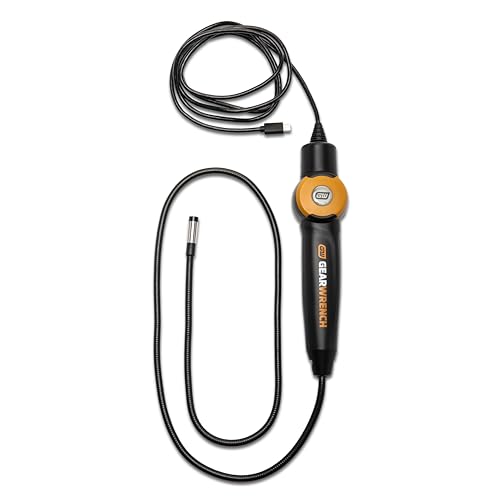
Semi-rigid cables offer a different advantage: they can bend but retain some shape. GEARWRENCH, BSTiltion, and Keenso all describe semi-rigid probe designs. This can help the user guide the cable through an opening without constantly repositioning it. A semi-rigid design may be preferable for a relatively direct path, while articulation is more relevant when camera orientation is the main challenge.
Verify what “high definition” means
Listing terminology varies, so look for a numeric image or display specification where possible. Triplett, GEARWRENCH, UNI-T, KCapyn, BSTiltion, and Keenso provide 1920 x 1080-related details. LIIAMOAR specifies a 5-inch 1080p IPS screen, while the LAUNCH listing describes high-definition imaging without providing the same complete numeric display detail. Fydun identifies a 4.5-inch high-definition screen.
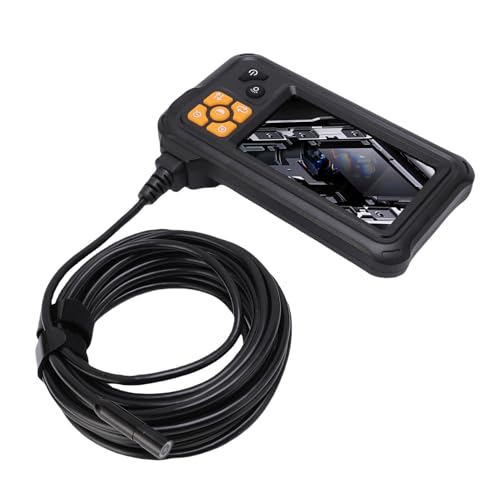
Screen size also affects usability. A 5-inch display, as found on Triplett, LIIAMOAR, UNI-T, and KCapyn, gives more viewing area than the 4.3-inch screens listed for Lurxxea, BSTiltion, and Keenso. A larger screen may be easier to share or inspect in the field, whereas a smaller unit can be easier to carry. Field of view is another useful detail: LIIAMOAR lists 178 degrees, and BSTiltion and Keenso also provide wide-view specifications.
Assess lighting and image controls
Dark cavities require more than a high-resolution sensor. Adjustable LEDs let the operator balance visibility against glare on reflective, oily, or metallic surfaces. Triplett lists eight LEDs with three brightness levels. Fydun, BSTiltion, and Keenso each list eight adjustable LEDs, while LIIAMOAR and LAUNCH list six. UNI-T also documents eight adjustable brightness LEDs.
Some models add controls that can help with orientation or close inspection. Lurxxea lists four-times digital zoom and mirror flip. BSTiltion and Keenso list color inversion and brightness adjustment. These features do not replace a suitable probe or light, but they can make the live image easier to interpret in a confined space.
Check water and heat protection
IP ratings should be matched to the stated job, not treated as a guarantee for every use. Triplett, GEARWRENCH, UNI-T, LAUNCH, Fydun, and Lurxxea list IP67-related camera or probe protection. KCapyn lists IP68 for its lens, which fits its documented damp-pipeline use. GEARWRENCH additionally states heat resistance up to 194°F, while UNI-T lists high-temperature power-off protection.
The evidence does not provide an IP rating for BSTiltion or Keenso, so those models should be considered where the inspection environment is controlled unless the manufacturer supplies additional documentation. Always confirm whether the rating applies to the camera tip, the complete probe, or the main display before exposing the equipment to water or other contaminants.
Decide how you will view and save findings
Standalone screens reduce setup steps. Triplett, LIIAMOAR, UNI-T, KCapyn, Lurxxea, Fydun, BSTiltion, and Keenso list displays, while LAUNCH and GEARWRENCH emphasize connections to compatible phones, computers, scanners, or diagnostic tools. A phone-compatible design may fit a technician who already works from a mobile device; an integrated display may be more convenient when gloves, workshop debris, or limited connectivity are factors.
For documentation, Triplett lists JPG and AVI capture, USB transfer, and removable SD storage. UNI-T lists JPG and AVI output, and KCapyn lists a DVR screen with built-in storage. LAUNCH lists one-click snapshots, while Lurxxea lists direct photo and video controls. Confirm the supported file type, storage method, and transfer process if inspection records need to be shared.
Final recommendation
LIIAMOAR S50 720-Degree Inspection Borescope ranks first overall in this specification-based comparison under the published weighted criteria.
The final choice among the best high-definition borescopes depends on the documented features that match your intended use.
Triplett BR510 is the highest-scoring returned product and the first overall specification-based choice. Its documented 1920 x 1080 display, two-way articulation, IP67 camera, adjustable eight-LED lighting, and image-transfer options create the most complete all-purpose package in this comparison.
Among the top high-definition borescopes, LIIAMOAR S50 is the most specification-aligned alternative when steering range is the priority, while GEARWRENCH GWSCOPE is a better fit for a USB-C-centered technician workflow. Choose KCapyn for long pipe runs, LAUNCH for a slim vehicle-oriented probe, and Lurxxea for a compact articulating design. Fydun, BSTiltion, and Keenso are simpler standalone options, with their documented screens and lighting controls suited to general inspection work.
Methodology
This is a specification-based comparison using the supplied public listing titles, features, and technical fields. Editorial criteria cover image and display resolution, probe access, illumination, environmental protection, and capture or viewing functions. No hands-on testing, customer sentiment, popularity information, or volatile marketplace claims were used in the published scores.
Frequently Asked Questions
What should I look for in the best high-definition borescopes?
Start with the opening size and required reach, then compare numeric image specifications, articulation or cable behavior, lighting controls, and protection ratings. A standalone screen can simplify field work, while phone or computer connectivity may be preferable for digital sharing. Recording and storage features matter if the inspection must be documented.
Is a smaller probe always better?
No. A smaller probe can enter tighter openings, but it may not provide the reach or cable stiffness needed for a particular job. LAUNCH lists a 5.5mm camera and Triplett lists 6mm, making them relevant to narrow access. KCapyn uses a 17mm camera with a much longer cable for pipeline work. The opening, target distance, and route should determine the size.
Which selected borescope is suited to long pipes?
KCapyn is the clearest match because its listing documents approximately 100 feet of semi-rigid cable, distance markings, an IP68 lens, a 5-inch DVR display, and onboard storage. Those specifications are oriented toward long pipeline and tank inspections rather than short automotive access points.
Do all high-definition borescopes include a screen?
No. Several selected models list integrated displays, including Triplett, LIIAMOAR, UNI-T, KCapyn, Lurxxea, Fydun, BSTiltion, and Keenso. LAUNCH emphasizes compatibility with Android devices, Windows PCs, and compatible scanners, while GEARWRENCH describes USB-C connections to compatible diagnostic tools, Android devices, and computers. Check the viewing method before purchasing.
Are IP67 and IP68 interchangeable?
No. They are different protection ratings, and the listing should be checked for the part of the product covered. KCapyn lists an IP68 lens, while several other selected products list IP67 camera or probe protection. Neither rating should be assumed to cover the display or handle unless the manufacturer states that it does.