Buying Guide
The best electrical conduit locknut fittings are not chosen by pack size alone. A locknut must match the conduit trade size and connection type, then provide the material, locking profile, sealing feature, and certification information appropriate to the installation. This comparison uses public listing data, so it is a specification review rather than a hands-on test. Before ordering, compare the product record with the conduit, connector, enclosure, and project requirements.
Start with trade size and conduit type
Trade size is the first screening point. The selected products cover several sizes, including 3/4 inch, 1/2 inch, 1 inch, 1-1/4 inch, 1-1/2 inch, and 2 inches. A locknut intended for one size should not be treated as interchangeable with another. RACO 1002 is identified for 1/2-inch rigid/IMC conduit, while RACO 1004 is identified for 1-inch rigid/IMC conduit. The Sigma ProConnex 47106 and COREX models both address 2-inch applications, but they differ in their documented design details.
Also distinguish rigid and IMC applications from PVC conduit. The Cantex 3/4-inch and 1-1/2-inch products are described as threaded PVC conduit fittings, whereas the RACO and bulk galvanized-steel options are directed toward rigid or IMC conduit. The correct choice depends on the actual threaded connection and enclosure being used. If a listing does not clearly identify the needed size or conduit family, verify compatibility before purchase rather than relying on appearance.
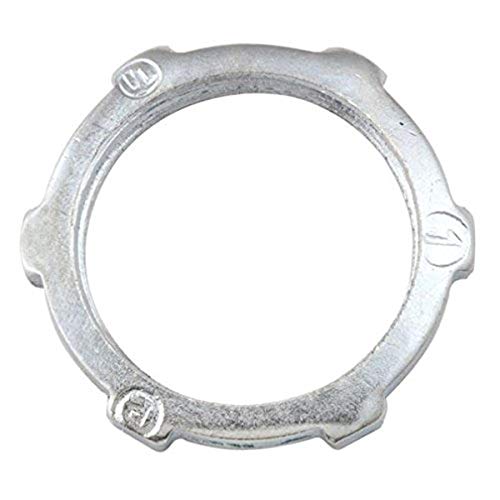
Steel is useful when the listing specifically calls for a metal locknut and mechanical protection. RACO 1002, RACO 1004, RACO 1195, Sigma ProConnex 47106, and COREX identify steel construction. Zinc electroplating or galvanizing is stated on several of these models and is described as corrosion protection. That language is relevant to material selection, but it does not replace the project’s own location and code requirements.
The Cantex products occupy a different documented niche because they are described as PVC conduit fittings, with the 1-1/2-inch model also identified as PVC coated. A PVC-related design may be appropriate when the conduit system calls for it, but the supplied data does not establish that every product is suitable for every wet, outdoor, underground, or chemically exposed location. Use only the environmental claims actually made for the selected item.
Decide whether a gasket is needed
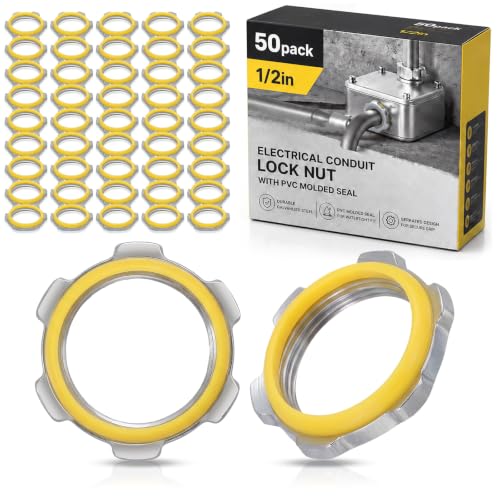
A molded gasket can matter when the design calls for a seal at the conduit connection. COREX identifies a PVC molded gasket and states suitability for wet locations. Moxweyeni also lists a PVC molded gasket and describes a sealing barrier intended to limit moisture, dust, and impurities. Those are meaningful differences from plain locknuts, but they should not be generalized to products that do not document a gasket.
A gasketed locknut is still only one part of an enclosure or conduit assembly. Check the connector, box, enclosure, and installation instructions together. The presence of a gasket in a listing does not by itself establish a complete weatherproof system or a particular enclosure rating.
Look at serrations and fastening language
Several 1/2-inch products describe serrated or six-edge designs intended to help prevent loosening from vibration. This feature can be relevant in installations where vibration is a concern, but the supplied evidence does not include laboratory measurements or field testing.
Plain steel locknuts can still be suitable where their stated size, material, and certification fit the job. A serrated profile should be viewed as a documented design feature, not as proof of superior performance in every application.
Treat certification and location statements seriously
Certification details are among the most useful differentiators in the supplied records. RACO 1002 states both UL listing and CSA certification. COREX states UL listing. By contrast, RACO 1195 is explicitly described as not UL listed and for dry locations, and the RACO 1194B2 listing also says it is not UL listed. The non-selected RACO 1194B2 therefore illustrates why a low-complexity locknut still requires careful specification checking, but it is not included as a recommendation here.
Many other listings do not state a certification. That absence should be reported as missing supplied evidence, not interpreted as approval or disapproval. Confirm the current product documentation and the requirements governing the installation before using a fitting in a regulated or environmentally demanding location.
Match pack quantity to the project
Pack size affects practical purchasing. RACO 1002 and RACO 1004 provide 100 pieces, RACO 1195 provides 50, and Moxweyeni, Yaocom, and HaoGludi also provide 50-piece packs. These formats make sense for contractors, panel work, or repeated enclosure connections. Sigma ProConnex is a two-pack, COREX is a single-pack, and the Cantex selections are five-packs, which may be more appropriate for limited work or a specific repair.
A larger pack is not automatically the better choice. Excess fittings can remain unused, and a small pack may be preferable when the required size is unusual or the project needs only one or two connections. Choose quantity after confirming the size and design, not before.
How this comparison was scored
The editorial criteria were created for conduit locknut fittings: trade-size and compatibility clarity received 25%, material and corrosion protection 20%, locking and connection security 20%, environmental suitability and certification 20%, and pack utility 15%. Each product received a 0.0-to-10.0 score on every criterion. The weighted results favor products with explicit technical evidence and do not use customer ratings, current listing information, popularity indicators, or marketplace labels. A private adjustment may be applied by the application after this editorial scoring, but it is not part of the published product scores.
Final Recommendation
RACO 1002 1/2-Inch Steel Locknuts, 100-Pack ranks first overall in this specification-based comparison under the published weighted criteria.
RACO 1002 1/2-Inch Steel Locknuts, 100-Pack is the highest-scoring returned product and the first overall specification-based choice among the best electrical conduit locknut fittings. Its documented 1/2-inch rigid/IMC fit, all-steel construction, zinc electroplating, UL listing, CSA certification, and 100-piece quantity make its specification profile unusually complete.
For a 1-inch bulk job, RACO 1004 is the more directly matched option. Choose Sigma ProConnex 47106 or COREX when the project calls for a 2-inch fitting, with COREX standing out for its documented gasket and UL listing. For gasket-focused bulk work, Moxweyeni and Yaocom provide detailed 1/2-inch specifications, while the Cantex products address threaded PVC conduit. These are the top electrical conduit locknut fittings in this comparison, but the right selection remains dependent on trade size, conduit material, location, and required certification.
Frequently Asked Questions
What should I check first when choosing the best electrical conduit locknut fittings?
Check the conduit trade size and conduit family first. The selected products are not interchangeable across 1/2-inch, 1-inch, 1-1/4-inch, 1-1/2-inch, and 2-inch applications. Also confirm whether the connection is for rigid, IMC, or threaded PVC conduit. After that, review material, gasket or serration details, location language, certification, and pack quantity.
Are gasketed locknuts necessary for every conduit installation?
No universal requirement can be inferred from these listings. COREX and Moxweyeni document PVC molded gaskets, and COREX specifically states wet-location suitability. Plain locknuts in this comparison do not all document the same feature. Use a gasketed design when the project specifications call for it, and evaluate the complete conduit and enclosure assembly rather than the locknut alone.
Which selected fittings are listed as UL certified?
RACO 1002 states UL listing and CSA certification. COREX states UL listing. RACO 1195 is explicitly not UL listed, while several other selected listings provide no certification statement in the supplied evidence. Always verify current documentation and the applicable requirements for the installation before treating a product as approved for a particular use.
Are serrated locknuts better for vibration?
Serrated designs are described by Moxweyeni, Yaocom, and HaoGludi as helping prevent loosening from vibration. That is a documented design intention, not a comparative test result. If vibration is a known project condition, compare the serrated feature with the connector, enclosure, installation method, and project specifications.
Is a 50- or 100-pack worthwhile for a small repair?
Usually, a smaller pack may be more practical for a limited repair, while 50- and 100-piece quantities suit repeated installations. Quantity does not determine compatibility. Confirm the required size, material, conduit type, certification, and environmental suitability before choosing between the pack formats.