Buying Guide
Selecting the best 90-degree electrical conduit fittings is mainly an exercise in matching systems. A fitting can be a good specification match for one installation and the wrong choice for another if the conduit type, nominal size, enclosure connection, or environmental requirement differs. The products above fall into two broad families: metallic EMT fittings and nonmetallic or metallic liquid-tight connectors.
Start with the conduit system
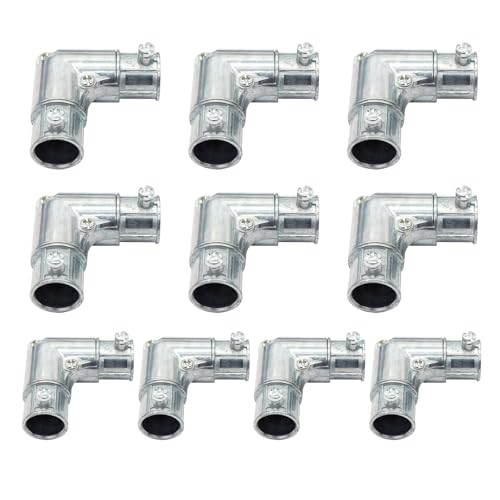
EMT fittings are intended for electrical metallic tubing. The AIRTAK, Qlvily, Loyzen, QWORK, and Xadnitu products are described as inside corner pulling elbows that connect EMT sections. Their set-screw format is different from a compression connector. The Sigma ProConnex 49057 is also for EMT, but its listing specifically says it terminates 1/2-inch steel EMT to a 1/2-inch knockout in a metal box or enclosure. That makes it a box-connection fitting rather than a general EMT-to-EMT corner elbow.
Liquid-tight fittings serve a different purpose. Joyangy, TOMSHIELE, HDHAODA, and Gisafai are listed for flexible conduit connections, with sealing components such as gaskets, O-rings, locknuts, ferrules, or dome nuts. Before buying, identify whether the project uses flexible nonmetallic conduit, Type B flexible conduit, or another system named in the product documentation. Do not assume an EMT elbow and a liquid-tight connector are interchangeable merely because both turn 90 degrees.
Confirm the nominal size
Size is one of the most important checks. Several selected EMT products are 1/2 inch, while the HDHAODA connector is 1-1/4 inch and the Gisafai connector is 1-1/2 inch. Joyangy and TOMSHIELE are listed at 1/2 inch. The fitting and conduit must use compatible nominal dimensions, and an enclosure knockout must match the connector where applicable.
Pack quantity should not replace a size check. A ten-piece set may be useful for a larger run, while a five-piece set may be enough for a small repair or provide a few spares. The Sigma product is a one-pack connector, which may be appropriate when only one box termination is needed. Conversely, the Qlvily and QWORK sets provide ten pieces for repeated corner connections.
Choose compression, set-screw, or threaded installation
Connection method affects both the installation process and the parts needed around it. Sigma uses a compression design and includes a zinc locknut. Its listing also states approval for concrete-tight applications. That combination makes the connection method and intended termination unusually clear.
The EMT corner products use set screws or combo-head screws. Their descriptions emphasize positioning the fitting at a 90-degree corner and securing the conduit. Qlvily additionally lists removable caps, while Xadnitu specifies a removable cover and combo screws. These access features may be helpful when the fitting design needs to be opened during assembly, but the supplied evidence does not establish a universal installation advantage.
Liquid-tight connectors generally use a ferrule and dome nut or a comparable sealing arrangement. Joyangy includes sealing gaskets and lock nuts, while HDHAODA lists an O-ring, domed nut, and steel locknut. TOMSHIELE describes pushing the conduit onto the ferrule and tightening the dome nut without special tools. Follow the particular manufacturer’s instructions and verify that the conduit end and enclosure opening are compatible.
Zinc die-cast construction appears across the Sigma, AIRTAK, Qlvily, Loyzen, QWORK, Xadnitu, and Gisafai listings. Gisafai further describes galvanized metal components, sealing gaskets, insulation rings, and heavy-duty locknuts. These products may be appropriate when the project calls for a metal fitting, but the listing evidence alone does not establish performance beyond the stated specifications.
Nonmetallic options use PVC or nylon. Joyangy, TOMSHIELE, and the liquid-tight connector listings describe PVC construction, while HDHAODA identifies nylon 6 and a 94V-2 flammability rating. Material selection should follow the conduit system, enclosure requirements, local electrical rules, and the environment. Resistance claims such as corrosion, sunlight, oil, or water resistance should be treated as product-specific rather than automatically applying to every nonmetallic fitting.
Review environmental requirements
For ordinary indoor EMT routing, the core questions are conduit compatibility, size, and connection style. Outdoor, damp, marine, refrigeration, pump, or equipment installations require closer attention to sealing and environmental documentation. Joyangy explicitly describes waterproof protection and includes sealing gaskets. TOMSHIELE lists outdoor use, sunlight and corrosion resistance, UL certification, and direct-burial suitability. HDHAODA lists UL status and resistance to oil, seawater, and mild acids. Gisafai describes watertight sealing for metal conduit connections and applications such as pools, ponds, basements, and outdoor installations.
These descriptions help narrow the choices, but they are not a substitute for checking the complete installation requirements. None of the selected product evidence supplies a universal IP or NEMA rating. If a project specification requires one, verify it separately before ordering.
Check certification and project documentation
Certification information varies considerably. AIRTAK states UL certification, Qlvily states cULus certification, TOMSHIELE states UL certification, and HDHAODA identifies a UL listing file number. Sigma provides a concrete-tight approval statement. Other selected listings provide useful material and design information but do not state a formal certification in the supplied evidence.
For permitted or commercial work, use the documentation required by the project, authority having jurisdiction, or equipment manufacturer. A product title alone should not be treated as proof of compliance. Confirm the exact model and size because a brand may offer several configurations.
Compare the pack to the project
Pack quantity affects purchasing convenience, but it is not a performance score. The five-piece AIRTAK and Loyzen sets suit smaller jobs, while Qlvily, QWORK, and Xadnitu provide ten EMT elbows. The liquid-tight options vary from two-piece to six-piece or five-piece packs. A larger pack can reduce interruptions on a multi-corner project, but unused fittings may be unnecessary if the installation needs only one connector.
Also distinguish a fitting-only purchase from a kit. The selected products here are compared as fittings or fitting sets. The product evidence should be checked carefully if a listing includes additional conduit, mixed straight and angled connectors, or other components. Matching every part to the intended run helps avoid buying a pack that contains the wrong connection type.
Final Recommendation
Sigma ProConnex 49057 1/2-inch EMT Compression Connector ranks first overall in this specification-based comparison under the published weighted criteria.
Sigma ProConnex 49057 is the first overall specification-based choice among the best 90-degree electrical conduit fittings because its 1/2-inch steel EMT termination, 1/2-inch knockout application, compression design, zinc construction, included locknut, and concrete-tight approval are clearly documented. It is the most precise match when the job involves a metal box or enclosure.
For EMT-to-EMT corner routing, AIRTAK is the most specification-aligned compact-pack alternative because the evidence identifies UL certification, zinc-alloy construction, a 1/2-inch size, and set-screw installation. Qlvily is a practical larger-pack option with cULus certification and removable caps. For liquid-tight work, HDHAODA is the best-documented large connector, while Joyangy and TOMSHIELE offer smaller PVC choices with sealing components and outdoor-oriented descriptions. Together, these are among the top 90-degree electrical conduit fittings for distinct installation scenarios, but the conduit size and required connection method should decide the final purchase.
Frequently Asked Questions
What should I verify before buying the best 90-degree electrical conduit fittings?
Verify the conduit family, nominal diameter, connection method, and enclosure interface. EMT-to-EMT elbows are not the same as a connector designed to terminate EMT at a knockout. For liquid-tight work, check whether the fitting is intended for the exact flexible conduit type and whether the supplied gasket, O-ring, ferrule, or locknut matches the installation. If the project requires certification, concrete-tight approval, or a specific enclosure rating, confirm that information for the exact model and size.
Are EMT inside corner elbows interchangeable with liquid-tight connectors?
No. The selected EMT inside corner products are described for connecting sections of electrical metallic tubing, commonly with set screws. Liquid-tight connectors such as Joyangy, TOMSHIELE, HDHAODA, and Gisafai are described with sealing hardware and flexible-conduit applications. Both designs create a 90-degree change, but their conduit interfaces and sealing approaches differ. Match the fitting to the system rather than selecting only by angle.
The Sigma ProConnex 49057 listing specifically states that it terminates 1/2-inch steel EMT to a 1/2-inch knockout in a metal box or enclosure. It also identifies a compression connection, zinc die-cast construction, included zinc locknut, and concrete-tight approval. Those details make it the clearest selected option for that particular use. Confirm the knockout and conduit dimensions before installation.
When does a liquid-tight fitting make more sense than an EMT elbow?
A liquid-tight fitting is worth considering when the project uses flexible conduit and needs the sealing components described by the listing. The selected liquid-tight products mention outdoor boxes, lighting, pumps, HVAC, refrigeration, marine equipment, and other equipment applications. TOMSHIELE specifically includes direct-burial suitability, while Joyangy describes waterproof protection. These claims are product-specific, so review the exact fitting documentation and installation requirements.
Does a larger pack mean a better conduit fitting?
Not necessarily. Pack quantity affects how many installations can be completed before another purchase, but it does not establish material quality, certification, sealing, or compatibility. A five-piece pack may be the right choice for a small repair, while a ten-piece EMT set may suit a larger run. Choose based on the required fitting design and size first, then select the quantity that matches the project.