Buying Guide
Choosing the best butcher and chef knives starts with the work you actually do. A brisket-focused cook has different needs from someone who wants one broad cleaver for poultry, vegetables, and outdoor meals. The products in this comparison are selected from public listing data, so the recommendations reflect documented specifications and intended uses rather than hands-on testing or customer sentiment.
A breaking knife is built around long, controlled cuts. The Cutluxe 10-Inch Cimeter is the clearest single-knife example, with a 10-inch blade and a listed Granton edge for meat breaking, trimming, cutting, and skinning. The Victorinox Fibrox 8-Inch Curved Breaking Knife takes a shorter, lighter approach and is described for breaking meat into smaller roasts and pieces.
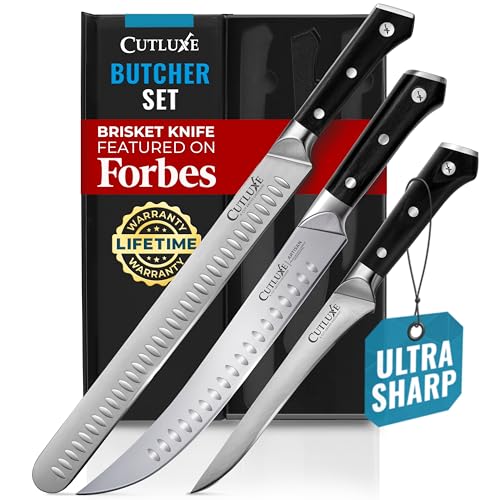
A brisket set can be more convenient when several stages of preparation are part of the routine. The Cutluxe 3-Piece Set separates brisket slicing, breaking, and boning into 12-inch, 10-inch, and 6-inch tools. That separation is useful because long slicing strokes and close work around bones call for different shapes.
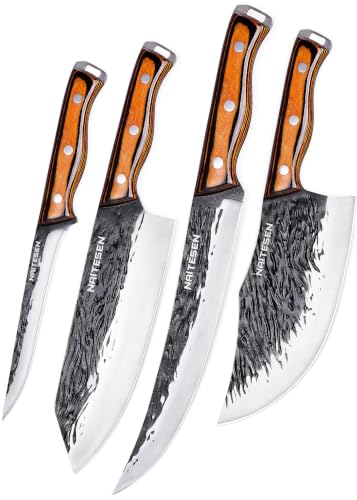
Cleavers emphasize broad blades and chopping leverage. The Mueller 7-Inch Meat Cleaver is listed for poultry joints, rib bones, brisket, scoring, and bench-scraper use. The Mueller 6.7-Inch Serbian Meat Cleaver also documents bone and meat work while retaining a size suited to general kitchen or outdoor preparation. The Naitesen set adds an 8.5-inch heavy-duty cleaver alongside dedicated breaking and boning knives.
Consider a set or a single knife
Sets provide more task coverage, but they also require more storage and maintenance. SANMEIHO has the broadest documented assortment in this ranking, with eight listed pieces spanning brisket, cleaving, chef, utility, and paring work. HOSHANHO also provides a varied eight-piece collection with bone chopper, cleaver, fillet, dividing, and paring formats.
Smaller sets can be easier to manage. Huusk supplies three butcher-oriented knives, covering Serbian chef, cleaver, and Viking formats. Naitesen uses four pieces to target cleaving, breaking, chef preparation, and boning without adding as many accessory items. A single knife may be the better fit if you already own general kitchen tools and only need a dedicated meat blade. The Cutluxe cimeter and Victorinox breaking knife are especially direct choices in that situation.
Read steel and edge claims carefully
The supplied listings use several different material descriptions, including high-carbon stainless steel, high-carbon German steel, high-carbon steel, and 5Cr15MoV. These terms help describe construction, but they do not by themselves prove how a knife will perform in every kitchen. Edge details are more useful when they are specific. HOSHANHO lists a 16-degree-per-side V edge, while SANMEIHO and Naitesen list 15-degree edges. Cutluxe provides a 14-to-16-degree-per-side range for its cimeter.
Hardness figures appear for some models as well. HOSHANHO lists 58-plus or minus two hardness, and Naitesen lists 56-plus Rockwell hardness. Such information can help compare the supplied specifications, but it should not be treated as a guarantee of edge life or cutting results. Proper use and maintenance still matter.
Prioritize control and handle construction
Full-tang construction appears across many of the selected sets and knives. It means the listing describes the blade material extending through the handle, which is relevant when comparing balance and structural design. HOSHANHO, Cutluxe, Huusk, SANMEIHO, Naitesen, Mueller, and XYJ all document full-tang or seamless full-tang construction in their supplied evidence.
Handle material and grip style vary. Cutluxe and Mueller list pakkawood handles, while HOSHANHO and SANMEIHO describe wood handles. Victorinox uses a textured, slip-resistant handle and specifically identifies wet-grip use. Dalstrong takes a different route with a waterproof polypropylene handle intended for fish camps, saltwater exposure, and other damp field conditions.
Finger-hole designs appear on several forged sets, including HOSHANHO-related alternatives in the candidate data, but the selected products should still be judged by the complete handle description. A finger hole can support a particular grip preference, yet it does not make every knife suitable for every hand or task.
Think about storage and maintenance
Portability is a major difference between the selections. SANMEIHO, HOSHANHO, and several other sets include roll bags, making them easier to organize for camping, BBQ preparation, or travel. Dalstrong includes a protective sheath, while Mueller and XYJ also document sheaths for their single-knife formats. These features protect the blade and make transport more practical, but users should still follow the care directions in the product documentation.
Maintenance guidance is particularly important for high-carbon and forged blades. Huusk advises hand washing, thorough drying, and occasional food-safe oil. For the selected products, the most suitable evidence-based approach is to follow each manufacturer’s care instructions rather than assume dishwasher use is appropriate.
Final Recommendation
SANMEIHO 8-Piece Butcher Knife Set ranks first overall in this specification-based comparison under the published weighted criteria.
SANMEIHO 8-Piece Butcher Knife Set is the highest-scoring first overall specification-based choice because it combines the widest documented task coverage with a 15-degree edge, full-tang handles, and a leather roll bag. It is a strong fit for cooks who want one organized system rather than a single specialist blade.
The top butcher and chef knives are not interchangeable. Choose the Cutluxe 3-Piece Set if brisket, breaking, and boning are your priorities; choose the Cutluxe Cimeter or Victorinox Fibrox if you need one focused breaking knife. Dalstrong is the most differentiated option for damp outdoor conditions, while Mueller’s cleavers and XYJ’s Serbian chef knife suit cooks who prefer a broad, portable single blade. HOSHANHO, Naitesen, and Huusk fill the middle ground with multi-knife formats and documented full-tang construction.
Overall, the best butcher and chef knives are the ones whose shape, edge information, handle design, and storage arrangement match your preparation routine. Treat listed specifications as comparison points, and confirm care instructions before use.
Frequently Asked Questions
What should I look for in the best butcher and chef knives?
Start with the task: breaking knives suit long meat cuts, boning knives provide closer control around bones, and cleavers emphasize broad-blade chopping. Then compare documented steel, edge angle, handle construction, and storage. A set such as SANMEIHO or Naitesen may be more useful than one general-purpose knife when your workflow includes several distinct stages.
Is a cimeter better than a cleaver for brisket?
They serve different roles. The Cutluxe 10-Inch Cimeter is listed for breaking, trimming, cutting, and skinning, making it the more specialized long-blade option. A cleaver such as the Mueller 7-Inch Meat Cleaver is listed for chopping bones, poultry joints, brisket, and general kitchen work. The right choice depends on whether you prioritize long slicing strokes or broad chopping capability.
Are full-tang butcher knives worth considering?
Full-tang construction is a useful specification to compare because the blade material is described as extending through the handle. Many selected products, including HOSHANHO, Cutluxe, Huusk, SANMEIHO, Naitesen, Mueller, and XYJ, document this construction. It may help buyers compare balance and structural design, but it does not replace evaluating the handle shape and intended use.
Which selected knife is easiest to carry outdoors?
Dalstrong, Mueller’s 6.7-inch Serbian cleaver, and XYJ each document a sheath. SANMEIHO and HOSHANHO include roll bags for their sets. Dalstrong is the most specifically oriented toward field conditions because its listing describes a waterproof polypropylene handle and titanium nitride coating for humid or saltwater environments. Always transport a knife in its supplied protective storage rather than loose in a bag.
How should high-carbon or forged knives be maintained?
Follow the supplied care directions for the specific product. Huusk advises hand washing, thorough drying, and occasional food-safe oil, while Mueller’s listing also recommends hand washing and thorough drying. Avoid assuming that a forged or high-carbon blade is dishwasher-safe unless the product documentation explicitly says so. Safe storage in a sheath or roll bag can also help protect the edge between uses.