Buying Guide
This guide to the best rebel slr film cameras compares documented specifications rather than hands-on results. The selected models are 35mm SLR cameras from Canon’s Rebel line or regional names identified with Rebel models. Across the group, the most important differences are autofocus detail, exposure control, film automation, included lens range, and flash implementation.
Start with the exposure controls
Exposure modes determine how much of the picture-making process the camera can automate. The Canon Rebel 2000 lists Program AE, aperture priority, shutter priority, and manual modes. That combination supports a simple starting point while leaving room for deliberate shutter or aperture choices.
The Rebel G and Rebel GII go further on paper with 11 exposure modes. The Rebel G specifically lists full manual options, while the GII describes modes ranging from full auto to metered manual. These models are a sensible fit when you want a camera that documents both guided and hands-on operation.
The Rebel XS listing identifies automatic, aperture-priority, and shutter-priority modes, but does not list manual exposure. That makes it more narrowly defined for users who want priority control without a fully manual specification. The Rebel Ti body does list full manual options and 11 modes, although the body-only format means the lens must be handled separately.
Compare autofocus and metering
Autofocus specifications vary in detail. The Rebel K2 and Rebel 2000 listings both document 7-point autofocus, while the Rebel X adds phase-detection AF with One-Shot and AI Servo modes. The Rebel T2 lists 7-point, high-speed, wide-area selectable autofocus. Those details are useful when comparing how explicitly each listing describes focusing assistance.
Metering information is most specification-aligned on the Rebel K2 and Rebel 2000 families. The K2 listing specifies a 35-zone metering system linked to its autofocus system. The Rebel 2000 listing also names a 35-zone evaluative metering system. By contrast, several other selected listings describe autofocus or exposure modes without giving a metering-zone count. That is a difference in documented evidence, not a claim about unlisted performance.
Check the included lens and mount
An included lens changes how ready a kit is for a first roll. The Rebel K2 options include either a 28-90mm or 28-80mm zoom, while the Rebel 2000 includes a 28-80mm lens. The Rebel T2 also includes a 28-90mm lens, with the listing specifying an ultrasonic motor. These wider ranges cover standard and short-telephoto perspectives in one kit.
The Rebel G, Rebel GII, Rebel XS, and Rebel Ti kit use 35-80mm-class options in the supplied evidence. That range remains a conventional general-purpose zoom, but it does not extend as far toward telephoto as the 28-90mm kits. Lens compatibility matters as well: the Rebel K2 listing explicitly states compatibility with more than 50 Canon EF lenses, and several other entries specify the Canon EF mount or an EF lens.
The Rebel Ti body is the only selected body-only configuration. It may be the right format for someone who already owns a compatible EF lens, but it should not be treated as a complete camera-and-lens kit.
Look at film transport and flash features
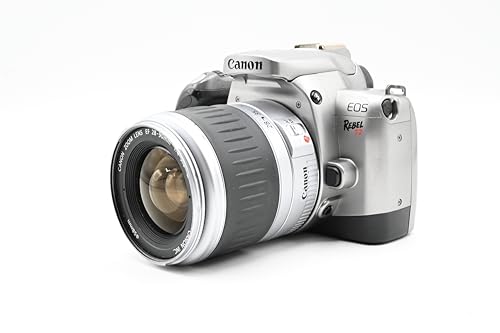
Automatic film handling can reduce routine steps between exposures. The Rebel 2000 listing specifically describes automatic loading, advancing, and rewinding. The EOS Kiss III listing, which identifies that camera as the Rebel 2000 in North America, also specifies DX-coded film support from ISO 25 to 5000 and automatic transport. These details make the Rebel 2000 family particularly well documented for film workflow.
Built-in flash features also differ. The Rebel X lists off-the-film metering and red-eye reduction. The Rebel G and GII list retractable or built-in flash systems with red-eye reduction. The Rebel T2 goes further in its description with an enhanced built-in E-TTL II autoflash. The Rebel K2 listing names an advanced E-TTL flash metering system. If flash control is central to your selection, prioritize entries with a named metering or reduction feature rather than assuming every built-in flash works identically.
Decide between a kit and a body
A kit with a stated EF zoom is the simpler route when you need both camera and lens in one listing. The Rebel K2, Rebel 2000, Rebel G, Rebel GII, Rebel T2, and Rebel XS entries all document camera-and-lens configurations. The Rebel Ti body does not include a lens, and the product title makes that limitation explicit.
Model names can also vary by region. The EOS Kiss Panorama is identified as the Rebel XS in the US and Canada, while the listing for New EOS Kiss identifies it as the Rebel G in the US and Canada. Those aliases are useful when checking documentation, but the comparison treats each supplied listing as its own distinct product record because the candidates have separate parent groups.
Final recommendation
Canon EOS Rebel K2 with EF AF Lens ranks first overall in this specification-based comparison under the published weighted criteria.
The final choice among the best rebel slr film cameras depends on the documented features that match your intended use.
The Canon EOS Rebel K2 with EF AF Lens is the highest-scoring returned product and the first overall specification-based choice. It combines 7-point autofocus, 35-zone metering, a 28-90mm zoom, EF compatibility, and color or black-and-white film support in one clearly documented kit.
Among the top rebel slr film cameras, the Canon Rebel T2 is the better fit when E-TTL II flash and a 28-90mm ultrasonic-motor zoom matter most. Choose the Canon Rebel 2000 for four clearly named exposure modes and automatic film transport. The Rebel G and GII are useful alternatives for 11-mode control, while the Rebel X stands out for its named One-Shot and AI Servo autofocus modes.
The Rebel XS is a straightforward priority-mode option, and the Rebel Ti body makes sense only when you already have an EF lens. Before selecting any renewed listing, verify the included lens, battery requirement, and exact body configuration against the listing details.
Frequently Asked Questions
What should I look for in the best rebel slr film cameras?
Start with the controls you actually need: autofocus point information, exposure modes, metering details, film transport, lens mount, and flash functions. The selected listings vary considerably in how much of this information they document. A camera with 35-zone metering and four named exposure modes offers clearer specification coverage than one that only states autofocus and built-in flash.
Are Canon Rebel and EOS Kiss names interchangeable?
Some supplied listings explicitly identify regional equivalents. The EOS Kiss Panorama is identified as the Rebel XS in the US and Canada, and New EOS Kiss is identified as the Rebel G in the US and Canada. The EOS Kiss III is identified as the Rebel 2000 in North America. Check the individual listing because the included lens and configuration can still differ.
Do all selected cameras include a lens?
No. Most selected entries are kits with an EF zoom, but the Canon EOS Rebel Ti body-only listing does not include a lens. The product title and evidence should be checked carefully before choosing a body-only configuration.
Which selected model documents the most flash detail?
The Rebel T2 listing specifies an enhanced built-in E-TTL II autoflash. The Rebel K2 lists advanced E-TTL flash metering, and the Rebel X lists off-the-film metering with red-eye reduction. These are specification differences; the supplied evidence does not establish hands-on flash performance.
Which Rebel model lists automatic film loading and rewinding?
The Canon Rebel 2000 listing specifically states automatic film loading, advancing, and rewinding. The EOS Kiss III listing, identified as the Rebel 2000 in North America, also documents automatic film handling and DX-coded film support.