Buying Guide
Shielded microphone cables are usually balanced XLR cables designed to carry a microphone signal between equipment such as a microphone, mixer, preamp, interface, or PA system. The products in this comparison are selected because their listings identify shielded construction and a male-to-female three-pin XLR format, rather than merely describing a general audio lead. Before choosing among the best shielded microphone cables, match the cable length and connector layout to the physical arrangement of your equipment.
Start with the shielding design
Shielding is the main category-specific feature to compare. It surrounds the signal conductors and is intended to reduce the effect of electromagnetic or radio-frequency interference. Listing language varies: Cable Matters specifies copper-braided shielding, while Amazon Basics identifies inner copper spiral shielding. VANDESAIL, Ltemziiy, Kxable, and several AA AUDIO ACCESSORY models document combinations of foil and braided shielding.
A dual-shield listing gives more construction detail than a simple statement that a cable is shielded. For example, the AA AUDIO ACCESSORY 6-foot Star Quad cable lists both a 100% coverage OFC braided shield and an aluminum foil shield. That does not establish a laboratory performance result, but it does make the design easier to compare on paper. If your cable will run near power supplies, lighting, computers, or wireless equipment, prioritize products whose listings explain the shielding layers.
The selected products use balanced male-to-female XLR designs, but their listed conductors differ. OFC, or oxygen-free copper, appears across many options. Cable Matters lists 21 AWG OFC, the AA AUDIO ACCESSORY two-pack lists 21 AWG 99.99% OFC, and Kxable lists 22 AWG pure copper. Other models list 24 AWG OFC conductors.
Wire gauge alone should not be treated as a complete performance guarantee. Instead, use it alongside the stated balanced layout, conductor material, and shielding. The Star Quad design is distinctive because it uses four conductors rather than the conventional two-conductor description found on many other cables. If a listing provides unusually specific conductor information, that can help distinguish a documented design from a generic product description.
Check connector details
A standard three-pin XLR male-to-female arrangement is the normal choice for connecting many microphones and professional audio devices. Confirm that your equipment has matching XLR ports before ordering; a shielded XLR cable will not replace a USB, TRS, or specialty connector cable.
Connector details can matter in moving setups. The listings include zinc-alloy or metal housings, molded strain relief, chuck-style strain relief, self-locking mechanisms, and locking latches. These features are intended to support a secure connection, but they do not mean every plug is compatible with every non-XLR socket.
Choose a length that fits the route
Six-foot cables are convenient for desktops, nearby mixers, and compact recording stations. The AA AUDIO ACCESSORY Star Quad, Cable Matters, and Ltemziiy selections occupy this range. Ten-foot cables give more freedom around a desk, stand, or small room; the AA AUDIO ACCESSORY two-pack and Amazon Basics pair are examples.
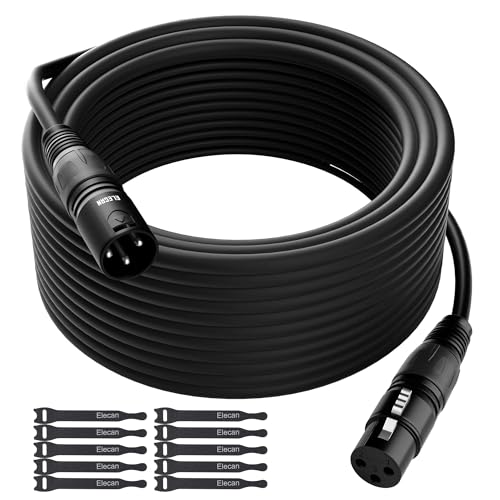
For small stages or meeting rooms, 15-foot and 25-foot options may provide better reach. VANDESAIL offers both lengths in two-packs, while Kxable offers a 30-foot pair and Elecan a single 30-foot cable. The GEARit 100-foot cable is aimed at substantially larger layouts. Longer cables can be harder to coil, store, and route, so avoid choosing extra length solely because it sounds more professional.
Decide between one cable and a pack
A two-pack is useful when you need two microphones, two signal paths, or a spare. The package format can also reduce the need to mix different cable constructions in one setup. Cable Matters, Ltemziiy, VANDESAIL, Amazon Basics, and the AA AUDIO ACCESSORY 10-foot model all provide two-cable options in this selection.
A single cable may be the better fit when you need one specific long run. Elecan and GEARit are single-cable choices, with the latter designed around a 100-foot length. Check the supplied quantity carefully: some listings describe the package in the title while the specification field may use a generic unit count.
Look at jacket and strain-relief construction
Jacket materials affect handling and storage. Nylon-braided products such as the VANDESAIL models and Ltemziiy are described as flexible or wear-resistant. PVC-jacketed options such as Amazon Basics and Elecan emphasize a flexible protective covering. Kevlar reinforcement appears in both AA AUDIO ACCESSORY selections, while several listings mention metal housings, molded strain relief, or reinforced soldered connections.
These are construction claims from public listings, not independent durability tests. Treat stated bend-cycle figures as manufacturer-provided information rather than a guarantee of service life. In practical use, avoid sharp kinks, pull from the connector body rather than the cable, and coil the cable without tight twists.
Match the cable to the setup
For a podcast desk or compact recording station, a 6-foot two-pack such as Ltemziiy or Cable Matters is easier to organize. For a more demanding documented construction, the AA AUDIO ACCESSORY Star Quad model adds a four-conductor design and named REAN connectors. For two microphones placed farther apart, the AA AUDIO ACCESSORY 10-foot pair or VANDESAIL 15-foot pair is more suitable.
Stage layouts call for careful routing and enough slack without leaving unnecessary loops where people walk. VANDESAIL 25-foot, Kxable 30-foot, and Elecan 30-foot models provide more reach, while GEARit is the most specialized choice for a 100-foot run. If your equipment is close together, a long cable may create storage and cable-management work without adding a documented benefit.
Final Recommendation
AA AUDIO ACCESSORY Star Quad XLR Cable 6ft ranks first overall in this specification-based comparison under the published weighted criteria.
AA AUDIO ACCESSORY Star Quad XLR Cable 6ft is the highest-scoring first overall specification-based choice among the best shielded microphone cables in this comparison. Its documented four-conductor Star Quad layout, dual shielding, REAN by Neutrik connectors, and Kevlar reinforcement give it the most specification-aligned specification profile, provided six feet is enough for your route.
For a two-microphone arrangement, the AA AUDIO ACCESSORY 10-foot 2-pack is the more practical selection. Cable Matters and Ltemziiy are strong compact alternatives, while VANDESAIL 15-foot and 25-foot pairs suit progressively larger layouts. Kxable 30ft and Elecan 30ft are appropriate when one or two extended runs are needed. GEARit 100ft is the specialist pick for maximum reach among the top shielded microphone cables. Amazon Basics remains a straightforward option when a conventional 10-foot copper-shielded pair meets the requirements.
The final choice should follow the connector type, distance, cable quantity, and documented shielding design—not a popularity label or customer metric. All rankings here are specification-based and should be treated as a structured comparison of supplied public listing data.
Frequently Asked Questions
What are the best shielded microphone cables for a home studio?
A 6-foot or 10-foot balanced XLR cable is usually the easiest length to manage in a home studio. Cable Matters, Ltemziiy, and the AA AUDIO ACCESSORY Star Quad model document suitable short-to-medium lengths, copper conductors, and shielded construction. Choose a two-pack if you need a second microphone connection or a spare.
Not necessarily. Multiple shielding layers are useful specification details, but the supplied listings do not provide independent test results that establish a universal performance ranking. Compare shielding with conductor material, connector construction, jacket design, and the actual interference conditions around your equipment.
How long should a shielded XLR microphone cable be?
Use the shortest length that comfortably reaches between devices while allowing safe routing and some movement. Six feet fits nearby equipment, 10 to 15 feet works for many small rooms, and 25 to 30 feet can serve stage or room layouts. A 100-foot cable such as GEARit is intended for a much larger route and may be inconvenient in a compact setup.
Are XLR microphone cables interchangeable with speaker cables?
The selected products are described as three-pin XLR male-to-female cables and are listed for microphones and other XLR-equipped audio devices. Connector compatibility does not by itself confirm suitability for every speaker, lighting, or power application. Check the equipment manuals and connector requirements before using a cable outside the microphone or balanced-audio context.
What should I inspect when the cable arrives?
Verify the male-to-female connector arrangement, stated length, quantity, and jacket condition. Test the locking mechanism gently and inspect the strain relief for movement or damage. The comparison does not include hands-on testing, so installation checks are appropriate before relying on any cable for a recording or live event.