Buying Guide
The best female-to-male cat 6 ethernet cables are extension leads: one end accepts an existing RJ45 plug and the other connects to a router, computer, printer, television, switch, console, or another Ethernet-equipped device. They are useful when a fixed cable is slightly too short, when a port is difficult to access, or when repeated plugging and unplugging should be moved away from the device’s built-in port.
This comparison uses public listing information rather than hands-on testing or customer-opinion summaries. The scores emphasize whether the listing clearly documents the requested cable type, network capability, signal design, connector construction, and physical fit.
Confirm the connector arrangement
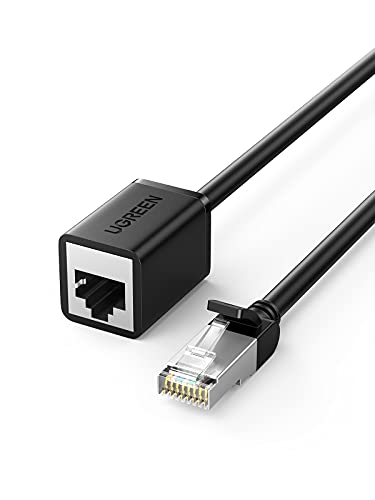
A true female-to-male extension has a female RJ45 socket on one end and a male RJ45 plug on the other. The male plug connects to the device or to another network lead, while the female socket accepts the existing cable. This differs from a coupler with two female sockets, a replacement patch cable with two male plugs, or a standalone adapter without a cable lead.
The selected products document the male-to-female arrangement directly or describe an extension cable that performs that function. Cable Matters, VENTION, UGREEN, J&D, XANHAM, and Haokiang are conventional cable extensions. Togconn adds several angle choices, while Weetcoocm documents an upward-angled connector for routing behind furniture or in a network closet.
Match the length to the layout
Short extensions are appropriate when the equipment is already close to the end of the existing cable. XANHAM and Haokiang provide 1-foot options, while J&D offers 2 feet and UGREEN offers 3 feet. These lengths can add access without introducing a large loop of unused cable.
For broader placement, Cable Matters and Orbram provide 6-foot options. VENTION and Dutevolns extend the choice to 10 feet, and Weetcoocm reaches 20 feet. Longer cables can help when a router or network device must move farther from the original cable endpoint, but they may also create extra slack that needs routing.
Togconn takes a different approach with five 0.6-foot extensions in different orientations. This design is about clearance rather than distance. The upward, downward, left, right, and straight options can help when a conventional straight plug would press against a wall, cabinet, television, or network panel.
Check speed and bandwidth documentation
Several listings state support up to 1,000 Mbps and 250 MHz, which is the clearest recurring specification in this group. VENTION, Weetcoocm, J&D, UGREEN, Dutevolns, Togconn, and XANHAM provide that type of documentation. Cable Matters describes support for a 10-Gigabit Ethernet network, while Haokiang lists up to 550 MHz bandwidth without a specific transfer-speed figure.
A cable extension does not automatically increase the capability of the connected network. The result depends on the cable, ports, and devices used throughout the connection. Treat the stated speed and bandwidth as listing specifications, not as a guarantee of a particular setup’s real-world throughput.
Choose shielding for the environment
Shielding is most relevant when the cable will run near potential sources of electrical interference or when the installation calls for a shielded network path. Cable Matters documents foil shielding; VENTION describes double shielding; Weetcoocm lists SFTP construction with foil around each pair and a tinned-copper braid; and Haokiang specifies aluminum-mylar foil plus tinned-copper-braid shielding.
J&D and Dutevolns also describe shielded RJ45 construction, while Togconn identifies FTP shielding. By contrast, UGREEN and Orbram emphasize pure copper conductors but do not provide the same explicit shielding detail in the supplied evidence. That difference does not by itself establish that one design will perform better in every environment; it simply makes the documented construction easier to compare.
Consider conductors and connector construction
Pure or bare copper conductors are specifically documented for Cable Matters, UGREEN, Orbram, Togconn, XANHAM, and Haokiang. J&D lists gold-plated connectors and Dutevolns lists aluminum-shell connectors. Gold-plated contacts appear in several listings, including Cable Matters, Weetcoocm, UGREEN, XANHAM, and Haokiang.
Jacket design also varies. UGREEN uses a PVC jacket and Orbram uses a nylon braid. VENTION states at least 10,000 bends, UGREEN states a similar bend-test figure, and Togconn reports more than 10,000 bending tests. These are supplied claims about construction, not independent test results, so they should be read as design information.
Account for compatibility and applications
The selected cables generally list backward compatibility with Cat 5 and Cat 5e cables. Several also identify support for UTP, FTP, and STP cable types. Cable Matters specifically mentions PoE and VoIP applications, and Haokiang names PoE devices among its compatible equipment.
Before choosing, verify that both connected devices use standard RJ45 Ethernet ports and that the extension’s orientation and length suit the installation. An angled option can reduce bending in a confined space, while a straight short cable may be easier to route on an open desk.
Final Recommendation
VENTION Shielded Cat 6 Ethernet Extension Cable, 10ft ranks first overall in this specification-based comparison under the published weighted criteria.
Cable Matters Shielded Cat 6 Extension Cable, 6ft 2-Pack is the highest-scoring returned product and the first overall specification-based choice. It combines documented Cat 6 compliance, 10-Gigabit network support, foil shielding, bare copper conductors, gold-plated contacts, and support for PoE and VoIP. The two 6-foot cables also provide useful installation flexibility.
Among the top female-to-male cat 6 ethernet cables, VENTION is a practical pick when a 10-foot shielded run is needed, while Weetcoocm is better suited to a long route that benefits from an angled connector. J&D and UGREEN fit compact or moderate-length layouts. Orbram stands out for its braided jacket, and Togconn is the most specialized option for varied connector directions.
The best female-to-male cat 6 ethernet cables should be selected by connector arrangement first, then by length, documented network specifications, shielding, and physical construction. A short cable is preferable when only a small amount of extra reach is needed; a longer or angled design makes more sense when the installation itself creates clearance or routing challenges.
Frequently Asked Questions
Among the best female-to-male cat 6 ethernet cables, what does female-to-male Cat 6 Ethernet mean?
It describes an extension cable with a female RJ45 socket at one end and a male RJ45 plug at the other. The female side accepts an existing Ethernet cable, while the male side connects to a compatible network port or cable endpoint.
Can these cables connect Cat 5e equipment?
The supplied listings for Cable Matters, VENTION, Weetcoocm, J&D, UGREEN, Togconn, XANHAM, and Haokiang state backward compatibility with Cat 5 or Cat 5e equipment. The connected devices and the rest of the network path still determine the operating capability.
Should I choose a shielded extension?
A shielded design may be appropriate when the cable runs near possible interference sources or when the installation specifies shielded Ethernet components. The listings for Cable Matters, VENTION, Weetcoocm, J&D, Dutevolns, Togconn, and Haokiang document shielding in different forms.
Is a longer cable always preferable?
No. A longer cable provides more placement range, but it may leave extra slack in a compact setup. One-foot, 2-foot, and 3-foot products are better suited to nearby equipment, while 6-foot, 10-foot, and 20-foot options address greater separation.
When is an angled extension useful?
An angled extension can help route the cable away from a wall, cabinet, television, or other obstruction. Weetcoocm documents an upward-angled design, and Togconn offers upward, downward, left, right, and straight connector orientations.