Buying Guide
The best professional microphone cables are usually balanced XLR cables designed for microphones, mixers, preamps, PA systems, or related three-pin equipment. The products here are compared from public listing evidence: connector format, conductor and shielding descriptions, jacket construction, length, pack size, and stated use. This is not a hands-on test, and the ranking does not summarize customer opinions.
Most selected products use a male-to-female, three-pin XLR-to-XLR layout. That is the most directly comparable design in this group and is intended for standard XLR-compatible microphones and audio equipment. Confirm the connectors on both pieces of equipment before ordering. A cable can be well built yet still be the wrong choice if one device needs a different plug or an adapter.
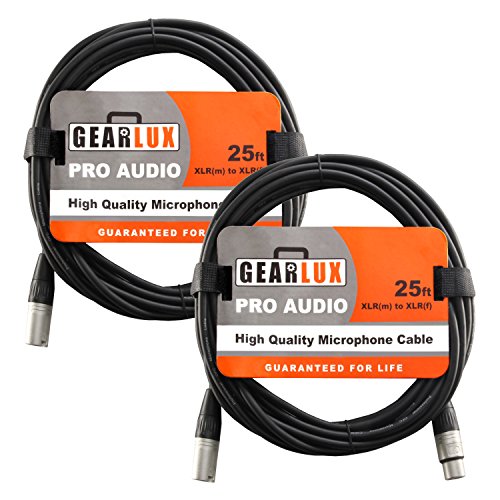
The connector evidence varies. Shure specifies chrome XLR connectors, while Elgato lists metal plugs and gold-plated pins. Gearlux, Cable Matters, and the VANDESAIL options describe metal connectors, and several listings mention locking or self-locking designs. Those details matter when cables are repeatedly connected and disconnected. They do not, by themselves, prove a particular service life, so treat durability language as specification evidence rather than a test result.
Choose the right length
Length affects both reach and cable management. The 3-foot VANDESAIL pair is aimed at nearby connections, such as a microphone close to a preamp or mixer. Cable Matters offers a 6-foot pair for compact work areas, while Elgato’s 10-foot cable sits between desktop and stage use. The 20- to 25-foot products provide more placement freedom for vocalists, presenters, and stage equipment.
A longer cable is not automatically better. Extra length can create loops that need to be coiled and stored carefully. A short cable can be easier to route but may leave little room to reposition a microphone. Measure from connector to connector, then allow enough slack for the actual path rather than measuring only the straight-line distance.
Evaluate shielding and conductors
Shielding is one of the most useful specification areas to compare. Gearlux lists copper braided shielding, while Cable Matters specifies copper braided shielding with a balanced design. The VANDESAIL and EBXYA listings describe both foil and copper-braid shielding. Amazon Basics identifies inner copper spiral shielding, and Elgato says its shielding is intended to reduce electromagnetic interference.
OFC and all-copper conductor descriptions also appear across the selection. AA AUDIO ACCESSORY specifies 21AWG OFC conductors, while Gearlux and Cable Matters list OFC construction as well. VANDESAIL and EBXYA identify 24AWG OFC conductors. These details help distinguish the designs on paper, but a listing does not establish a measured noise floor or guarantee a result in every environment. Keep power supplies, lighting, and audio cables organized when possible.
Consider jacket and strain-relief design
The jacket determines how a cable feels during setup and storage. Shure calls its cable Hi-Flex. Elgato uses a nylon-braided jacket, and the VANDESAIL products use nylon braiding as well. Heams lists a flexible tweed cloth jacket. Other options use PVC, including Gearlux, Cable Matters, and Amazon Basics. PVC can be a practical, familiar choice, while braided or cloth jackets may offer a different handling feel.
Strain relief is another useful detail. VANDESAIL and Cable Matters specify molded strain relief, and several products describe metal connector housings or grip features. These features support a more secure physical connection, but they should not be treated as proof that a cable cannot be damaged. Avoid pulling a cable by its plug, sharply folding it, or leaving it under foot traffic.
Match the pack size to the system
Single cables make sense for a replacement or one-microphone setup. Two-packs are useful for stereo-adjacent equipment, two microphones, or a spare. Gearlux and VANDESAIL’s 25-foot pair provide long matched runs, while Cable Matters and the short VANDESAIL pair focus on compact connections. EBXYA’s four-pack and Heams’ six-pack are better for larger inventories, rehearsals, or installations where several microphone positions must be ready at once.
Color identification can save setup time when multiple lines are connected. EBXYA and Heams list color-coded connectors, and the Heams pack is explicitly supplied with multiple cables. Color coding does not affect signal design, but it can make cable tracking easier during teardown.
Build a practical cable kit
For a small studio, one 6- or 10-foot cable and one longer spare may cover most needs. For live sound, two or more 20- or 25-foot cables provide more placement flexibility. Short 3-foot leads can be useful for nearby rack or desk connections, but they should supplement rather than replace longer cables when microphones move around.
The best professional microphone cables for your setup are therefore the ones whose connector type, reach, jacket, and quantity fit the system. Give priority to clearly documented balanced XLR construction when that matches your equipment, then compare shielding and handling details. A warranty can add support, as shown by the Shure and AA AUDIO ACCESSORY listings, but it does not replace checking the physical specifications.
Final Recommendation
VANDESAIL XLR Cables, 25-foot 2-Pack ranks first overall in this specification-based comparison under the published weighted criteria.
The final choice among the best professional microphone cables depends on the documented features that match your intended use.
Shure C25J is the highest-scoring returned product and the first overall specification-based choice. Its 25-foot Hi-Flex format, chrome XLR connectors, low-impedance specification, and warranty make it the most balanced single-cable option in this comparison.
For a 10-foot creator or home-studio setup, Elgato is a strong alternative because its nylon braid, metal plugs, gold-plated pins, and shielding description are clearly stated. Gearlux is a better fit when two 25-foot cables are needed, while AA AUDIO ACCESSORY adds a reinforced braided design and detailed 21AWG OFC specifications.
The top professional microphone cables for larger systems are represented by the VANDESAIL 25-foot pair, EBXYA four-pack, and Heams six-pack. They prioritize longer reach or higher quantity. Cable Matters is the compact two-pack pick, Amazon Basics is a straightforward single 25-foot cable, and the 3-foot VANDESAIL pair is best reserved for nearby equipment.
Before purchase, verify the connector format and measure the route. Select the shortest length that reaches comfortably, or choose a multipack when several microphones need matching cables. Treat performance claims as listing specifications rather than independently verified test results.
Frequently Asked Questions
Are balanced XLR cables the usual choice for professional microphones?
The selected XLR-to-XLR products are described for professional microphones and related audio equipment, and several explicitly identify balanced construction. Check the input and output connectors on your specific microphone and mixer before ordering. Connector compatibility is more important than the cable’s branding.
What length should I choose for a microphone cable?
Use 3 or 6 feet for nearby equipment, 10 feet for many desktop or home-studio layouts, and 20 to 25 feet when a microphone needs to move across a room or stage. Leave practical slack, but avoid buying excessive length that will create unnecessary coils.
Do braided microphone cables offer a proven audio advantage?
A braided or cloth jacket primarily describes the cable’s exterior handling and construction. Some selected products combine braiding with shielding and OFC conductors, but the supplied listings do not provide independent measurements showing that a particular jacket improves audio performance. Compare the complete specification rather than the jacket alone.
When is a microphone cable multipack useful?
A multipack is useful when you run several microphones, want a spare, or need consistent lengths across a setup. Two-packs suit small systems, while four- and six-packs are more appropriate for larger inventories. Consider storage space and labeling, especially with long cables.
How do I narrow down the best professional microphone cables?
First confirm three-pin XLR compatibility, then choose the required length and quantity. After that, compare shielding descriptions, conductor details, jacket material, connector housing, strain relief, and warranty information. The best professional microphone cables are the ones that meet those documented needs without adding an unsuitable connector or unnecessary length.