Buying Guide
The best snake borescopes differ mainly in how they show the image, steer the probe, and handle the distance between the operator and the inspection point. The right choice depends less on a single headline specification and more on the access route, the need for records, and whether the work is wet, dark, or difficult to control.
Choose the viewing system first
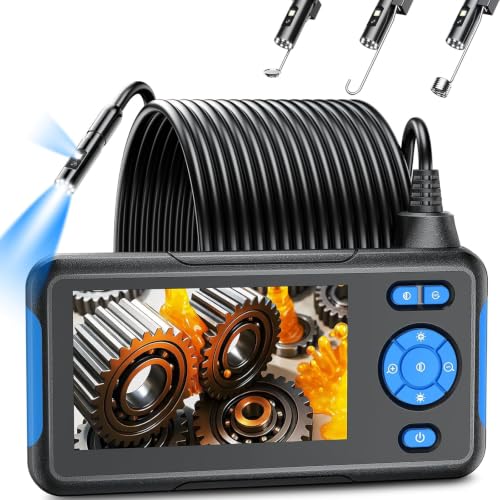
A standalone screen is usually the most direct format. Models such as the VEVOR SX4, Teslong NTS300, TGJOR G50, T TAKMLY N43, Klein Tools ET17, Anykit AD430, and SKYBASIC C20 include their own displays, so they do not rely on a phone during the inspection. This can be useful in a garage, crawlspace, workshop, or job site where a separate device is inconvenient.
Phone-connected scopes trade the built-in monitor for portability and app features. DEPSTECH NTC55 and PAPIBLU use a phone or tablet for viewing, while Teslong TD300 uses USB-C and an app. Check the stated operating-system or connector requirements before buying. The DEPSTECH listing specifically notes Android OTG support, and the TD300 is documented for iPhone 15+ or Android devices through USB-C.
Match probe control to the access route
A semi-rigid cable is a practical general-purpose design because it bends while retaining some shape. It can be pushed through a cavity, pipe, duct, or engine area without behaving like a loose wire. The 16.4- to 16.5-foot cables on the DEPSTECH NTC55, TGJOR G50, T TAKMLY N43, Teslong NTS300, PAPIBLU, and SKYBASIC C20 are suited to longer runs than the five-foot Teslong TD300 or 4.9-foot VEVOR SX4.
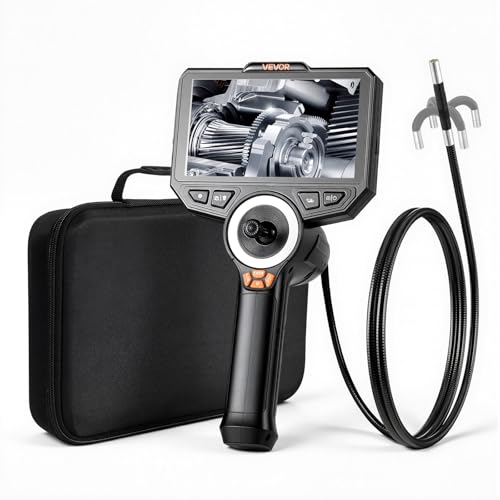
Articulation adds another kind of control. The VEVOR SX4 documents 4-way articulation, while Anykit AD430 documents 210° two-way articulation and Teslong TD300 documents 180° two-way articulation. These designs can help aim the camera after it has passed a bend or reached a component that is difficult to view by twisting the cable alone. Articulation does not automatically mean greater reach, so compare the probe length with the route you need to inspect.
Consider camera diameter and lens direction
Camera diameter determines whether the probe can enter a particular opening. The Anykit AD430 lists a 0.22-inch probe, the VEVOR SX4 lists a 0.24-inch camera head, and the Klein Tools ET17 lists a 5.5 mm camera. These slimmer options may be more appropriate for tight access than the 7.9- or 8 mm probes used by several dual-lens models.
A front camera looks along the probe, while a side camera can show a wall, pipe surface, or engine feature without fully rotating the cable. DEPSTECH NTC55, Teslong NTS300, TGJOR G50, T TAKMLY N43, PAPIBLU, and other selected models document dual-lens viewing. A dual-lens design is particularly relevant when the inspection target is on the side rather than directly ahead.
Compare image detail with the recording requirement
Published resolution is useful, but it is not the only image consideration. Several standalone scopes list 1080P imaging. The supplied evidence does not establish that every model will appear equally clear in every environment, so treat these figures as specification points rather than hands-on performance results.
If you need to share findings or keep a record, choose a model that explicitly supports capture. DEPSTECH NTC55, Teslong NTS300, Klein Tools ET17, Teslong TD300, and PAPIBLU document photo or video functions. T TAKMLY N43 and SKYBASIC C20 state that they cannot take photos or videos, making them more appropriate for live viewing than report preparation.
Check lighting and wet-area protection
Dark spaces require adjustable illumination. The selected products document LED lighting, with several offering eight adjustable LEDs and the VEVOR 360° model listing 6+1 LEDs. Brightness control can be useful when surfaces reflect light or when the camera enters a deep, unlit cavity.
IP67 appears across many of the selected probes, including the VEVOR SX4, Anykit AD430, DEPSTECH NTC55, Teslong NTS300, TGJOR G50, T TAKMLY N43, PAPIBLU, and SKYBASIC C20. IP protection is a technical rating, not permission to expose the entire device to water. Follow the product instructions and pay attention to probe-specific limitations. Engine work should be performed only after components have cooled when the listing gives such a warning.
Think about power and handling
Battery information matters for repeated inspections. VEVOR SX4 lists 5–6 hours of continuous operation with a 7000mAh battery, VEVOR’s 360° model lists 5–6 hours with a 5000mAh battery, Anykit AD430 lists five hours with a 3000mAh battery, and Teslong NTS300 lists approximately 4.5 hours. TGJOR G50 lists 3–4 hours, while the T TAKMLY listing gives up to five hours of standby time rather than continuous operation. These are published claims, not independent runtime tests.
A kickstand, phone holder, or one-handed control can also change how easy it is to work. Klein Tools ET17 includes a self-storing kickstand, Teslong TD300 documents a phone holder and thumb controls, and Anykit AD430 uses a thumb-slider. These features may reduce the need to hold both the display and the probe at the same time.
How this comparison was made
This is a specification-based comparison using supplied public listing data, not a hands-on test and not a summary of customer opinions. Products were assessed on image clarity, probe navigation, reach and access, display or connection design, and readiness for dark or wet inspection areas. The ranking favors documented utility for common plumbing, automotive, HVAC, industrial, and home tasks. Volatile marketplace information was not used in the public criteria or product descriptions.
Final Recommendation
DEPSTECH NTC55 2K Dual-Lens Phone Borescope ranks first overall in this specification-based comparison under the published weighted criteria.
The final choice among the best snake borescopes depends on the documented features that match your intended use.
VEVOR SX4 4-Way Articulating Borescope is the highest-scoring returned product and the first overall specification-based choice. Its 4-way steering, slim 0.24-inch camera head, 6-inch IPS display, IP67 camera, and stated 5–6-hour operation give it the broadest documented control package in this selection.
Choose Anykit AD430 when a slim probe and built-in screen matter more than maximum articulation. Choose DEPSTECH NTC55 when phone-based 2K imaging and recording are priorities. For a longer, self-contained scope, Teslong NTS300 offers a 16.5-foot cable, dual lenses, and a 5-inch display. The top snake borescopes are not interchangeable: screen-based models simplify setup, phone models support portability and capture, and articulating models focus on steering.
For basic live viewing, SKYBASIC C20 and T TAKMLY N43 avoid app dependence. For a smaller utility camera, Klein Tools ET17 lists a 5.5 mm head. Before ordering, confirm the required opening diameter, cable length, device connector, recording needs, and whether the inspection area calls for a documented water-resistant probe.
Frequently Asked Questions
What are the best snake borescopes for plumbing?
For longer plumbing runs, consider Teslong NTS300, TGJOR G50, SKYBASIC C20, or DEPSTECH NTC55 because each documents roughly 16.4 to 16.5 feet of cable. For bends where aiming is difficult, Anykit AD430 or VEVOR SX4 adds articulation. Confirm the opening size and use the IP rating according to the product instructions.
Is a phone-connected or standalone borescope better?
A standalone model such as TGJOR G50 or Klein Tools ET17 is ready to view through its included display and avoids phone compatibility questions. A phone-connected model such as DEPSTECH NTC55 can offer app-based capture and portability. The better format depends on whether immediate setup or digital recording is more important.
Do dual-lens snake borescopes help with side walls?
They can. A front lens looks forward, while a side lens can show the surface beside the probe. DEPSTECH NTC55, Teslong NTS300, TGJOR G50, T TAKMLY N43, and PAPIBLU document dual-lens designs. This may reduce the need to twist or withdraw the cable when the area of interest is not directly ahead.
What probe size should I choose?
Choose a probe that fits the smallest access opening you will use. Anykit AD430 lists a 0.22-inch probe, VEVOR SX4 lists a 0.24-inch camera head, and Klein Tools ET17 lists a 5.5 mm camera. Larger 7.9- or 8 mm probes may provide a more conventional general-purpose format but require a wider entry point.
Can these scopes record inspection images?
Some can, but not all. DEPSTECH NTC55, Teslong NTS300, Klein Tools ET17, Teslong TD300, and PAPIBLU document photo or video capture. T TAKMLY N43 and SKYBASIC C20 state that they cannot capture photos or videos, so select them for live viewing rather than documentation.