Buying Guide
Choosing among the best digital borescopes starts with the inspection environment rather than the product name. A scope for a rifle barrel has different requirements from one for a drain, engine bay, wall cavity, or HVAC duct. The most useful specifications are probe diameter, cable length and stiffness, camera resolution, lighting, viewing method, water protection, and whether the tip can change direction.
Match the probe to the access point
Probe diameter determines where the camera can enter. The Vividia D3145 lists a 4.5mm probe, while the Vividia VA-980 and Autel MV108S list 8.5mm probes. The smaller D3145 is suited to narrower openings, but a smaller diameter does not automatically mean a better image or longer reach. The TGJOR G50, DEPSTECH DS300SLSE, and LANRU P100 emphasize long semi-rigid or extended cables for pipes, ducts, and distant cavities.
Cable behavior also matters. A flexible cable can curve through an opening, while a semi-rigid cable can hold a position after it is pushed into place. The TGJOR and DEPSTECH listings specifically describe semi-rigid cables. The Klein ET16 adds an armored gooseneck design, which may be preferable where the probe needs added protection during repeated maneuvering. For firearm inspection, a rigid rod such as the Teslong NTG450H is a more appropriate documented design than a flexible snake because its listing specifies barrel compatibility and a scaled insertion tube.
Compare image detail and focus
Resolution is one of the easiest specifications to compare, but it should be considered with focal distance and the inspection subject. The TGJOR G50 and Autel MV108S list 1080P-class output, and the Teslong NTG450H lists a 1920-by-1080 screen. The LANRU P100 also states 1080P image capture. These models may suit users who want to document details identified in the supplied image specifications.
The Vividia D3145 lists 1280-by-720 resolution, while the Klein ET16 and Poseidon AKN list 640-by-480 resolution. Those figures are lower on paper, but resolution is not the only factor. The Poseidon AKN lists a 3–6cm fixed focal distance, and the VA-980 lists a 3–40cm focal distance. Check whether your subject will be close to the lens or farther away before choosing based on resolution alone.
Choose a screen or USB workflow
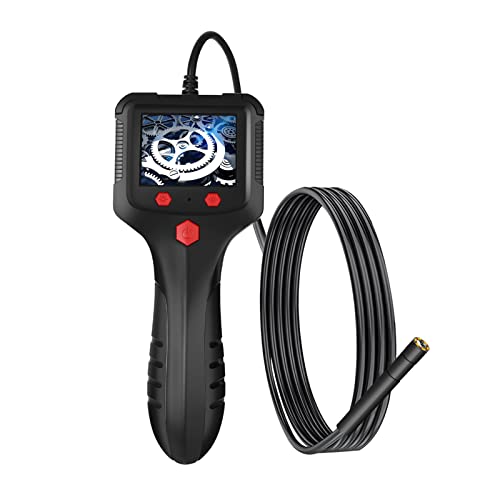
A dedicated-screen model is generally simpler to deploy because the display is built into the handheld unit. The TGJOR G50, DEPSTECH DS300SLSE, LANRU P100, Innova 3380, Poseidon AKN, and Teslong NTG450H all document an integrated screen. This format can be useful in a garage, crawl space, or workshop where using a phone may be inconvenient.
USB models connect to a computer, tablet, or phone and can suit users who want to use a larger existing display. The Klein ET16 uses a direct USB-C connection with an Android app, while the Autel MV108S identifies compatibility with Autel scanners and PCs. The Vividia D3145 and VA-980 list PC, Mac, and selected Android use. Compatibility is not universal, so verify the port, operating system, OTG requirement, or scanner model before purchase.
Recording is another important distinction. The Autel MV108S, Vividia D3145, and Vividia VA-980 list image or video capture through software or an app. The Teslong NTG450H and Poseidon AKN include recording features in their dedicated-screen systems. By contrast, the DEPSTECH DS300SLSE listing explicitly says it cannot capture photos or record video, so it is better suited to live viewing than creating an inspection record.
Evaluate lighting and viewing direction
Dark cavities require adjustable illumination. The Klein ET16, Innova 3380, Autel MV108S, and TGJOR G50 list adjustable LED lighting, while the DEPSTECH DS300SLSE lists adjustable lighting and image-orientation controls. More LEDs do not by themselves establish a brighter or clearer image, but adjustable intensity lets you adapt the view to reflective metal or a dark pipe.
Tip direction can matter more than extra cable length when the target is beside or behind the probe. The Poseidon AKN lists a plus-or-minus 175-degree sweep, the Vividia VA-980 provides continuously adjustable 0-to-180-degree articulation with locking, and the Vividia D3145 bends up to 180 degrees in one direction. The TGJOR G50 offers dual-lens front-and-side viewing, which is a different way to inspect side surfaces without a documented articulating tip. The Teslong NTG450H includes side-view mirrors for rifle-barrel inspection.
Check wet-use limitations
An IP rating applies to the part described in the listing, not necessarily the entire device. The TGJOR G50, DEPSTECH DS300SLSE, Innova 3380, Autel MV108S, and Klein ET16 list IP67 protection for the camera or lens. The Poseidon AKN specifically says IP67 applies to the probe only. That distinction matters around drains, flooded machinery, oil, and damp automotive components.
The Vividia VA-980 and D3145 listings do not provide an IP protection rating, so they should not be treated as documented wet-environment choices. The Teslong NTG450H is a rigid firearm scope and does not list waterproof protection. Always separate a waterproof camera head from a waterproof handle, cable connection, screen, or battery compartment.
Final recommendation
TGJOR G50 Dual-Lens Inspection Borescope ranks first overall in this specification-based comparison under the published weighted criteria.
The final choice among the best digital borescopes depends on the documented features that match your intended use. The TGJOR G50 is the first overall specification-based choice because its 1080P specification, dual-lens design, 16.4-foot semi-rigid probe, dedicated screen, adjustable LEDs, and IP67 protection cover a broad range of inspection tasks.
Among the top digital borescopes, the DEPSTECH DS300SLSE is a strong alternative for live viewing without a phone, while the Autel MV108S is better aligned with compatible diagnostic tablets and PCs. Choose the Innova 3380 for a shorter automotive and household tool with retrieval accessories. For directional control, consider the Poseidon AKN, Vividia VA-980, or Vividia D3145 based on screen workflow, probe diameter, and articulation style.
The Teslong NTG450H is the most specialized selection because its rigid probe and.20-caliber-or-larger rifle specification target firearm maintenance. The LANRU P100 and Klein ET16 are reach-oriented choices, with the former offering a 5-meter cable and the latter an armored 10-foot USB-C probe. No selection should be treated as a hands-on performance guarantee; this is a specification-based comparison using the supplied public listing evidence.
Frequently Asked Questions
What are the best digital borescopes for plumbing and drains?
The TGJOR G50, DEPSTECH DS300SLSE, LANRU P100, and Innova 3380 all document features relevant to plumbing or wet-area inspection. The TGJOR and DEPSTECH models use long semi-rigid cables, while the LANRU listing specifies a 5-meter cable. The Innova 3380 adds an IP67-rated lens and retrieval accessories. Compare cable reach, screen size, and whether you need recording before choosing.
Is a phone-connected or dedicated-screen borescope better?
A dedicated-screen scope such as the TGJOR G50, DEPSTECH DS300SLSE, or Innova 3380 can be more self-contained because the display is built in. USB models such as the Klein ET16, Autel MV108S, Vividia D3145, and Vividia VA-980 can suit users who already have a compatible phone, computer, tablet, or scanner. The better format depends on the devices available and whether you need a separate recording workflow.
Do all digital borescopes record photos and video?
No. The Autel MV108S, Vividia D3145, and Vividia VA-980 list image or video capture, while the Teslong NTG450H and Poseidon AKN document recording through their dedicated-screen systems. The DEPSTECH DS300SLSE listing specifically says it cannot take pictures or videos. Confirm this feature if you need inspection documentation.
What does IP67 mean on a borescope?
IP67 is a technical protection rating stated for certain camera heads or lenses in these listings. It does not necessarily cover the complete device. The Poseidon AKN listing explicitly limits IP67 protection to the probe, so users should keep the handle, display, and connections away from water unless the manufacturer separately documents protection for them.
Which probe design is useful for viewing around corners?
Articulating models provide direct directional control. The Poseidon AKN lists a plus-or-minus 175-degree sweep, the Vividia VA-980 lists lockable 0-to-180-degree articulation, and the Vividia D3145 lists one-way articulation up to 180 degrees. Dual-lens or side-view accessories can also show side surfaces, as documented for the TGJOR G50 and Teslong NTG450H, but those approaches are not the same as a steerable probe tip.