Buying Guide
The best stereo radio antennas are not interchangeable in every setup. Start with the antenna socket on the back of the receiver, then check whether the product supports FM only or includes a separate AM element. The listings in this comparison describe F-type plugs, PAL adapters, BNC adapters, 3.5mm adapters, bare-wire AM terminals, and 75-to-300-ohm conversion options. A physically well-matched antenna is easier to install than one that requires an improvised connection.
Match the antenna to the receiver
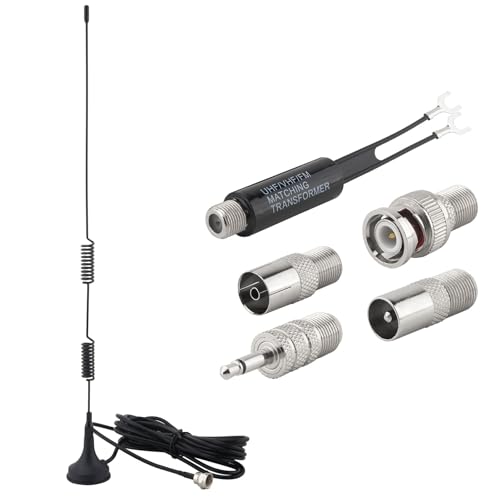
A 75-ohm FM input is common among the selected products. Bingfu’s adhesive dipole, Superbat’s adhesive dipole, the Superbat indoor dipole, Fancasee, and the AEDIKO FM section all identify 75-ohm operation. The BINGFU magnetic-base models and Kaunosta specify F-type male connections, while several include adapters for other interfaces.
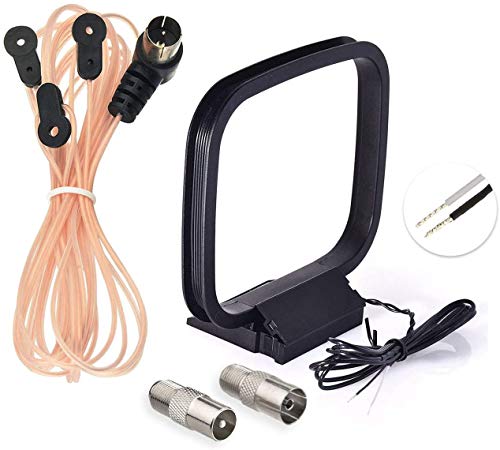
If the receiver has separate AM terminals, a combined kit may be more suitable. The Bingfu FM dipole and AM loop set uses a 75-ohm FM section plus a two-pin bare-wire AM loop. AEDIKO follows a similar arrangement with a 4.9-foot FM coax antenna and a fold-out AM loop. These designs address both bands, but the AM connection must match the receiver’s terminal layout.
Choose a mounting style
Dipole antennas are a useful choice when you can spread the antenna arms across a wall or another open indoor surface. The selected Bingfu and Superbat adhesive models use wall mounting, while the Superbat indoor dipole lists approximately 27-inch arms. Adhesive mounting keeps the antenna in a defined position, but it is not as convenient to move repeatedly as a freestanding or magnetic design.
Magnetic-base antennas offer a different approach. The Bingfu magnetic telescopic antenna and Kaunosta model can be positioned on a metal surface, and both listings recommend vertical placement on metal. This may be convenient beside a receiver, on a metal shelf, or in another suitable location. The CHHLIUT antenna also uses a magnetic base and adds a retractable element, but its connector details are less complete.
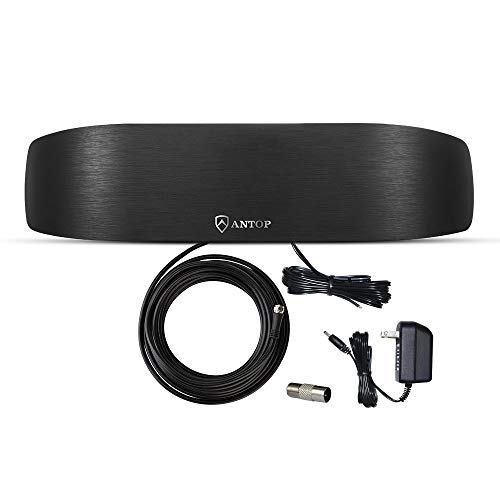
The Antop uses a compact flat-panel form and documents a multi-directional design. It also includes an amplifier and 4G filter. Those features make it a distinct option for users who want a more integrated indoor AM/FM antenna rather than a simple passive wire or dipole. The listing does not state a cable length, so plan the installation around the receiver and the antenna’s intended position.
Consider cable length and room layout
Cable reach affects where the antenna can be placed relative to the stereo. The CHHLIUT listing states a five-meter coaxial cable, the Bingfu and Superbat adhesive products specify 10 feet, and the magnetic Bingfu and Kaunosta models also list 10-foot cables. These lengths can help move the antenna away from the receiver or closer to a window, where the supplied descriptions suggest placement may help.
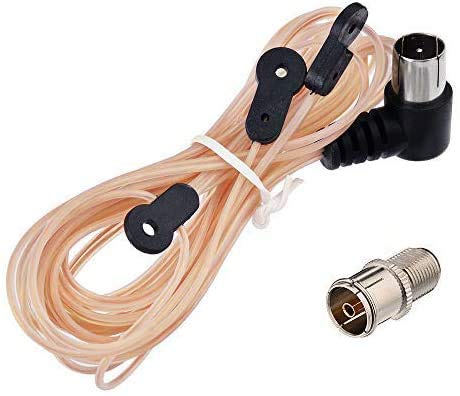
Shorter cables can still work well for tabletop systems. Fancasee and AEDIKO each list a 4.9-foot FM cable, while the Superbat indoor dipole lists 6.56 feet. Measure the likely route before choosing. Remember that the dipole arms themselves also need room, whereas a telescopic or retractable antenna occupies a more compact adjustable shape.
Decide whether AM support matters
For FM-only listening, a dedicated FM dipole, coax antenna, telescopic antenna, or magnetic-base model may provide the simpler specification match. The Fancasee, Superbat, Bingfu adhesive, Bingfu magnetic, and CHHLIUT listings focus on FM. The products should not be treated as documented AM solutions because their supplied evidence does not list AM elements.
For AM and FM receivers, choose a product that explicitly includes both. The Antop, Bingfu FM-and-AM set, and AEDIKO set document dual-band coverage. The AM components use different connection approaches, so verify whether your receiver expects a two-pin bare-wire loop or AM spring-clip connection before installation.
Check adapters before ordering
Adapter quantity alone does not establish universal compatibility, but it can reduce interface uncertainty when the adapter type matches the receiver. The Antop lists F-female and AM spring-clip compatibility, plus an IEC-male-to-F-female adapter. Kaunosta lists PAL, BNC, 3.5mm, and 75-to-300-ohm adapters. The Bingfu and Superbat adhesive kits list F-type, TV, and 3.5mm options.
The Superbat telescopic model is another documented adapter-oriented design, but it was not selected because the comparison prioritizes the stronger overall combination of installation, coverage, reach, and receiver-oriented evidence. Always compare the actual socket on the stereo with the supplied connector description rather than relying only on brand names.
Use the specifications realistically
A listing may describe improved reception, more stations, or clearer audio, but those claims are not substitutes for a measured result in your room. Reception can vary with building materials, local signal conditions, nearby electronics, antenna orientation, and location. The Bingfu adhesive listing explicitly notes that terrain, weather, buildings, and interference can affect the signal.
The most useful approach is to treat the listed mounting method, cable length, connector, impedance, and frequency coverage as planning information. Place the antenna as described, keep connections secure, and reposition it when the design allows. Do not assume that a longer cable, amplifier, or telescopic element will produce the same result in every building.
Final Recommendation
Kaunosta Magnetic Base FM Antenna ranks first overall in this specification-based comparison under the published weighted criteria.
Antop High Gain Indoor AM/FM Antenna is the first overall specification-based choice among these best stereo radio antennas because it documents dual-band coverage, amplification, a 4G filter, multi-directional design, and several connector types. It is the most feature-rich option in the supplied evidence, though its cable length is unspecified.
For a broad set of FM receiver interfaces, Kaunosta Magnetic Base FM Antenna is one of the top stereo radio antennas to consider. Its five adapters, 75-to-300-ohm option, magnetic base, and 10-foot cable give it substantial setup flexibility. CHHLIUT is a better fit when a retractable antenna and five-meter cable are the main priorities. For a fixed wall installation, the Bingfu and Superbat adhesive dipoles provide similar 75-ohm, 10-foot formats with multiple adapters.
If AM is essential, compare the Bingfu FM Dipole and AM Loop Antenna with the AEDIKO FM Coax and AM Loop Antenna Set. Both explicitly document separate FM and AM elements. Fancasee is the simplest selected option for a compatible F-type FM receiver, while the Superbat indoor dipole offers particularly clear physical dipole specifications. In every case, verify the receiver socket, terminal type, and available placement space before selecting an antenna.
Frequently Asked Questions
How do I choose the best stereo radio antennas for an F-type receiver?
First confirm whether the receiver expects a 75-ohm F-type input. Fancasee, the selected Bingfu models, Superbat’s dipoles, Kaunosta, and AEDIKO’s FM antenna document F-type-related connections. Then compare cable length, mounting style, and whether you need AM support. An adapter should only be used when its listed interface matches the receiver.
Are dipole antennas different from telescopic stereo antennas?
Yes. A dipole uses two extended antenna arms, while a telescopic model uses an adjustable rod or retractable element. The selected Bingfu and Superbat dipoles are designed for spreading across an indoor surface. Bingfu’s magnetic telescopic model and CHHLIUT’s retractable model emphasize adjustable positioning. The better design depends on available space and the receiver connection.
Which top stereo radio antennas support both AM and FM?
The selected Antop antenna documents AM/FM operation. The Bingfu FM Dipole and AM Loop Antenna includes separate FM and AM elements, and the AEDIKO set also includes an FM coax antenna and AM loop. Check the AM terminal type because the Bingfu and AEDIKO listings specify bare-wire AM connections, while Antop lists AM spring-clip compatibility.
Does a longer cable guarantee better radio reception?
No. A longer cable can make placement easier, but the supplied listings also identify location, interference, buildings, and other conditions as factors. CHHLIUT lists five meters, while several Bingfu and Superbat products list 10 feet. Cable reach is a positioning feature, not a guarantee of a particular reception result.
Can I use these antennas outdoors?
Most selected products are described primarily for indoor use. Kaunosta’s listing mentions indoor and some outdoor environments, but it also gives specific vertical-on-metal placement guidance. The other products should not be assumed to be weatherproof or outdoor-rated because that information is not supplied. Verify the installation environment and product documentation before using an antenna outside.