Buying Guide
Choosing the best wireless network antennas starts with the device, not the advertised gain number. Check the connector, the supported frequency bands, the number of antenna ports, and whether the installation is indoors, outdoors, fixed, or movable. The selected products cover replacement antennas, multi-antenna packs, magnetic-base models, low-profile pucks, and focused directional panels.
Match the connector first
Connector terminology is a frequent source of installation problems. Several selected products use RP-SMA male connectors, including Superbat, POBADY, and both Bingfu packs. The supplied listing for the Bingfu models clarifies that the RP-SMA male connector has a hole rather than a center pin. That is different from a standard SMA connection.
Stemedu and ANTOSIYA specify SMA male connectors, while Tupavco documents an N-Female connector. Eifagur uses RP-SMA male. YOTENKO includes an SMA-to-RP-SMA adapter, which may help in some installations, but the device-side connector should still be checked before selection. Connector adapters do not automatically resolve every mechanical or electrical mismatch.
Choose the right frequency coverage
Most of the selected models cover 2.4GHz and 5GHz or 5.8GHz. That includes Eifagur, Tupavco, YOTENKO, POBADY, Stemedu, ANTOSIYA, and the Bingfu options. Dual-band coverage is appropriate when the network hardware operates on those common Wi-Fi ranges.
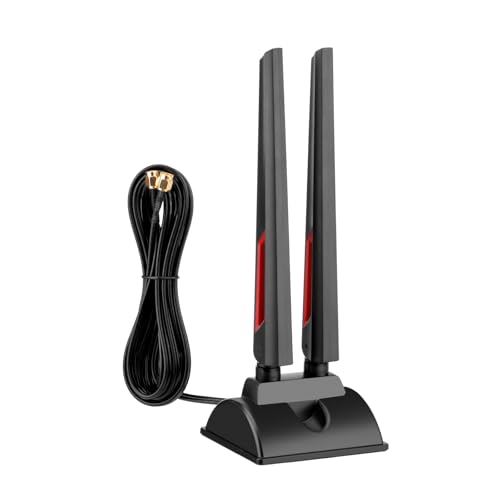
Superbat is the only selected model with documented 6GHz support. Its listing also identifies Wi-Fi 6E compatibility, so it is the clearest match for a modern device that can use the 6GHz band. A tri-band antenna cannot add 6GHz capability to hardware that does not support that band; it only provides antenna coverage for compatible equipment.
Decide between omnidirectional and directional designs
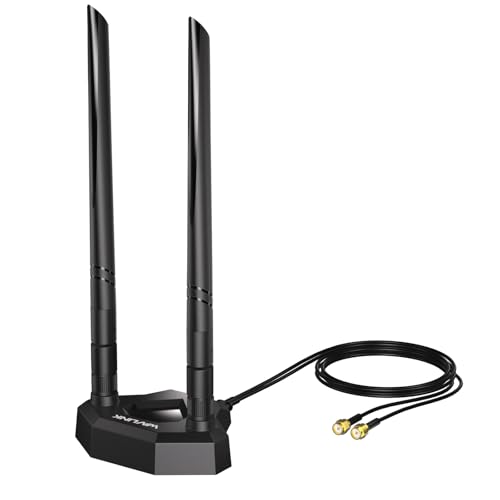
Omnidirectional antennas radiate around the antenna and are generally easier to position for coverage in an area. Superbat, POBADY, YOTENKO, Stemedu, and the Bingfu products document omnidirectional operation. This form is useful when the receiving devices are distributed around a room, desk, enclosure, or general workspace.
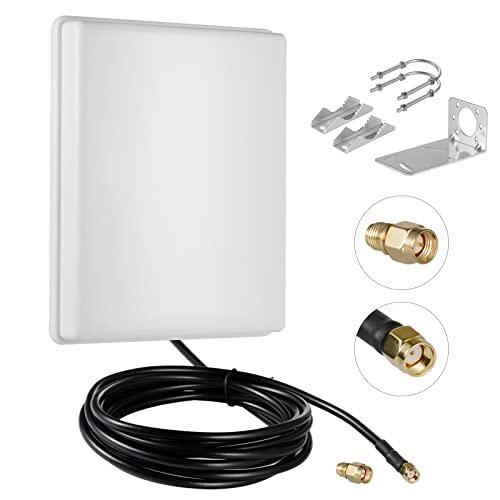
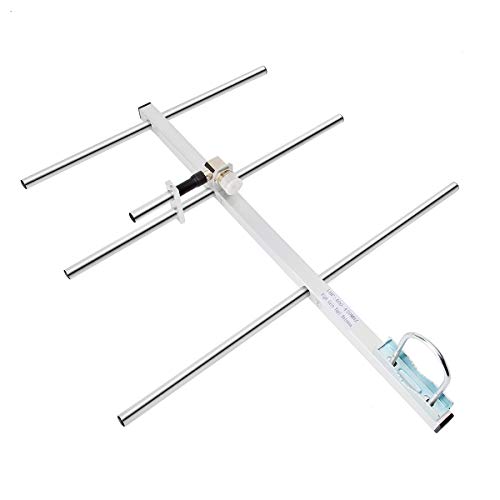
Directional antennas concentrate energy toward a chosen direction. Eifagur and Tupavco use panel designs, while ANTOSIYA uses a PCB Yagi design. These products are more appropriate when the target is known, such as a remote access point, a building-to-building path, or a camera located in a specific direction. Directional placement usually requires more deliberate orientation than an omnidirectional replacement.
Interpret gain with the antenna pattern
Gain should be considered together with coverage pattern and installation. Eifagur lists 15dBi, Tupavco lists 13dBi, ANTOSIYA lists 12dBi at 2.4GHz, and Stemedu lists 12dBi. Those figures are not directly interchangeable because the products use different designs, bands, and connector arrangements.
The selected Bingfu models list 9dBi and 8dBi, while POBADY lists 8dBi. YOTENKO documents a puck design and presents different gain figures for specific contexts. Eightwood does not state gain in the supplied listing, so it is ranked for band support, cable length, base, and adjustability rather than an unsupported gain comparison.
A higher stated gain can accompany a narrower directional pattern. If the goal is general room coverage, an omnidirectional model may be easier to use. If the goal is a fixed remote point, a directional panel or Yagi may make more sense on paper.
Consider mounting and cable length
Cable length affects where the antenna can be placed relative to the network device. Eifagur supplies 10 feet, Bingfu’s 9dBi pack supplies 10 feet per antenna, Eightwood supplies 6.5 feet, and Superbat supplies 6 feet. POBADY and YOTENKO document approximately 4.9 feet or 1.5 meters. Longer cables can help move an antenna away from a desktop computer or enclosure, but the connector and cable type still need to suit the installation.
Magnetic bases appear on Superbat, POBADY, Eightwood, and the Bingfu 9dBi pack. They are useful on compatible metal surfaces and allow repositioning without a permanent mount. YOTENKO uses a screw-mount puck and documents IP66 protection, making it a more enclosure-oriented choice. Eifagur and Tupavco are outdoor-oriented panel antennas; Tupavco includes pole-mount hardware, while the pole is separate.
Check how many antennas the device needs
A two- or four-pack may be appropriate for a router or wireless card with multiple antenna ports. The Bingfu 9dBi and 8dBi selections each include four antennas, while Stemedu supplies two. A single antenna cannot replace every antenna in a multi-port system unless the device documentation allows that arrangement.
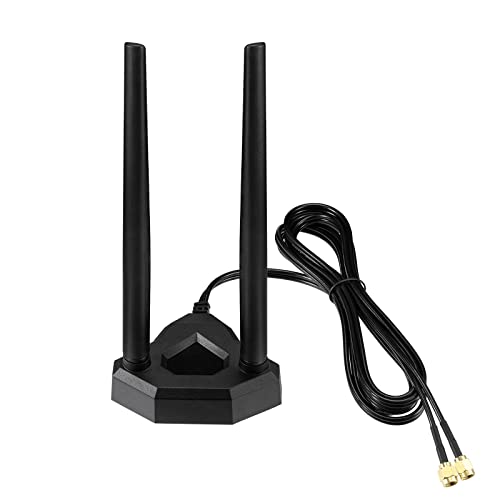
Also distinguish a complete antenna from a kit that includes pigtail cables. Stemedu is a two-antenna set, while the supplied data for some other products includes adapters or cables for specific interfaces. Eightwood’s kit is documented for Mini PCIe and explicitly excludes M.2 NGFF cards. That kind of interface note is more important than a general compatibility claim.
Final Recommendation
Eifagur 15dBi Dual-Band Outdoor Panel Antenna ranks first overall in this specification-based comparison under the published weighted criteria.
Superbat WiFi 6E Tri-Band Magnetic Base Antenna is the first overall specification-based choice among these best wireless network antennas because it combines 2.4GHz, 5GHz, and 6GHz support with an omnidirectional pattern, a 6-foot cable, and magnetic placement. For a fixed outdoor link, Eifagur and Tupavco provide documented directional panel designs, high gain, and weather-oriented construction. YOTENKO is the more compact enclosure-focused option, while ANTOSIYA offers a directional PCB Yagi format.
The top wireless network antennas are not interchangeable: select by connector and port count before comparing gain. Choose Bingfu’s four-packs for compatible multi-antenna equipment, Stemedu when SMA connectivity and a two-antenna set fit the system, and POBADY or Eightwood when flexible indoor placement matters. The final decision should follow the network device’s manual and the physical installation requirements.
Frequently Asked Questions
Are the best wireless network antennas compatible with every router?
No. Compatibility depends on the connector, supported bands, antenna ports, and device design. RP-SMA models such as Superbat, Eifagur, POBADY, and Bingfu are not automatically interchangeable with SMA products such as Stemedu or ANTOSIYA. Check whether the connector has a center pin or hole and verify the required interface before installing an antenna.
Is a directional antenna better for general home coverage?
Not necessarily. Eifagur, Tupavco, and ANTOSIYA document directional designs that focus coverage toward a chosen direction. That can suit a remote access point or fixed camera, but an omnidirectional model such as Superbat, POBADY, or Eightwood may be easier for devices spread around a general area.
What is the advantage of Superbat’s 6GHz support?
Superbat documents support for 2.4GHz, 5GHz, and 6GHz Wi-Fi 6E. The 6GHz capability is relevant only when the connected network hardware also supports Wi-Fi 6E and uses the correct RP-SMA interface. It does not upgrade a router or wireless card that lacks 6GHz capability.
Do four-antenna packs work with every wireless card?
No. A four-pack is intended for equipment with compatible antenna ports and connector requirements. The Bingfu 9dBi and 8dBi packs document four RP-SMA male antennas, but the device may need a different count, connector, or cable arrangement. Confirm the hardware layout before choosing a multi-antenna pack.
Should an outdoor antenna be weatherproof?
For exposed placement, weather-oriented construction is important to consider. Eifagur documents an outdoor waterproof panel, Tupavco lists weatherproof housing and corrosion-resistant materials, and YOTENKO documents IP66 protection. Indoor antennas and kits without stated weather protection should not be assumed suitable for direct outdoor exposure.