Buying Guide
The best template power tool accessory jigs are selected by matching the guide’s documented job, size range, and tool requirements to the project. A door-hinge mortising template is not interchangeable with a pocket-hole fixture or cabinet-hardware locator, even though all are marketed as woodworking jigs. Start with the operation, then check the adjustment system, construction, included accessories, and any stated limits.
Match the jig to the operation
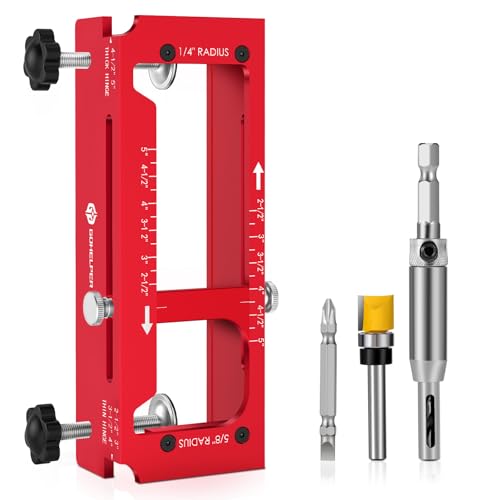
For door work, the Crafom, Matework, Gohelper, Milescraft, and Mengshi designs are the most directly relevant choices in this comparison. Crafom and Gohelper cover broad hinge-length ranges and support multiple hinge profiles. Matework and Gohelper document depth gauges, while Milescraft includes a ball-bearing-guided router bit and is specifically described for doors and jambs. Mengshi is more focused on 5.5-inch concealed hinges.
For European-style cabinet hinges, the Kreg KHI-HINGE uses a dedicated 35mm cup-drilling format and adjustable offsets. That specialization is useful when the hinge hardware is known in advance. It also means the jig is not a general-purpose door mortising template.
Pocket-hole projects call for a different layout. The Kreg 720PRO is specified for material from 1/2 to 1.5 inches thick, while the BORA Compact Metal Pocket-Hole Jig Pro emphasizes automatic calibration and a compact package. These fixtures guide angled joinery holes rather than router cuts, so compare them by material setup and included drill components instead of hinge range.
The BLEKOO jig is intended for self-centering doweling and straight-hole work. Joykiss is a specialty router jig for cutting-board juice grooves. These focused tools can be more suitable than a broad template when the project repeats one defined operation.
Check fit range and adjustment
Range matters when dimensions vary between jobs. Crafom documents 2.5- to 5-inch hinge lengths, and Matework and Gohelper document comparable broad door-hinge coverage, although their stated door and jamb limitations differ. Milescraft is narrower at 3 and 3.5 inches but has a clear standard-hinge purpose. Mengshi lists one 5.5-inch hidden-hinge template size.
Look for the exact adjustment type, not just the word adjustable. Kreg KHI-HINGE lists four hinge offsets. Joykiss gives two large work-area ranges and includes spacers for groove placement. BLEKOO uses self-centering alignment and laser-etched scales. Those details show how the jig is intended to establish position.
Consider construction and stability
An aluminum body appears on the Crafom, Matework, Gohelper, and BLEKOO listings. Crafom and Gohelper specifically describe anodized finishes, while Matework also lists non-slip silicone pads for door-slab contact. These documented features may matter when a template must stay aligned against a finished surface.
The Joykiss guide uses HDPE and an L-shaped structure, with a smooth surface described for router movement. Kreg’s 720PRO lists an anti-slip surface, adjustable clamping, and supplied screws. BORA lists anti-slip pads. These are design features, not proof of performance under every condition, so secure the workpiece and follow the manufacturer’s instructions.
Tool compatibility can determine whether a jig is usable immediately. Milescraft includes a 1/2-inch ball-bearing-guided router bit. Matework and Gohelper list router and self-centering hinge bits, and Mengshi states compatibility with most router tools without specifying a bit package. Kreg KHI-HINGE is designed for a hand drill and includes a carbide-tipped boring bit with a stop collar.
Pocket-hole systems commonly rely on a drill and supplied guide hardware. BORA includes a square pocket-hole bit and stop collar, while Kreg 720PRO includes a drill guide and screws. BLEKOO is paired with a power drill and guide bushings. Confirm whether your existing drill, router, bit diameter, and material thickness match the listing before buying.
Balance specialization against flexibility
A specialized jig can provide clearer boundaries and fewer layout decisions. The Kreg concealed-hinge model, Joykiss juice-groove jig, and BLEKOO doweling jig each target a defined task. A broader model such as Crafom may better suit varied door hinge sizes, but it can require additional setup choices. The right balance depends on whether you repeat one operation or handle different dimensions.
Final recommendation
Matework Anodized Aluminum Door Hinge Jig ranks first overall in this specification-based comparison under the published weighted criteria.
Crafom Adjustable Aluminum Door Hinge Jig is the first overall specification-based choice among these selections. Its broad hinge-length coverage, aluminum construction, and support for several hinge profiles make it the most flexible door-focused option in the comparison. The best template power tool accessory jigs still need to match the job: choose Matework or Gohelper when a depth gauge and supplied bits matter, Milescraft for documented door-and-jamb work, or Mengshi for a 5.5-inch concealed hinge.
For cabinet and furniture work, Kreg KHI-HINGE, Kreg 720PRO, BORA, and BLEKOO cover distinct drilling and joinery needs. Joykiss is the focused choice for cutting-board grooves. Among the top template power tool accessory jigs, the most specification-aligned fit is the one whose stated dimensions, drill or router requirements, and included parts align with the material in front of you.
Frequently Asked Questions
Identify the hinge length, corner profile, door thickness, and whether the task is on a door slab or jamb. Crafom documents 2.5- to 5-inch hinges and several profiles. Matework and Gohelper also cover broad hinge sizes but state door-slab limitations. Milescraft specifically lists both doors and jambs, while Mengshi is aimed at 5.5-inch hidden hinges.
Are these jigs used with a router or a drill?
It depends on the design. Several door templates are described for router use, and Milescraft, Matework, and Gohelper list router-related bits. Kreg KHI-HINGE is a hand-drill 35mm cup-boring jig. BLEKOO and Kreg 720PRO are drilling guides, while BORA is a pocket-hole system that uses drill-guided joinery components.
What does a built-in depth gauge add?
A depth gauge provides a documented reference for setting the cut or bore depth before starting. Matework and Gohelper list built-in depth gauges for their door-hinge kits. Kreg KHI-HINGE uses a stop collar on its boring bit. These features support setup, but they do not replace checking the hinge, bit, door thickness, and manufacturer instructions.
Which selected jig is suited to concealed cabinet hinge installation?
Kreg KHI-HINGE is specifically designed for 35mm European-style concealed cabinet hinges. It supports 3mm, 4mm, 5mm, and 6mm hinge offsets and includes a four-cutter carbide-tipped bit with a stop collar. Its focused design is preferable when the cabinet hardware uses that documented cup size.
Is a larger adjustment range always better?
No. A larger range can accommodate more dimensions, but a specialized jig may provide more relevant positioning controls for one task. Joykiss gives a large cutting-board work area, while Kreg KHI-HINGE focuses on 35mm concealed hinge cups and defined offsets. Select the documented range that covers your project without treating breadth alone as proof of better results.