Buying Guide
Choosing the best bearing joinery router bits starts with identifying how the guide will control the cut. A bearing may follow a template, ride along an edge, or set the outside boundary of a slot or profile. Those uses are not interchangeable. A rabbeting bit is aimed at a shoulder or recess, a dovetail bit works with a jig or guide arrangement, a slot cutter creates a defined groove, and a flush-trim bit follows a pattern to duplicate its edge.
The products in this comparison were selected from listing titles, feature statements, and technical specifications. They were not physically tested. That distinction matters because the evidence can establish dimensions, stated materials, cutter construction, and intended applications, but it cannot establish actual cut quality, service life, vibration, or ease of setup in a particular router.
Match the bit to the joint
For adjustable rabbets, the Freud 32-504 is the most flexible documented option. Its interchangeable bearings cover depths from 1/8 inch through 1/2 inch, making it suitable for different back-panel and furniture-joint requirements. The Freud 32-522 covers four deeper settings from 5/16 inch to 1/2 inch and uses a 1/2-inch shank. That larger shank can be useful where supported, but it is not a substitute for a 1/4-inch-collet bit.
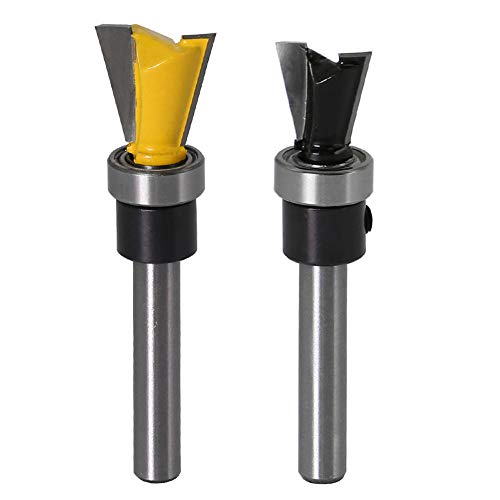
Dovetail work calls for a different profile. The Yakamoz Dovetail Joint Router Bit Set includes two bearing-guided cutters and documents separate cutting depths of 1/2 inch and 9/16 inch. Check the dimensions of the jig, stock, and intended dovetail before routing. A bearing guide helps maintain the relationship to the jig, but it does not remove the need to set the bit height and verify the layout.
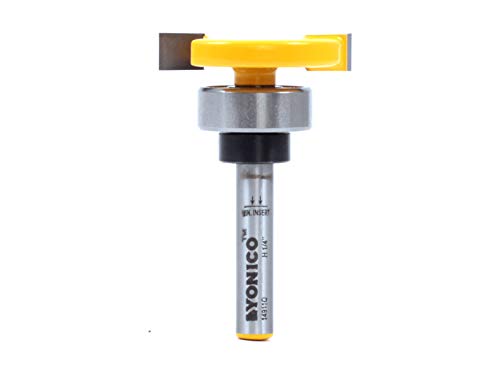
For a defined groove, the Yonico Top Bearing Slot Cutter is more focused. It cuts a stated 1/4-by-1/4-inch slot. That specificity is helpful when the joint or spline specification is already known, but it also means the bit is less adaptable than an adjustable rabbeting set.
Compare bearing position and reach
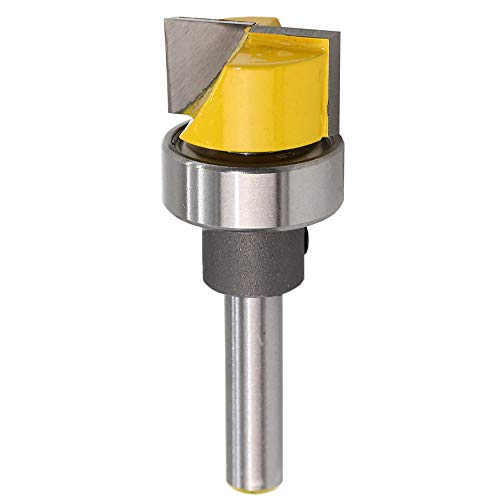
Bearing location affects how the bit interacts with a template or edge. The Yonico Top Bearing Slot Cutter and the Freud 50-102 are explicitly described as top-bearing designs. The Yakamoz Hinge Mortising Template Bit is intended for hinge templates and shallow cutouts, while the Whiteside 3001 uses a bearing guide on the shank for template or flush cutting.
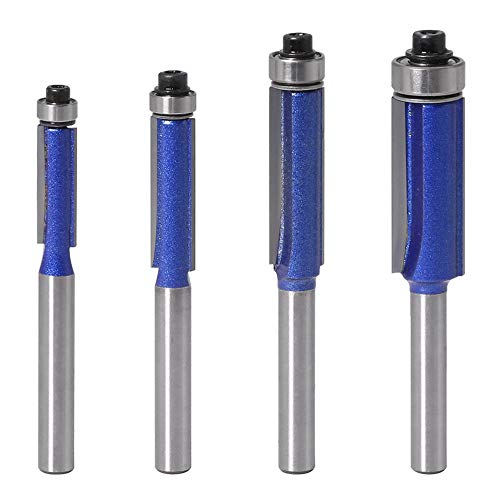
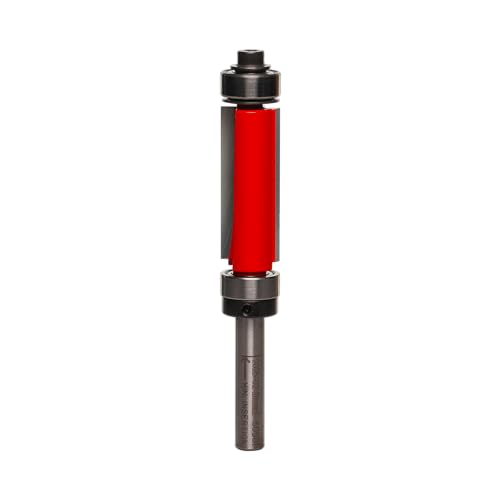
Reach is just as important as bearing position. The Newdeli Pattern Flush Trim Bit Set offers four cutting lengths from 3/8 inch to 1-1/2 inches while keeping a 1/2-inch cutting diameter. This can help when a pattern or template has different thicknesses. The Wolfride Four-Piece Flush Trim Set takes a different approach by offering four cutting diameters from 1/4 inch to 1/2 inch. The FivePears bit is a single fixed option with a 1/2-inch diameter and 1/2-inch cutting length.
Before choosing, compare the template thickness, the material that must be removed, and the clearance around the workpiece. A longer cutter is not automatically preferable; it may expose more cutting edge than the job requires. Likewise, a larger diameter may not fit a narrow recess or curved template detail.
Check shank and router compatibility
Most selected products use a 1/4-inch shank, which is common on compact and portable routers. The Freud 32-522 is the exception in this group, with a 1/2-inch shank. Confirm the router collet size before buying, and insert the shank as directed by the router and bit manufacturer.
Router mounting also matters. Several selected listings specify handheld and table-mounted use, including the Freud 32-504, Freud 32-522, Whiteside 3001, Yonico Top Bearing Slot Cutter, and Freud 50-102. The FivePears listing additionally mentions automatic routers. These statements describe intended compatibility, not a guarantee that every router setup will suit every dimension. Collet capacity, speed control, workpiece support, and the manufacturer’s operating instructions remain important.
Consider cutter and body construction
The evidence includes several construction details that can help narrow a specification-based choice. The Whiteside 3001 uses a steel body, carbide cutting edges, and a double-flute configuration. The Freud 32-504 and Freud 50-102 provide carbide-related construction details, with the latter listing Perma-SHIELD coating. The Yakamoz Hinge Mortising Template Bit specifies C3 micro-grain tungsten carbide cutters, a solid hardened steel body, and two flutes.
Other selected products document industrial-grade or precision-ground carbide cutters, heat-resistant coatings, or anti-kickback designs. These are useful features to compare, but they should not be turned into unsupported promises about finish quality or longevity. Use the stated speed limits where supplied, secure the workpiece, and make settings appropriate to the material and router.
Pick a set or a single-purpose bit
A set can reduce the need to buy separate profiles. The Freud 32-504 provides several rabbet depths through interchangeable bearings. The Wolfride and Newdeli sets provide either diameter or cutting-length variety for pattern trimming. The Yakamoz dovetail set supplies two dovetail sizes.
A single-purpose bit can be easier to specify and store. The Yonico slot cutter, Freud 50-102, Yakamoz Hinge Mortising Template Bit, and FivePears bit each target a more defined task. For occasional repair or a single furniture design, a fixed profile may be more practical than a set with unused pieces. For varied cabinet, furniture, or template work, dimensional flexibility may justify the additional setup and organization.
Final recommendation
Freud 32-504 Rabbeting Bit Set ranks first overall in this specification-based comparison under the published weighted criteria.
Freud 32-504 is the first overall specification-based choice among the best bearing joinery router bits because its interchangeable bearings cover the broadest documented rabbet range while retaining handheld and table-mounted compatibility. It is the most specification-aligned fit for a buyer who wants one adjustable rabbeting setup for furniture and cabinet work.
The Freud 32-522 is a good alternative for deeper rabbets when a 1/2-inch shank is suitable. For template duplication, the Whiteside 3001 offers clear dimensions and a shank-mounted bearing guide. The Yakamoz Dovetail Joint Router Bit Set is the more focused choice for dovetail-jig work, while the Yonico Top Bearing Slot Cutter fits a defined quarter-inch slot.
Among the top bearing joinery router bits, the Wolfride Four-Piece Flush Trim Set provides the most diameter variety, and the Newdeli Pattern Flush Trim Bit Set provides the most cutting-length variety. Choose the Yakamoz Hinge Mortising Template Bit for its named hinge application. The Freud 50-102 and FivePears are straightforward fixed-profile options when a 1/2-inch flush-trim diameter matches the template.
Frequently Asked Questions
What are the best bearing joinery router bits for rabbets?
The Freud 32-504 is the most adaptable documented choice because its interchangeable bearings cover 1/8- to 1/2-inch rabbet depths. The Freud 32-522 is better aligned with deeper 5/16- to 1/2-inch rabbets and uses a 1/2-inch shank. Verify the desired shoulder depth and router collet before selecting either one.
How do I choose between a flush-trim set and a single bit?
Choose a set when your templates vary in diameter or thickness. The Wolfride Four-Piece Flush Trim Set varies cutting diameter, while the Newdeli Pattern Flush Trim Bit Set varies cutting length. Choose the Freud 50-102 or FivePears when a fixed 1/2-inch profile matches the job and you prefer a simpler selection.
Are top bearing joinery router bits suitable for handheld routers?
Several selected products state compatibility with handheld routers, including the Freud 32-504, Whiteside 3001, Yonico Top Bearing Slot Cutter, and Freud 50-102. That does not eliminate setup requirements. Secure the template or workpiece, confirm the collet and speed range, and follow the bit and router instructions.
Which bit is intended for hinge mortises?
The Yakamoz Hinge Mortising Template Bit is specifically listed for routing door hinge mortises with a hinge template. Its documented 3/4-inch cutting diameter and 7/16-inch cutting length make it a focused option for shallow cutouts. Compare those dimensions with the hinge and template before cutting.
The supplied listings generally identify wood, MDF, plywood, particle board, composites, or similar materials. Some explicitly say to avoid steel, iron, sand, or other non-wood materials. Do not assume a wood joinery bit is suitable for metal; use only materials and operating conditions supported by the product documentation.