Buying Guide
Choosing the best 12v trolling motors starts with the boat rather than the motor label. A 12V system normally uses one 12V battery, but the required thrust, shaft length, mount, and control method vary significantly between a kayak, a jon boat, and a larger fishing boat. The products above are compared from supplied public listing data; they were not hands-on tested, and this guide does not summarize customer opinions.
Confirm the electrical setup
Every selected motor is identified as a 12V model, so the battery system is the first compatibility check. The supplied listings do not provide a single universal battery recommendation for every motor. The VEVOR listing explicitly says a 12V motor requires one 12V battery, while the Newport Kayak Series identifies a 12V lead-acid setup. Confirm battery type, capacity, wiring, and circuit protection against the manufacturer’s instructions before installation.
The battery indicator can be useful when planning a trip, but it is not a substitute for correct battery sizing. Only selected products are discussed here; models without that feature should not be assumed to include it.
Match thrust to the hull and conditions
The selected group ranges from 45 lb to 65 lb of listed thrust. More thrust can be useful for heavier loads, wind, or current, but the listing data does not establish a universal boat-size formula. Newport specifically positions its 62 lb NV-Series for larger boats, heavier loads, wind, and current. The 50 lb Minn Kota Endura C2 and 55 lb choices occupy a middle range for general fishing craft, while 45 lb Edge models may be appropriate when a smaller freshwater boat favors a lighter, simpler setup.
Avoid treating thrust as a speed guarantee. Newport states that speed depends on boat shape, weight, water, and wind, and the VEVOR listing gives the same type of qualification. Propeller design also matters for use conditions. The Minn Kota Edge and Endura C2 listings document Power Props for heavy vegetation, while the Newport NV-Series and VEVOR list three-blade propellers.
Choose bow mount or transom mount
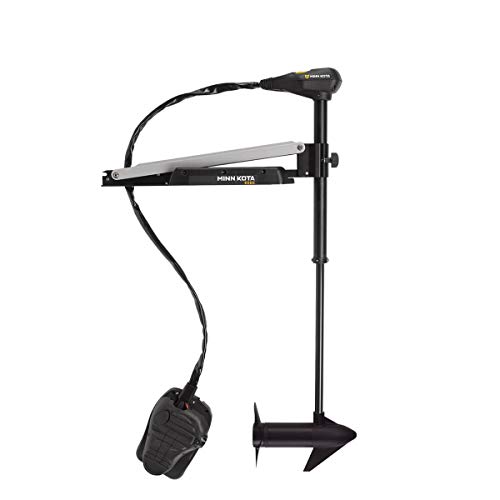
Bow-mount motors place the motor at the front of the boat and can be useful when anglers want to pull or position the boat from the bow. The Minn Kota Terrova, both selected Haswing Cayman products, and both Minn Kota Edge models are bow-mount designs. Terrova adds GPS-assisted Spot-Lock and other navigation modes; the Haswing models provide wireless control and cruise control; the Edge models use manual foot or tiller control.
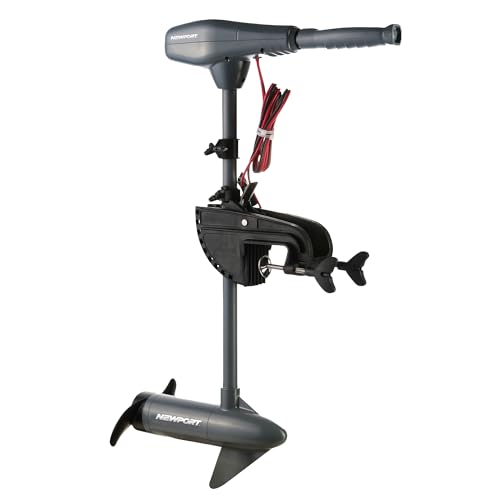
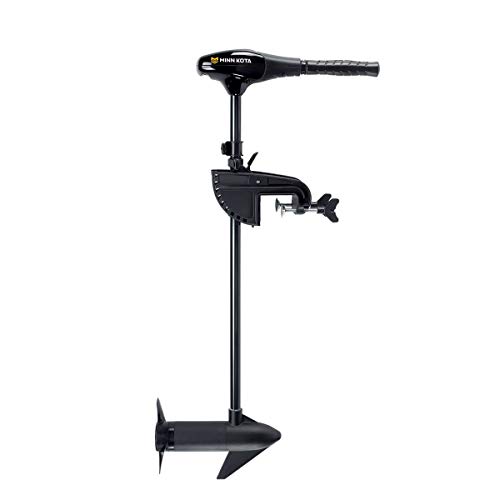
Transom-mount motors attach at the rear and are common on kayaks, canoes, inflatables, and small boats. The AQUOS brushless model, Newport NV-Series, Minn Kota Endura C2, Newport Kayak Series, and VEVOR are transom options. A transom motor may be the more straightforward choice when the boat already has a rear motor bracket. Check the transom shape, mounting clearance, steering position, and cable route before ordering.
Select the right shaft length
Shaft length determines how deeply the motor sits in the water and should match the boat’s mounting height and typical water conditions. The selected products document lengths from the Newport Kayak Series’ 24-inch shaft to the Haswing and AQUOS bow models’ 48-inch shafts. VEVOR lists a 30-inch shaft, while the Newport NV-Series and Minn Kota Endura C2 list 36 inches.
A short shaft can be useful on a kayak or low transom, but it may not reach far enough on a taller boat. A longer shaft may provide depth for bow mounting, yet it can add bulk or be inconvenient on a compact craft. The Minn Kota Edge hand-control model’s 45-inch shaft and Terrova’s 54-inch shaft illustrate why bow-mount height needs careful measurement rather than guesswork.
Decide how much control you need
Control style changes the fishing experience. The Terrova is the most electronically advanced selection, with Spot-Lock, Jog, drift, follow, and dodge modes plus a wireless LCD remote. The Haswing Cayman models also use wireless remotes, but their listings clearly state that cruise control is not Spot-Lock and may require manual direction correction in wind or current.
Manual controls remain useful when simplicity is more important than automated positioning. The Minn Kota Edge foot-control model uses a heel-toe cable-steer pedal, while the Edge hand-control model uses a twist-grip tiller. The Endura C2, Newport models, AQUOS transom model, and VEVOR use transom-oriented controls with multiple forward and reverse settings. Stepless control, documented on the AQUOS brushless model and Haswing products, can offer finer adjustment than fixed speed steps, although the supplied data does not quantify real-world performance.
Consider water type and construction
Freshwater and saltwater compatibility should be treated as a firm selection filter. The Haswing Cayman models, AQUOS brushless transom motor, Newport NV-Series, Newport Kayak Series, and VEVOR explicitly support both freshwater and saltwater. The Minn Kota Terrova and Edge products are listed for freshwater. Do not assume a freshwater-only model is suitable for saltwater without manufacturer confirmation.
Construction details can support maintenance planning. The Haswing models document a sacrificial anode, Newport lists corrosion-resistant metals, and VEVOR specifies a sealed waterproof aluminum motor head. These are specifications, not guarantees of service life. Rinse and maintain any motor according to its manufacturer’s instructions, especially after saltwater use.
Compare monitoring, storage, and handling details
A battery indicator helps you monitor available power during a trip. Adjustable shafts and telescoping handles can improve fit and control, while a quick-release bracket or latch-and-door bracket can make removal easier. The Terrova documents one-touch stow and deploy; the Haswing products include a lifting handle and foot-operated stow-and-deploy pedal; the Minn Kota Edge models use a latch-and-door bracket.
Weight and storage also deserve attention. Terrova is listed at the current price, whereas the Newport Kayak Series and VEVOR are listed at 23 and the current price respectively. Listing weights may not use identical measurement conventions, so treat them as reference points rather than a perfect cross-brand comparison.
Final Recommendation
Minn Kota Terrova 55 lb GPS Bow-Mount ranks first overall in this specification-based comparison under the published weighted criteria.
Minn Kota Terrova is the highest-scoring returned product and the first overall specification-based choice among the best 12v trolling motors. Its documented GPS positioning, wireless LCD remote, navigation modes, variable speed, 55 lb thrust, and 54-inch shaft create the broadest control package in this comparison. It is best suited to anglers who can accommodate a substantial bow-mount system and want electronic positioning features.
For a transom installation, the Newport NV-Series 62 lb motor is a strong specification-based alternative when higher listed thrust, saltwater construction, a 36-inch shaft, and battery monitoring matter. Kayak owners should look first at the Newport Kayak Series because its 24-inch shaft is specifically documented for kayak use. The Minn Kota Edge foot-control model is the simpler freshwater bow choice for anglers who prefer direct cable-steer control.
The top 12v trolling motors are not interchangeable. Confirm shaft reach, mounting space, battery requirements, water type, and desired control method before choosing. A motor with more features is not automatically the right fit if its shaft or mount does not match the boat.
Frequently Asked Questions
Among the best 12v trolling motors, are 12V trolling motors suitable for kayaks?
Some are. The Newport Kayak Series documents a 24-inch shaft and kayak-focused design, while VEVOR lists kayaks among its compatible watercraft and provides a 30-inch shaft. Check the kayak’s motor mount, transom height, battery location, and allowable equipment weight. A longer bow-mount model such as Minn Kota Terrova may be impractical on a compact kayak even though it is a capable motor.
How do I choose between a bow mount and a transom mount?
Choose based on the boat’s mounting hardware and how you steer. Bow mounts such as the Haswing Cayman models and Minn Kota Edge models place control at the front and can suit anglers who want bow-oriented positioning. Transom models such as the Newport NV-Series and Minn Kota Endura C2 attach at the rear and are often simpler for small boats. Measure the mounting surface and shaft reach before deciding.
Do all 12V motors work in saltwater?
No. The supplied listings identify saltwater suitability for the Haswing Cayman models, AQUOS brushless transom motor, Newport NV-Series, Newport Kayak Series, and VEVOR. The Minn Kota Terrova and Edge listings specify freshwater. The correct choice depends on the manufacturer’s stated environment; do not infer saltwater compatibility from thrust or voltage alone.
Is GPS positioning the same as cruise control?
No. Minn Kota Terrova documents Spot-Lock and related navigation modes. The Haswing Cayman listings document cruise control and specifically state that it is not Spot-Lock, with possible manual directional correction in wind or current. These are different control functions, so decide whether you need automated position holding or speed maintenance.
What shaft length should I buy?
Measure from the mounting surface to the water and compare that distance with the motor’s documented shaft length. Selected examples range from the Newport Kayak Series’ 24-inch shaft to Terrova’s 54-inch shaft. A kayak or low transom may need a shorter shaft, while a bow mount on a taller boat may need more reach. The supplied listings do not provide one universal shaft formula.