Buying Guide
The best usb digital voice recorders differ by how they handle capture, file transfer, storage, and review. Every model in this comparison is presented as a standalone recorder rather than an accessory or replacement part. The specifications come from public product listings, so stated operating times, storage-hour counts, and noise-reduction descriptions are listing claims rather than independent test results.
Start with the connection type
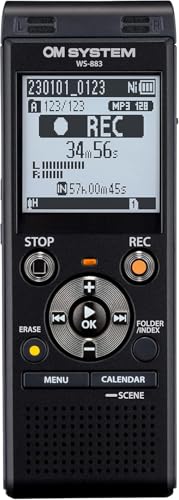
USB access matters because it determines how recordings move to a computer or compatible mobile device. The OM SYSTEM WS-883 lists a built-in USB terminal for direct connection to a PC and charging the supplied battery. The Yegolito recorder and KASHEVI KL150 specifically document USB-C access. The Sbwwas LX189 also lists USB-C connectivity and says it can connect to a PC or phone, while the Moresen Z35 lists Type-C charging and USB drive functionality.
The Sony ICD-PX370 explicitly describes a built-in direct USB connection for transfer to a PC. EVISTR lists a Type-C cable, and JAWPLOY lists USB transfer, although the supplied evidence does not identify every connector standard in the same detail. If your computer uses USB-A, USB-C, or a phone connection, confirm the required adapter or cable before choosing.
Match microphone and audio features to the setting
A meeting, classroom, or interview can place speakers at different distances and angles. Stereo microphone documentation is especially clear on the OM SYSTEM WS-883 and Sony ICD-UX570. The WS-883 lists a 90-degree stereo microphone system, while the Sony model provides wide/stereo, narrow/focus, and normal recording choices. Those controls are useful to compare when you need broader room coverage or a more focused pickup pattern, although the listing data does not establish real-world results.
Several compact models list 360-degree or omnidirectional pickup. Yegolito specifies a 360-degree omnidirectional microphone, and MayBest and VEVARUN describe 360-degree sound pickup. EVISTR lists a dynamic noise-reduction microphone and adjustable recording gain. KASHEVI combines a 360-degree microphone with an intelligent noise-cancellation chip. These descriptions identify advertised design features, but they do not replace testing in a particular room.
Noise reduction appears across several listings, including the OM SYSTEM WS-883, EVISTR L357, MayBest UL101, VEVARUN recorder, KASHEVI KL150, Yegolito recorder, JAWPLOY J12, Sbwwas LX189, and Moresen Z35. The systems are described differently, from noise cancellation and low-cut filtering to DSP, intelligent, or triple noise reduction. Compare the exact wording and avoid assuming that similarly named features perform identically.
Decide whether voice activation helps
Voice activation can start or resume recording when sound is detected, which may reduce silent sections. The Sony ICD-UX570 lists voice-operated recording. Yegolito, KASHEVI, VEVARUN, EVISTR, JAWPLOY, Sbwwas, and MayBest also document voice activation or voice-activated modes. Some provide extra controls: KASHEVI lists seven sensitivity levels, EVISTR lists seven levels of voice-control sensitivity, and VEVARUN identifies a 45 dB threshold.
This feature is not always the right setting. A quiet speaker, a low voice, or intermittent sound may interact differently with the activation threshold. For continuous proceedings where every pause matters, a standard recording mode may be more appropriate. The KASHEVI, Yegolito, and JAWPLOY listings also document continuous recording modes or continuous recording figures, giving those models more flexibility when switching between modes.
Compare storage claims carefully
Internal capacity is stated as 8GB on the OM SYSTEM WS-883, 64GB on EVISTR, MayBest, VEVARUN, and JAWPLOY, 72GB on Yegolito, and 128GB on KASHEVI, Sbwwas, and Moresen. More capacity can reduce the need to transfer files frequently, but the advertised number of hours depends on bitrate and recording format.
The listings illustrate this clearly. EVISTR gives a maximum-hour figure at 32 kbps, while KASHEVI gives a separate storage figure at 518 kbps. Sbwwas states 9,800 hours at 32 kbps, and Moresen states 9,860 hours. Those figures should not be compared as though they represent the same audio setting. WAV and higher-bitrate files use storage differently from lower-bitrate recordings, but the supplied evidence does not provide a universal runtime calculation for every model.
Look at controls and playback
One-touch or one-switch operation is documented on the WS-883 through Simple Mode, Yegolito, MayBest, VEVARUN, Sbwwas, and Moresen. This can make starting and saving a session more direct. EVISTR lists A-B repeat, rewind, and variable-speed playback. JAWPLOY lists A-B repeat and an MP3 playback function. Moresen lists a built-in HiFi speaker for direct playback, while Sbwwas lists playback and MP3-player functionality.
Sony ICD-PX370 uses MP3 recording and direct PC transfer, while Sony ICD-UX570 lists voice-operated recording and three recording options. These features show why a recorder’s controls should be matched to the session. Users reviewing language lessons or interviews may prefer A-B repeat and variable speed; users transferring files after a meeting may prefer direct USB access.
Consider size and daily handling
The selected recorders range from very small pocket designs to longer traditional handheld shapes. VEVARUN states a 0.52-ounce weight, JAWPLOY states 1.16 ounces, and KASHEVI states 1.51 ounces. Sony describes the ICD-UX570 as having a slimmer design. OM SYSTEM, EVISTR, and Yegolito provide dimensions that help show their physical format, although listing dimensions may not include every protrusion or accessory.
A small body can be convenient for carrying, but a larger display or more physical controls may be easier to operate. The OM SYSTEM WS-883’s Simple Mode uses larger text and limits menu options. Before choosing a mini recorder, check whether its buttons, screen, connector, and playback controls fit your preferred routine.
Final Recommendation
KASHEVI KL150 128GB Digital Voice Recorder ranks first overall in this specification-based comparison under the published weighted criteria.
OM SYSTEM WS-883 Digital Voice Recorder is the first overall specification-based choice among these best usb digital voice recorders.
Its stereo microphone system, Intelligent Auto Mode, direct USB terminal, 8GB memory, noise-cancellation feature, and Simple Mode create the most balanced documented feature set in this comparison. The Sony ICD-UX570 is a useful alternative when a slimmer stereo recorder and selectable recording patterns matter more. EVISTR L357 is suited to users who want gain adjustment and detailed playback tools.
For large stated capacities, compare KASHEVI KL150, Sbwwas LX189, and Moresen Z35, while Yegolito provides a particularly direct USB-C workflow. Sony ICD-PX370 is worth considering when direct PC transfer and MP3 recording are the central requirements.
Among the top usb digital voice recorders, the right choice depends on the way you record and transfer files. Prioritize stereo or directional options for the documented microphone controls, voice activation for sessions with pauses, and WAV/MP3 support when file compatibility matters. Finally, check the exact connector and the recording bitrate behind any storage-hour claim.
Frequently Asked Questions
What should I check first when choosing the best usb digital voice recorders?
Start with the connection standard, then compare the microphone design, recording modes, storage, file formats, and playback controls. Direct USB is documented on the Sony ICD-PX370 and OM SYSTEM WS-883. USB-C is specifically documented on Yegolito, KASHEVI, Sbwwas, EVISTR, and Moresen. The supplied evidence does not identify the connector standard for every selected model, so confirm it for your computer or phone.
Is voice activation useful for lectures and meetings?
It may help reduce silent sections by starting or pausing when sound crosses a detection threshold. EVISTR and KASHEVI list adjustable sensitivity levels, while VEVARUN states a 45 dB threshold. For sessions where quiet passages are important, compare voice-activated and continuous modes rather than assuming one setting fits every use.
Which selected recorder has the clearest documented playback controls?
EVISTR L357 lists A-B repeat, rewind, and variable-speed playback. JAWPLOY J12 also lists A-B repeat, and Moresen Z35 documents a built-in HiFi speaker for direct playback. These are specification differences; the supplied evidence does not include independent listening tests.
Do higher storage numbers always mean more recording time?
No. Storage-hour claims depend on recording bitrate and format. EVISTR, Sbwwas, KASHEVI, and Moresen state different capacities or hour figures under particular conditions. Compare the bitrate associated with the claim and decide whether you need WAV, MP3, or a lower-bitrate setting before relying on a maximum-hour number.
Which of the best usb digital voice recorders is easiest to carry?
The VEVARUN listing states a 0.52-ounce weight, and JAWPLOY states 1.16 ounces. KASHEVI lists 1.51 ounces and a slim design. Sony describes the ICD-UX570 as slimmer, while Yegolito and EVISTR provide compact dimensions. Choose based on the documented size and the controls you need, since a smaller body may offer less room for buttons or a display.