Buying Guide
The best wireless voip phones are not one uniform product type. The supplied candidates include DECT handsets, Wi-Fi SIP phones, cordless home-service handsets, and fixed desk phones that use Wi-Fi instead of a network cable. Start by deciding whether you need room-to-room mobility, a wireless desk connection, or a complete home-phone service package.
Choose the wireless design first
DECT systems such as the Yealink W73P are designed around cordless handset use. They are a sensible direction when users need to walk around an office or home while remaining connected to a base or compatible VoIP installation. The W73P is the clearest expansion-oriented example because its listing documents up to 10 handsets and 20 simultaneous calls.
Wi-Fi handsets such as the Grandstream WP826 and Yealink AX86R connect through a wireless network. This can be useful when a conventional base arrangement is undesirable, but the result still depends on the available Wi-Fi network and the phone system being used. The AX86R adds Wi-Fi 6 fast roaming, Bluetooth, and IP67 protection for environments where mobility and durability matter.
Wi-Fi desk phones, including the Yealink T34W, T54W, T57W, and Grandstream GRP2612W, remain workstation products. Their wireless feature generally reduces cable dependence rather than turning the phone into a roaming handset. They make sense for offices that want a familiar desk layout with flexible network placement.
SIP-focused models provide the clearest evidence for business VoIP installations. The W73P, AX86R, WP826, and Yealink desk phones identify SIP or VoIP account support in their listings. Account limits are particularly important for offices: the T57W and T54W list 16 SIP or VoIP accounts, while the T34W and GRP2612W list four.
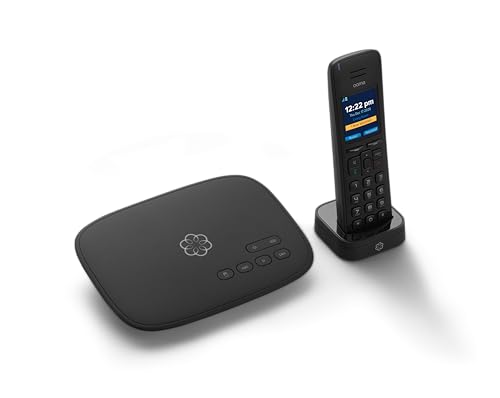
Ooma products should be treated differently. The HD3 handset is explicitly designed for Ooma Telo service, while the Telo bundles package the service hardware with one or more handsets. These are suitable when the household has chosen Ooma rather than when the buyer needs an open SIP handset. Telo Air is the Ooma option whose listing specifically documents built-in wireless connectivity for placing the base around the home.
Before choosing a SIP model, confirm that your provider supports the required device and account configuration. The listing evidence establishes the phones’ documented account or service positioning, but it does not establish compatibility with every US provider.
Consider call-management needs
Busy users should look for account capacity, conferencing, headset support, and visible controls. The T57W has 29 touch keys, a seven-inch adjustable color touch screen, 16 SIP accounts, USB, and wireless headset support. The T54W offers a smaller display but keeps the 16-account capacity and adds Bluetooth, Wi-Fi, USB, and dual-port Gigabit Ethernet.
The AX86R is more specialized. It lists four SIP accounts, five-way conferencing, a full-duplex speakerphone, Bluetooth headset support, HD audio, and smart noise cancellation. Those features are relevant to mobile workers who need hands-free communication. The W73P also emphasizes active office use with noise reduction, multiple simultaneous calls, and quick charging.
For home calling, the Ooma HD3 and bundled systems document caller ID, call waiting, voicemail, and 911 calling. These models are easier to evaluate by service features than by business account capacity.
Evaluate the display and physical controls
A large display can make call navigation easier, but it is not automatically the right choice. The WP826 has a four-inch color LCD, while the T57W uses a seven-inch adjustable touch screen. The W73P has a 1.8-inch color screen, and the Ooma HD3 has a two-inch color screen. Compare these sizes with the way the phone will be used: a desk user may benefit from a large interface, while a roaming handset may prioritize weight and battery behavior.
Also check whether the listing includes the required power arrangement. The T34W, T54W, and T57W listings state that a power adapter is not included, while the W73P listing documents quick charging. This distinction can affect installation planning even when the phone’s wireless features are suitable.
Plan for expansion and placement
Expansion matters when several people or rooms need access. The W73P has the largest documented handset capacity in this selection. Ooma’s Telo bundles offer a different form of expansion by packaging one or more HD3 handsets, while Telo Air focuses on wireless placement of the service base. For a single office user, a Wi-Fi desk phone such as the T34W may provide enough flexibility without adding handsets.
The Ooma bundles are best understood as complete service packages rather than universal SIP systems. Match the platform, handset count, account requirements, and placement needs before selecting a model.
Final Recommendation
Yealink W73P SIP Cordless Phone System ranks first overall in this specification-based comparison under the published weighted criteria.
Yealink W73P SIP Cordless Phone System is the first overall specification-based choice. The Yealink AX86R is a strong specialized option, combining Wi-Fi 6 fast roaming, Bluetooth 5.0, IP67 protection, safety alarms, four SIP accounts, conferencing, and HD audio for demanding mobile work.
For a scalable office, the Yealink W73P is the logical direction because its listing documents up to 10 DECT handsets and 20 simultaneous calls. The Yealink T57W is a fit for a busy desk where a large touch display matters, while the T54W offers a more moderate adjustable-display configuration. Among the best wireless voip phones for home service, the Ooma Telo Air with HD3 Handset stands out when wireless base placement is important. The Grandstream WP826 is a Wi-Fi handset choice, and the Yealink T34W is a focused option for a smaller office. These are also useful choices among the top wireless voip phones for distinct office and home setups.
Frequently Asked Questions
Are wireless VoIP phones the same as regular cordless home phones?
No. Regular cordless home phones commonly use a base connected to a telephone service, while VoIP models may use SIP accounts, Wi-Fi, or a dedicated internet phone service. Some conventional cordless systems can work with VoIP services, but the supplied evidence varies by model. The selected Ooma systems, for example, are designed around Ooma Telo service, while the Yealink and Grandstream business models document SIP or VoIP account support.
Do Wi-Fi VoIP phones need an Ethernet cable?
Not for their network connection when Wi-Fi is supported and configured. The Yealink T34W, T54W, and T57W, Grandstream GRP2612W, WP826, and Yealink AX86R all document Wi-Fi-related connectivity. They still require power, and desk-phone listings may require a separate adapter or use PoE depending on the installation. The supplied evidence does not confirm that every phone includes its power adapter.
Which best wireless voip phones are suited to a small office?
The answer depends on whether the office needs roaming handsets or wireless desk phones. The Yealink W73P is the clearest expansion choice because it documents up to 10 handsets and 10 SIP accounts. The Yealink T34W is a focused desk-phone option with four SIP accounts, conferencing, Wi-Fi, Ethernet, and headset support. The T54W is suited to managers who need a higher account limit and an adjustable color display.
Is the Ooma HD3 compatible with any SIP provider?
The supplied listing describes the HD3 as working with Ooma Telo service. It documents Ooma-specific functions such as online phone-book syncing and Ooma home-calling features, but it does not establish general compatibility with every SIP provider. Choose it when Ooma is the intended platform rather than as a universal SIP handset.
What should I check before buying a cordless VoIP handset?
Confirm the service or SIP requirements, wireless standard, base-station requirements, power arrangement, account capacity, and expansion limits. Also check whether you need a roaming handset or a Wi-Fi desk phone. The W73P represents a DECT-style cordless option, while the WP826 and AX86R document Wi-Fi handset connectivity. A desk model such as the T57W provides wireless networking but is still intended for a workstation.