Buying Guide
The best usb car power inverters are not interchangeable just because they plug into a 12V accessory socket. Their useful differences are the amount of AC power they can continuously supply, the USB charging standards they support, the number and type of connections, and how clearly they document protection and cooling. Start by matching the inverter to the devices you actually intend to use, then check whether the vehicle socket and the combined load are appropriate.
Match continuous output to the load
Continuous AC output is the first specification to check. The listings for several 200W models specifically describe laptop and small-electronics use, but that does not mean every appliance is suitable.
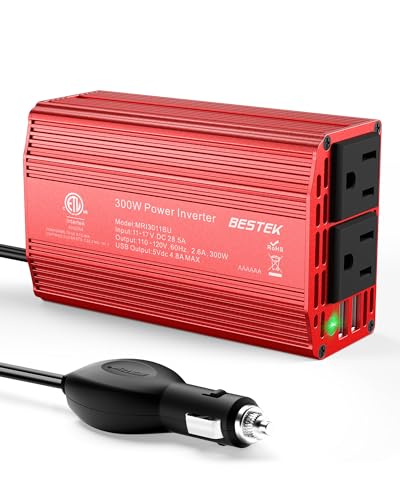
The 300W BESTEK and ALLWEI options provide additional AC headroom, and the FSATBTNE, EPANEE, and Vansoet models list 400W continuous output. A higher number is useful only when the vehicle connection and the connected equipment can support it. Also distinguish continuous output from peak or surge output: peak figures describe short startup demand and should not be treated as an ongoing operating rating.
Choose USB-C output deliberately
USB ports can be more convenient than the AC outlets because they avoid adding a separate wall charger. The FSATBTNE and EPANEE models list 65W USB-C PD, which is the most specification-aligned documented USB-C output in this selection. That specification may suit compatible laptops and tablets, subject to the device, cable, and total-load limitations stated by the listing.
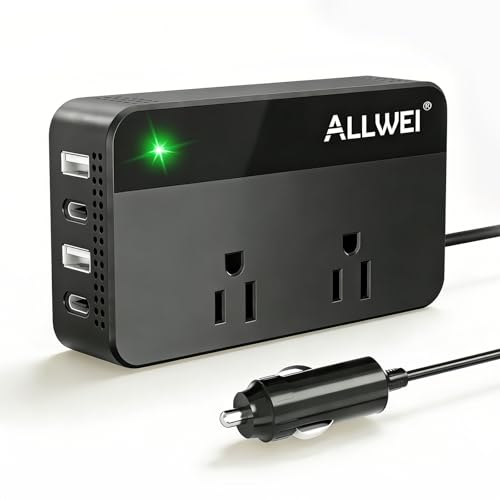
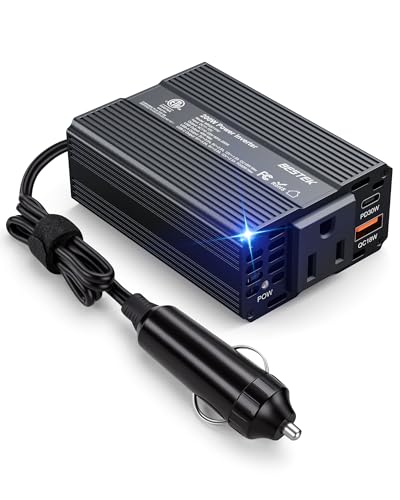
These designs are useful when several people need USB-C charging at once. The 300W BESTEK and ALLWEI models provide one USB-C port alongside USB-A, and the compact BESTEK 200W model pairs 30W USB-C with 18W USB-A.
Do not assume that every USB-C port supports the same charging protocol. Look for the documented PD wattage, and remember that actual charging varies with the device, cable, and other connected loads. If your kit uses older USB-A cables, a model with multiple USB-A ports may be more convenient than one focused on USB-C.
Count the connections you need
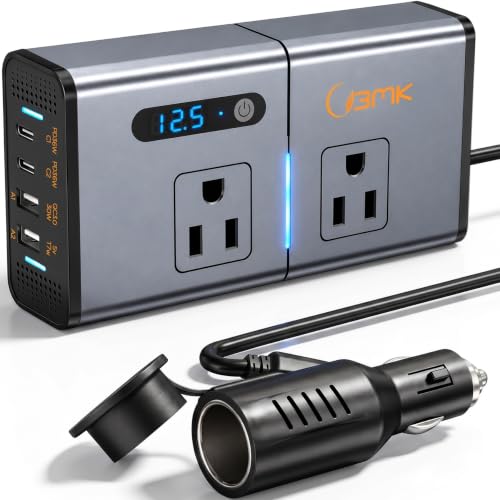
Port layout can matter as much as total wattage. The BMK inverter has two AC outlets, two USB-C ports, two USB-A ports, and a pass-through 12V socket, making it the most connection-heavy choice here. The PiSFAU and ALLWEI 200W models also list four USB ports alongside two AC outlets.
The Vansoet 400W model takes a different approach with two AC outlets, two USB-C ports, and two USB-A ports, plus a dedicated AC switch. That switch lets you turn off the AC section while retaining USB charging, according to the supplied description.
Every selected product lists some form of protection, but the exact descriptions vary. Commonly documented safeguards include overvoltage, undervoltage, overload, overheating, and short-circuit protection. These features are intended to shut down or limit output during abnormal conditions; they do not remove the need to stay within the inverter’s stated limits.
A display or indicator can make the unit easier to monitor. The Vansoet 400W model lists a green normal-status light and a red fault indicator. The BESTEK 200W model lists ETL certification, and Vansoet’s 200W listing also states ETL certification. Treat certification claims as supplied listing information and verify current documentation when certification is important to your setup.
Consider cooling, size, and placement
Inverters convert power and can generate heat, so active cooling appears throughout this category. BMK, FSATBTNE, EPANEE, BESTEK, ALLWEI, and Vansoet describe temperature-controlled or intelligent fans. Fan behavior may vary with load and temperature, so a quiet-light-load description should not be read as a promise of silence in every situation.
Compact dimensions help when the accessory socket is near a console or armrest. Longer cords can improve placement for rear-seat passengers: FSATBTNE lists a 24-inch cable, and ALLWEI 300W lists a 33-inch cord. Check clearance around the socket, ventilation openings, and any switches before choosing a location.
Final recommendation
FSATBTNE 400W Power Inverter ranks first overall in this specification-based comparison under the published weighted criteria.
FSATBTNE 400W Power Inverter is the first overall specification-based choice among these best usb car power inverters. Its 400W continuous output, 65W USB-C PD, two AC outlets, temperature-controlled fan, and documented 24-month warranty create the most specification-aligned all-around specification profile. EPANEE is a close alternative with comparable output and a listed three-year warranty, while Vansoet 400W is preferable when four USB ports and independent AC control matter most.
For connection variety, BMK is especially compelling because it combines seven documented power connections with voltage monitoring. For compact everyday use, the BESTEK 200W and ALLWEI 200W models keep the design focused while retaining AC and USB-C charging. In short, the top usb car power inverters should be selected by load, port needs, and vehicle fit rather than by wattage alone.
Frequently Asked Questions
What should I check before buying one of the best usb car power inverters?
Confirm that the inverter is intended for your vehicle’s voltage system, then compare continuous AC output with the combined requirements of your devices. Check the number of AC, USB-C, USB-A, and pass-through 12V connections, and review the listed protections and cooling design. A 400W label does not mean every vehicle socket or accessory can safely provide that amount, so follow the product instructions and vehicle specifications.
Are USB-C ports better than USB-A ports on a car inverter?
Neither is automatically better. USB-C PD ports can provide higher documented output on models such as FSATBTNE and EPANEE, which may be useful for compatible laptops and tablets. USB-A ports remain convenient for older cables and common phone accessories. Choose the combination that matches your devices, and check the listed wattage rather than relying on the connector shape alone.
Can a car power inverter run a laptop and charge phones at the same time?
Several selected models explicitly describe simultaneous AC and USB charging. FSATBTNE, EPANEE, BESTEK, PiSFAU, and ALLWEI list combinations intended for laptops, phones, tablets, or similar electronics. However, the total demand must remain within the inverter’s continuous rating, and actual USB output can vary with the connected device, cable, and combined load. High-demand appliances require separate scrutiny.
What is the benefit of a voltage display or status indicator?
A display can show vehicle input voltage, as documented for BMK and PiSFAU, while a status indicator can identify normal or fault conditions, as listed for Vansoet 400W. These features provide information during use, but they do not replace checking connections, respecting output limits, and responding to the inverter’s instructions if a fault appears.
Is a compact inverter always the best choice?
Compact size helps with storage and tight dashboards, but it can mean fewer ports or less AC capacity. Larger units such as FSATBTNE and EPANEE provide higher documented output. Choose the smallest model that still provides the required connections, cooling clearance, and continuous capacity.