Buying Guide
The best four-section monopods are defined less by a single headline specification than by how their sections, locks, feet, and mounting hardware fit the intended camera setup. Start with the working height you actually need, then check whether the documented support capacity covers the camera, lens, and any attached accessories. A four-section design generally offers a useful compromise: it can reach a practical shooting height while collapsing into a manageable form for transport.
Match construction to the kit
Carbon fiber appears in the Benro Adventure 8X MAD38C, Manfrotto XPRO Carbon Fiber, SIRUI P-424FS, and Manfrotto 290 Carbon Fiber. The supplied listings identify low stated weights for the Benro and Manfrotto carbon models, while the Benro also documents an 8-layer build and a 35-pound capacity. That combination suits photographers carrying substantial equipment. The SIRUI adds a 10-layer description and a 12 kg capacity, but its main distinction is modular operation rather than minimum weight.
Aluminum models remain useful when the design includes a specialized base or video hardware. The Benro A38FD lists a 39.7-pound capacity and a detachable ball-joint base. The Manfrotto XPRO Aluminum Video model emphasizes a FLUIDTECH base and a 79.59-inch listed height. The Oben ACM-1400 takes a simpler approach with a 17.6-pound capacity, 19.2-inch collapsed length, wrist strap, and belt clip. For a lightweight general-purpose support, those documented details may matter more than material alone.
Check height and folded dimensions
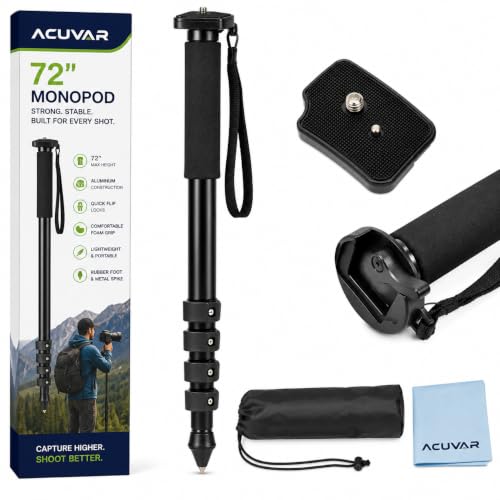
Reach varies considerably. The Manfrotto XPRO Aluminum Video model has the tallest listed height at 79.59 inches, followed by the Acuvar Pro Series at 72 inches and the Cayer FP34 at 71.2 inches. The Amazon Basics model reaches 67 inches, while the Manfrotto XPRO Carbon Fiber and Benro A38FD list heights around the mid-60-inch range. These differences affect overhead framing, eye-level operation, and the ability to work around crowds.
Folded dimensions are equally important for travel. The Benro Adventure 8X folds to 20.7 inches, the Oben ACM-1400 to 19.2 inches, and the Acuvar Pro Series to 21.5 inches. The Amazon Basics model is listed at 21.4 inches in its product dimensions. The Manfrotto 290 Carbon Fiber lists a 23.2-inch length. Compare these figures with the size of the camera bag or case rather than assuming every four-section support occupies the same space.
Evaluate locks and setup speed
Flip locks are easy to identify and can be opened individually when changing height. The Manfrotto XPRO models use Quick Power Lock systems, described as supporting rapid setup. The Manfrotto 290 uses adjustable aluminum leg locks, while the SIRUI listing identifies an upper twist collar for pan control and four carbon-fiber leg sections.
Lock style is only one part of setup. Look for details such as quick-release plates, leg warmers, foam grips, wrist straps, or belt clips when the monopod will be repositioned often. The Cayer FP34 includes a fluid head and two plates, while the SIRUI P-424FS uses a pull-down quick-release system. The Acuvar Pro Series also includes a quick-release platform. These features can reduce the number of separate steps between carrying the support and mounting the camera, although the supplied evidence does not establish a hands-on speed comparison.
A basic rubber foot is appropriate for many indoor floors and paved surfaces. The Amazon Basics model adds retractable spikes, and the Acuvar Pro Series lists both a rubber foot and retractable spike.
The SIRUI is particularly configurable: its listing describes a tripod base with 36-degree swiveling, a minipod, and two adjustable leg angles. The Cayer FP34 lists a folding three-leg base, a pivoting foot, and a tabletop-tripod option. These designs may be useful for controlled video movement or temporary standing support, but a base does not turn a monopod into a hands-free replacement for a full tripod. Follow the supplied warning for the Cayer: engaging its vertical lock may allow the monopod to stand, but the listing states it does not provide a fully hands-free solution.
Review mounting compatibility
Most selected models document either direct camera mounting or reversible threads. The Benro Adventure 8X and Benro A38FD identify reversible 1/4-20 and 3/8-16 mounts. The Manfrotto XPRO Aluminum Video model also lists both thread sizes. The Amazon Basics, Acuvar Pro Series, and the 65-inch Acuvar model document a standard 1/4-inch camera mount. If you plan to use a video head, fluid head, or specialized plate, verify the thread and plate arrangement before selecting a support.
For video, the Cayer FP34 is the most complete documented kit because its fluid head, pan range, tilt range, plates, and base are all specified together. The Manfrotto XPRO Aluminum Video model is another video-focused option, particularly when tall framing and the FLUIDTECH base are priorities. For still photography, a simpler direct-mount design may be easier to carry and quicker to pack.
Final recommendation
Benro Adventure 8X Carbon Fiber MAD38C ranks first overall in this specification-based comparison under the published weighted criteria.
Benro Adventure 8X Carbon Fiber MAD38C is the first overall specification-based choice among the best four-section monopods. Its 35-pound documented capacity, 8-layer carbon fiber, 62.4-inch height, 20.7-inch folded length, pivoting rubber foot, and reversible mounting thread form the most complete balance in this comparison.
The Manfrotto XPRO Carbon Fiber is a close alternative for photographers who prioritize a low stated weight and 20 kg payload. Choose the SIRUI P-424FS when modular modes, panning, swiveling, and a quick-release system are central to the setup. For video, the Cayer FP34 supplies the most integrated head-and-base arrangement, while the Manfrotto XPRO Aluminum Video reaches higher than any other selected model.
Among the top four-section monopods for heavy equipment, the Benro A38FD stands out for its 39.7-pound stated capacity and detachable base. The Manfrotto 290 Carbon Fiber and Oben ACM-1400 are more conventional portable choices. The Amazon Basics and Acuvar Pro Series models emphasize light carrying weight, useful reach, and basic surface adaptability. Select according to documented capacity first, then confirm height, folded length, mounting thread, and whether the included foot design matches the surfaces where you work.
Frequently Asked Questions
What should I check first when choosing the best four-section monopods?
Check the documented support capacity against the complete camera setup, not just the camera body. Then compare maximum height, folded length, section-lock style, mounting thread, and foot design. The Benro Adventure 8X and Benro A38FD document particularly high capacities, while the Amazon Basics model emphasizes low weight and retractable footing.
Are carbon-fiber monopods always lighter than aluminum models?
Not necessarily. The supplied listings show several lightweight carbon-fiber options, including the 1.1-pound Manfrotto 290 Carbon Fiber, but listed weight varies by model and included hardware. The Cayer FP34, for example, includes a fluid head and base, so its 4.2-pound specification reflects a more complete video configuration. Compare the stated weight of the exact setup you will carry.
Do stabilizing feet make a monopod hands-free?
No. A stabilizing base or folding foot can add balance, panning, or tilting functions, but the Cayer FP34 listing specifically cautions that its vertical lock does not provide a fully hands-free solution. The SIRUI P-424FS, Benro A38FD, and other base-equipped designs should likewise be treated as camera supports requiring appropriate control.
Which selected model offers the greatest listed height?
The Manfrotto XPRO Aluminum Video MVMXPROA4US has the greatest listed height at 79.59 inches. The Acuvar Pro Series follows at 72 inches, and the Cayer FP34 lists 71.2 inches. Height alone should not decide the selection; also compare capacity, folded dimensions, base design, and mounting hardware.
When is a fluid head useful on a four-section monopod?
A fluid head can be useful for video workflows that require documented pan and tilt movement. The Cayer FP34 lists 360-degree panning and -50 to +90 degree tilt, while its base adds additional positioning options. A still photographer who mounts a camera directly may prefer a simpler support with fewer integrated components.