Buying Guide
Quick-release monopods differ most in how the camera attaches, how the pole changes height, and whether the lower section provides only a foot or a complete support base. The best quick-release monopods should therefore be compared by the complete operating system rather than by the plate alone. A model may have a quick-release plate but still be a basic pole, while another may add a fluid head, pedal control, or detachable feet.
Start with the release design
A dedicated plate can reduce the time needed to move a camera from the monopod to handheld use or another support. The Acuvar Pro Series and KLIOMAX list built-in quick-release platforms or plates. The COMAN M1Pro and M1Pro V5 describe one-click or push-down locking mechanisms, while the SIRUI AM-404FL with QC-55 uses the same quick-release system on the monopod and its base. That shared design is useful when the shooting setup changes between supported and footed configurations.
The IFOOTAGE Cobra 3 Strike A150S documents a collar that releases accessories and then auto-locks them when inserted. YC Onion instead specifies a two-button release with internal travel intended to prevent sudden plate ejection. These descriptions are different, so buyers should match the mechanism to the way they work. If frequent camera swaps are central to the setup, look for a clearly documented plate or collar action rather than assuming that any mounting screw is quick release.
Match the load specification to the rig
Support capacity is a published specification, not a promise of field stability. The COMAN M1Pro lists the highest capacity in this group at 20 kg. SIRUI lists 12 kg, while the COMAN M1Pro V5 and NEEWER TP42 list 10 kg. Manbily specifies 7 kg, and the COMAN M1mini V1 and YC Onion Pineta Pro list 5 kg in their supplied evidence.
A camera body, lens, head, gimbal, monitor, and accessories should be considered together. A high capacity does not automatically make a monopod appropriate for every rig, because the mounting interface and base design also matter. The M1Pro has a 3/8-inch top screw and accessory ports; the SIRUI has a reversible 1/4-inch and 3/8-inch mounting screw; and NEEWER provides both screw sizes through an adapter. These details help determine whether an existing head or adapter can be used.
Decide whether you need feet
A conventional single-pole monopod is usually the simplest format. These feet can suit hard floors, grass, dirt, or other surfaces, but they do not create the same operating configuration as a detachable support base.
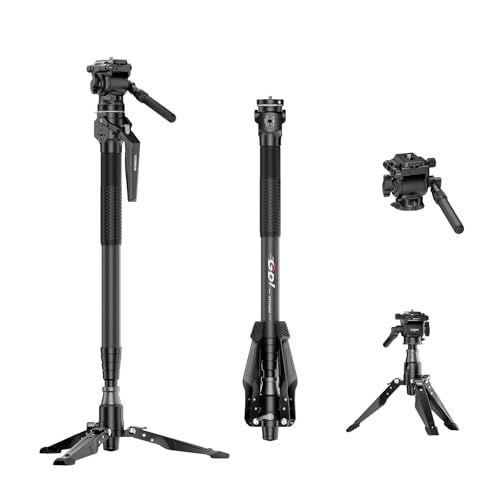
Footed models add another layer of flexibility. COMAN M1Pro, COMAN M1Pro V5, COMAN M1mini V1, SIRUI, YC Onion, IFOOTAGE, and Manbily all document some form of support base or feet. The IFOOTAGE model adds a pedal-operated lock, while Manbily lists a base with 20-degree tilt and 360-degree rotation. COMAN M1mini V1 describes fixed, pole, and low-angle configurations. These features can be useful for video framing or low-angle work, but they also add components and may increase the carrying burden.
Check height and folded length
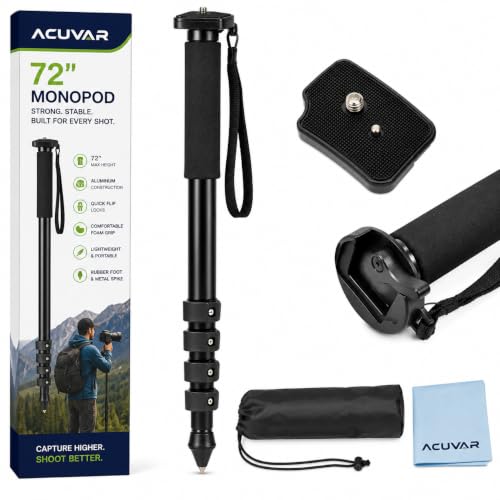
A greater maximum height can help with elevated framing, but the folded measurement determines how easily the monopod fits in a bag. Acuvar and KLIOMAX reach 72 inches. COMAN M1Pro reaches 65 inches, while the COMAN M1Pro V5 and M1mini V1 list 1750 mm and 160 cm respectively.
The compact figures are just as important. Acuvar folds to 21.5 inches, while COMAN M1Pro and M1mini V1 each list 66 cm folded lengths. Choose the height range that suits your camera position, then verify that the folded size works with the intended bag.
Consider movement control for video
A basic quick-release plate is enough for still photography, but video users may prefer controlled movement. COMAN M1Pro V5 includes a hydraulic fluid head with 360-degree pan and plus or minus 90-degree tilt. COMAN M1mini V1 also lists a V1 fluid head with 360-degree rotation and plus or minus 90-degree tilt. IFOOTAGE emphasizes one-handed height adjustment and pedal control, while SIRUI documents 360-degree panning through its upper collar.
These features describe the available controls, not a hands-on assessment of smoothness. For a video setup, also check the mounting thread, payload specification, and whether the head is included. A pole with a quick-release plate may still require a separate head for the desired camera movement.
Review materials and carrying details
Carbon fiber appears on the COMAN models and YC Onion Pineta Pro.
A wrist strap can be relevant for a pole-style monopod. These additions do not replace a support base, but they can make a simple monopod easier to carry and control. Look for the construction, section count, lock type, foot style, folded length, and mounting interface as a group.
Final Recommendation
COMAN M1Pro 65-inch Carbon Fiber Monopod ranks first overall in this specification-based comparison under the published weighted criteria.
COMAN M1Pro 65-inch Carbon Fiber Monopod is the highest-scoring returned product and the first overall specification-based choice. Its documented 20 kg capacity, one-click adjustment, detachable steel support feet, 3/8-inch top screw, and 66 cm folded length give it the broadest specification profile in this comparison.
The SIRUI AM-404FL with QC-55 is a strong alternative when matching quick release across the monopod and base matters. For video control, IFOOTAGE Cobra 3 Strike A150S and COMAN M1Pro V5 provide the clearest documented one-handed, pedal, or fluid-head features. The best quick-release monopods are not identical: the right selection depends on the rig, required height, base style, and mounting hardware.
The top quick-release monopods in this list cover both dedicated plate systems and simpler pole designs with plate-lock or quick-lock adjustment. Confirm the exact included plate and thread arrangement before pairing one with an existing head or camera.
Frequently Asked Questions
Among the best quick-release monopods, what should a quick-release monopod include?
Look for a documented quick-release plate, collar, or mounting system, plus a clear explanation of how the camera locks and releases. The SIRUI QC-55, COMAN models, IFOOTAGE Cobra 3 Strike A150S, YC Onion Pineta Pro, Acuvar, and KLIOMAX provide specific release information. A model that only lists a standard screw may need an additional head or plate for quick camera changes.
They can provide more documented configuration options, but “better” depends on the rig and shooting method. COMAN M1Pro V5 and M1mini V1 include fluid heads, IFOOTAGE lists pedal-operated base control, and SIRUI documents 360-degree panning. A simple pole may be easier to carry, while a footed model may offer a useful base for supported framing. The supplied data does not establish hands-on stability or movement quality.
Which listed models support a heavier camera setup?
The COMAN M1Pro lists a 20 kg maximum load, followed by SIRUI at 12 kg and COMAN M1Pro V5 and NEEWER TP42 at 10 kg. These are listing specifications and should be compared with the combined weight of the camera, lens, head, and accessories. Also check the mounting thread and whether the stated capacity applies to the complete monopod or a particular head.
Which models are easiest to pack?
NEEWER TP42 lists 16 oz and adjusts from 22.6 to 66.5 inches. KLIOMAX lists a 16.75-inch collapsed length, while Acuvar lists a 21.5-inch collapsed length. COMAN M1Pro and M1mini V1 each list 66 cm folded lengths, making them compact relative to their working height but not the shortest options here.
Do spike feet work on every surface?
No. A spike may be unsuitable for finished floors, while rubber may not grip soft ground in the same way. Choose the contact type based on the documented surface options and the shooting location.