Buying Guide
The best diamond saw blades for stone should be selected by matching the blade to the stone, the machine, and the kind of cut required. A blade that is suitable for a paver or concrete block may not be the right choice for a porcelain edge or a detailed granite cut. The products above are ranked from supplied specifications and listing claims, not from hands-on testing or customer sentiment.
Match the rim design to the cut
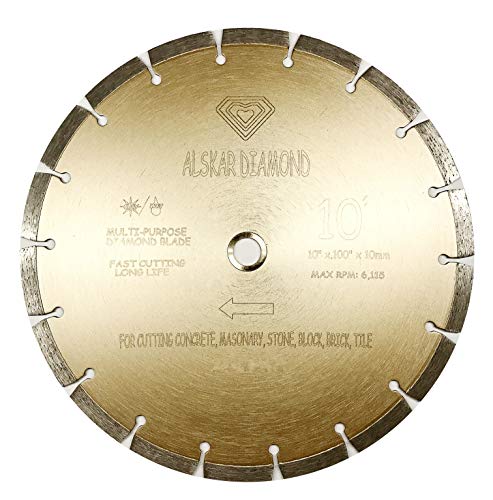
Segmented blades have visible gaps between diamond sections. In the supplied listings, those gaps are associated with airflow, heat dissipation, dust removal, slurry removal, or debris clearance. That makes segmented designs a practical starting point for general masonry, concrete, brick, block, pavers, and stone. The EZARC, Inwell, ALSKAR DIAMOND, ORIXTREME, FEWELL, and MASTER DEPOT models all document this design type.
A continuous rim maintains contact around the cutting edge. Makita describes its continuous-rim E-02668 as providing a smoother and more precise finish than segmented blades, while DEWALT’s DW4725 is also a continuous-rim masonry blade. This design is worth considering when the stated priority is a clean, controlled cut in tile, granite, ceramic, porcelain, or stone. The supplied evidence does not establish that every continuous-rim blade is better for every material, so use the documented application as the deciding factor.
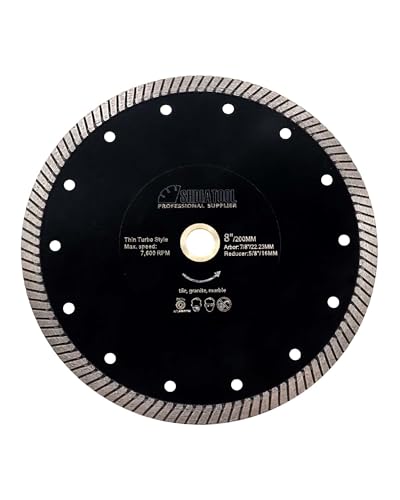
Turbo blades sit between those broad design categories in this comparison. The GRAFF and SHDIATOOL models use turbo designs and are listed for stone, granite, marble, masonry, tile, or related hard surfaces. Their specifications make them useful candidates when a buyer wants a more specialized rim profile rather than a straightforward segmented or continuous-rim blade.
Check diameter and cutting depth requirements
Diameter affects the tool that can accept the blade and the depth available for a cut. The selected products range from 4.5 inches to 10 inches. Compact blades such as the EZARC, Makita, and DEWALT models may be easier to pair with smaller handheld equipment, but their smaller diameter provides less reach than a 9- or 10-inch blade. The ALSKAR DIAMOND, ORIXTREME, and FEWELL models are larger options for compatible saws or grinders.
Do not assume that a larger diameter automatically makes a blade suitable for a particular tool. Confirm the tool guard, spindle, maximum permitted diameter, and operating speed before installation. The listings provide different arbor and RPM details, but they do not establish compatibility with every machine. A 10-inch blade is not an interchangeable substitute for a 4.5-inch blade simply because both are intended for stone or masonry.
Arbor fit is one of the most important specification checks. Several selected blades identify a 7/8-inch arbor, and some also document a 5/8-inch adapter or reducing ring. The GRAFF lists a 7/8-inch arbor with a 5/8-inch adapter; Inwell includes a 5/8-inch reducing ring; and SHDIATOOL lists a 7/8-inch bore with a 5/8-inch reducer washer. These details can make a blade more versatile, but they do not remove the need to check the tool manufacturer’s requirements.
The DEWALT DW4725 also specifies a 7/8-inch arbor. Other products in the wider candidate pool use different arbor dimensions, which shows why title-level size matching is not enough. Before buying, compare the full arbor specification, not just the blade diameter. Also check whether the supplied ring or washer is intended for your machine and whether the blade can be securely clamped without looseness.
Decide between wet and dry cutting
Wet cutting can be useful where the listing supports it and where the equipment is designed for water use. In this selection, EZARC, Inwell, ALSKAR DIAMOND, ORIXTREME, FEWELL, GRAFF, and SHDIATOOL explicitly document wet-or-dry flexibility. MASTER DEPOT also lists both methods. Their evidence does not provide a universal operating procedure, so follow the blade and tool instructions for setup, water delivery, guarding, and dust control.
The Makita E-02668 is included for its continuous rim and finish-oriented description, but the supplied evidence does not specify wet-or-dry operation. DEWALT’s DW4725 is identified as a dry-cutting blade. Those distinctions matter when a project requires wet cutting or when the user wants to manage airborne dust through a water-supported process.
Consider material coverage, not just the word stone
Stone is a broad category. The selected listings mention natural stone, granite, marble, sandstone, limestone, concrete, brick, block, pavers, terrazzo, ceramic, porcelain, or other masonry materials. The more specific the listing is about your material, the more directly the product supports that use in this specification comparison.
For broad masonry coverage, the segmented options are the most clearly documented. For granite, marble, and tile-oriented work, GRAFF, SHDIATOOL, and Makita provide more targeted material references. EZARC specifically names granite, sandstone, and limestone, while the large ALSKAR DIAMOND, ORIXTREME, and FEWELL blades focus on construction materials that include stone. Material compatibility should remain the first filter, followed by tool fit and cutting method.
Read thin-kerf and cooling claims carefully
Thin profiles can be relevant when a buyer wants a narrower cut. DEWALT describes the DW4725 as having a thinner kerf, GRAFF lists a 2.5mm kerf, and MASTER DEPOT identifies a 1.6mm thickness. SHDIATOOL lists a 2mm segment thickness. These are useful specifications, but they should not be treated as identical measurements or as proof of a particular finished-cut result.
Cooling and debris-management features are also design considerations rather than guarantees. Segmented gaps and slots are described in several listings as supporting airflow, heat dissipation, dust removal, slurry removal, or chip deflection. Use those claims to narrow the choice, then confirm the blade’s operating instructions and the tool’s safety requirements.
Final recommendation
EZARC 4-1/2-Inch Segmented Diamond Blade ranks first overall in this specification-based comparison under the published weighted criteria.
The final choice among the best diamond saw blades for stone depends on the documented features that match your intended use.
EZARC 4-1/2-Inch Segmented Diamond Blade is the first overall specification-based choice among these products. It has unusually complete evidence for stone and masonry coverage, wet-or-dry use, arbor compatibility, segment dimensions, and cooling-related design. For larger cutting formats, Inwell and ALSKAR DIAMOND provide well-documented 7- and 10-inch alternatives. For a smoother finish-oriented design, Makita is the clearest continuous-rim choice. The top diamond saw blades for stone are not interchangeable, so confirm diameter, arbor, RPM, guard, material, and cutting method before selecting one.
Frequently Asked Questions
What should I look for in the best diamond saw blades for stone?
Start with documented material compatibility, then check rim design, diameter, arbor, maximum speed, and wet-or-dry instructions. Segmented options such as EZARC and Inwell are broadly documented for masonry and stone, while Makita is positioned around continuous-rim finish work. The right choice depends on the material and tool rather than the product name alone.
Are segmented blades suitable for granite and masonry?
Several selected products explicitly list granite and masonry. EZARC names granite, concrete, sandstone, and limestone; Inwell lists granite and masonry; and MASTER DEPOT lists granite, stone, brick, block, and related materials. Segments are also described as supporting airflow and debris removal. Verify the blade’s stated application before using it on a particular stone.
Is wet cutting always required for stone?
No universal requirement can be established from these listings. Many selected models, including GRAFF, SHDIATOOL, FEWELL, and ALSKAR DIAMOND, are listed for wet or dry cutting, while DEWALT DW4725 is identified for dry cutting. Follow the product and tool instructions, especially for water use, guarding, dust control, and operating conditions.
What arbor size do these blades use?
Arbor sizes vary, so check the specification before purchase. Several selected products use a 7/8-inch arbor, and some include or document a 5/8-inch adapter or reducing ring. GRAFF and SHDIATOOL provide particularly clear reducer details. A reducer does not guarantee compatibility with every saw or grinder; the machine’s spindle and guard requirements still control.
Which design is better for a smoother stone finish?
Makita’s E-02668 is the clearest finish-oriented option in this comparison because its listing describes constant contact from the continuous rim and a smoother, more precise finish than segmented blades. That is a supplied design claim, not a hands-on test result. For other materials or applications, compare the specific blade’s documented coverage and tool requirements.