Buying Guide
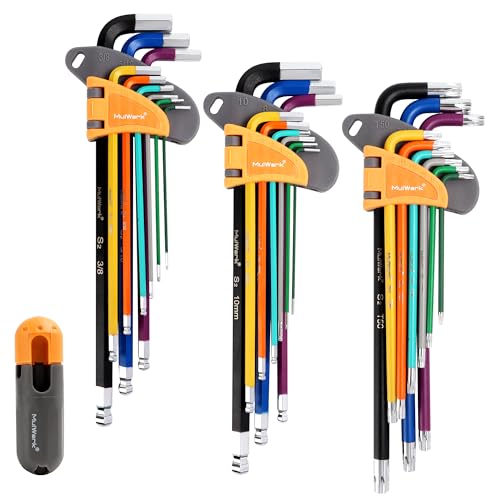
The best high-torque hex keys are not defined by one feature alone. A long arm can improve reach and turning leverage, but a T-handle may provide better control when the fastener is exposed. Ball ends can help approach a socket from an angle, while conventional ends are useful when the tool must engage straight into the fastener. The right choice depends on fastener size, measurement system, access, and the force required.
This comparison uses public listing data. It is not a hands-on test, and it does not summarize customer opinions. Material claims, size ranges, handle designs, storage features, and stated applications are treated as specifications rather than independently verified performance results.
Start with the fastener system
If the work includes both inch and metric fasteners, a dual-system kit is usually more practical than buying two narrow sets. ELEAD, HORUSDY, HAUTMEC, and Pozoho document SAE and metric coverage. Their ranges differ, so check the smallest and largest included sizes instead of relying only on piece count.
TEKTON adds star L-keys to its SAE and metric hex keys. That may reduce the need for another specialty set, but it also makes the kit less focused for someone who only uses internal hex fasteners. ROTATION takes the opposite approach by concentrating on metric sizes and reaching 19mm, which may suit large machinery or automotive fasteners.
Focused sets can be sensible when the measurement system is already known. BLACK CANYON and EKLIND 10213 are SAE choices. TOMMARS and Fancytool are metric choices. Their narrower coverage may simplify selection, but mixed-hardware projects could require a second set.
Compare L-key and T-handle designs
L-keys are compact and versatile because either arm can engage the fastener. The long arm generally favors reach, while the short arm can provide leverage when used as the turning bar. TEKTON, BLACK CANYON, EKLIND 10213, ELEAD, HORUSDY, Pozoho, ROTATION, and Fancytool document L-key or long-key layouts.
T-handles place the grip across the shaft. HAUTMEC and TOMMARS specifically document ergonomic handles, and HAUTMEC adds distinct long and short arms. This format may be easier to control during repeated turning when the fastener is open and both hands can be positioned around the handle. The trade-off is storage: T-handles generally take more room than loose L-keys and may be less convenient in a narrow opening.
Understand ball-end access
Ball-end hex keys can help when a straight approach is difficult. BLACK CANYON, TOMMARS, TEKTON, and Fancytool document angled entry, with listed angles of 20 or 25 degrees depending on the set. That feature may help reach fasteners behind an obstruction or in a confined position.
Angled access is not the same as maximum straight-line force. For a stubborn fastener, engage the key as fully and directly as the space allows. A ball end may be useful for positioning and access, while a straight end may be preferable when the tool must transmit substantial force through direct engagement. The listings establish angle features but do not provide independent torque testing.
Evaluate steel and treatment claims
Material descriptions help compare construction, but they should be read precisely. TEKTON lists 8660 nickel chromium molybdenum steel with heat treatment to HRC 54-58. Fancytool lists S2 alloy steel and HRC 59. TOMMARS specifies S2 steel and resistance to rotational distortion. HAUTMEC lists forged CR-V steel with 50-52 HRC, while ELEAD and HORUSDY describe heat-treated steel with black-oxide finishes.
These details indicate that manufacturers emphasize hardness, toughness, wear resistance, or corrosion protection. They do not independently prove that one set will outperform another in every application. A finish described as rust resistant still benefits from clean, dry storage.
Match length to the workspace
Long arms can reach recessed fasteners and improve leverage. Pozoho describes long-arm access for engines, furniture, and tight spaces. ROTATION emphasizes extra-long keys for reach and torque. TEKTON lengthens its largest keys, while Fancytool specifies 6.7-inch arms as a balance between reach and maneuverability.
Longer is not always better. In a cramped enclosure, a short arm may be easier to swing. HAUTMEC and TOMMARS address this with long and short operating ends in a T-handle format. ELEAD and HORUSDY provide separate long-reach and short high-leverage keys. These layouts may help when a project alternates between deep access and forceful turning.
Consider organization and identification
Size identification matters when a kit contains similar-looking tools. TEKTON uses laser and stamped markings on most keys. ELEAD and HORUSDY list high-visibility markings and cases. HAUTMEC uses color-coded handles and a rack, while BLACK CANYON uses color coding for its SAE set. EKLIND 10213 uses red keys and a marked holder. Fancytool lists a labeled case.
Storage is also a practical distinction. A case or rack helps retain the set and makes missing sizes easier to notice. A T-handle rack suits a bench or garage, while an L-key case may travel more easily. Choose the format that fits where the tools will be used.
Match the set to the application
For bicycles and furniture, a compact metric set or T-handle design may be sufficient if the listed sizes match the fasteners. TOMMARS, Fancytool, and HAUTMEC specifically mention these types of work. Automotive and machinery users may benefit from broader dual-system coverage or larger metric sizes, making Pozoho, TEKTON, ELEAD, HORUSDY, or ROTATION more relevant.
For workshop maintenance involving SAE fasteners, BLACK CANYON and EKLIND 10213 provide focused alternatives. When a project includes star fasteners as well as hex fasteners, TEKTON documents both types in one kit. Always compare the actual fastener head, required size, clearance, and handle style before choosing.
Final Recommendation
TEKTON 41-Piece Ball-End Hex and Star L-Key Set ranks first overall in this specification-based comparison under the published weighted criteria.
The final choice among the best high-torque hex keys depends on the documented features that match your intended use.
TEKTON 41-Piece Ball-End Hex and Star L-Key Set is the highest-scoring returned product and the first specification-based choice. Its 41-piece coverage, heat-treated 8660 steel, marked keys, long-size leverage, and angled ball ends make it the most versatile option in this comparison. It is especially suitable for a workshop that uses SAE, metric, and star fasteners.
Among the top high-torque hex keys, ROTATION is the specialist choice for large metric sizes, while HAUTMEC suits users who prefer T-handle control. Pozoho, ELEAD, and HORUSDY are broad dual-system alternatives with torque-handle or dual-length features. TOMMARS and Fancytool are focused metric options, while BLACK CANYON and EKLIND 10213 serve SAE work. Each has a documented design trade-off.
Before buying, confirm whether the set includes the measurement system and size range required, whether a ball end is useful for the available angle, and whether the storage format suits the workspace. Specifications can narrow the field, but correct fit and straight engagement remain important for demanding fastener work.
Frequently Asked Questions
What should I look for in the best high-torque hex keys?
Prioritize a suitable size range, a long or dual-length design, and documented steel or heat-treatment details. T-handles can add grip and control, while ball ends can improve access at an angle. For mixed projects, choose a set with both SAE and metric sizes. For a known specialty, a focused set may avoid unnecessary pieces.
Are ball-end hex keys suitable for high-torque work?
They can help with angled access, but the supplied listings do not establish independent torque limits. Use the ball end when access requires it, and use the straight portion as directly as possible when applying substantial force. TEKTON, BLACK CANYON, TOMMARS, and Fancytool document angled-entry features, but their listings should not be read as hands-on performance testing.
Is a T-handle better than an L-key?
Neither format is universally better. A T-handle can offer a comfortable grip and controlled turning, as documented for HAUTMEC and TOMMARS. An L-key is generally more compact and can provide two working arm lengths. Consider the fastener depth, surrounding clearance, and whether portability or repeated control matters more.
Should I buy SAE and metric hex keys together?
Buy both systems when the project list includes mixed hardware or when the fastener standard is uncertain. ELEAD, HORUSDY, HAUTMEC, and Pozoho provide documented dual-system coverage. If all known fasteners are SAE or all are metric, a focused set such as EKLIND 10213, BLACK CANYON, TOMMARS, or Fancytool may be more appropriate.
Which set is suited to large metric fasteners?
ROTATION is the clearest choice in this comparison because its 14-piece metric range extends to 19mm and its listing emphasizes extra-long keys for large sockets and machinery work. Check the fastener size before purchasing, since many general-purpose metric sets stop at 10mm and will not cover the same large hardware.