Buying Guide
The best long arm hex keys should be selected by matching the key format to the fasteners, clearance, and force required for the job. A longer shaft can improve reach and leverage, but a longer tool is not automatically better in every space. Review the size system, end design, material, and storage before choosing a set.
Start with SAE, metric, or both
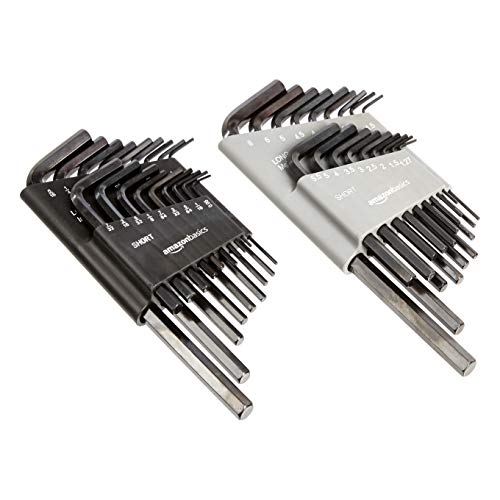
SAE sizes are measured in inches and are common on many American-standard fasteners. Metric sizes are measured in millimeters and are common on bicycles, imported vehicles, machinery, and many household products. If the equipment in your workspace varies, a combination set reduces the chance of needing a second kit. The GEARWRENCH 83504, GEARWRENCH 83505, Amazon Basics 36-Piece Set, Klein Tools BLS18, and toolant 26-Piece Set all document SAE and metric coverage.
A dedicated SAE set can still be the better fit when your work is narrowly defined. The Klein Tools LS12 and Titan 12713 concentrate on inch sizes, while Titan also specifies an extra-long format. For metric-only work, a dedicated metric kit may be efficient, but the selected products emphasize broader coverage where the evidence supports it.
Compare L-style and T-key designs
Traditional L-style keys provide two working ends. The long side is useful for reach and leverage, while the short side can help apply force where clearance allows. GEARWRENCH 83504 and GEARWRENCH 83505 specifically describe using either side, and Amazon Basics documents both long and short arm lengths.
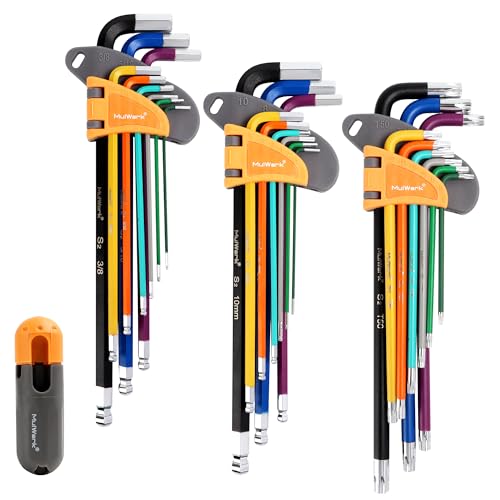
T-key designs place the shaft into a cross handle. This can provide a more substantial hand position and may be preferable for repeated turning. Eklind 50914 is the selected example with cushion-grip T-keys and 9-inch arms. Some sets also include a removable T-handle or extension accessory. MULWARK documents a T-handle, while its listing also includes extra-long ball-end keys. These accessories can add leverage, but they may make the kit less compact than a basic L-key set.
Decide whether ball ends matter
Ball ends are useful when the key must enter a socket-head fastener at an angle. Several selected products document an entry angle of up to 25 degrees, including Klein Tools BLS18, GEARWRENCH 83505, Titan 12713, MULWARK, and toolant. This feature can help around obstructions where a straight insertion path is inconvenient.
A ball end should not be treated as a replacement for straight engagement in every situation. For higher-force work, use the end and angle the product documentation supports. Straight or chamfered ends can help guide the tool into the fastener. Klein Tools LS12 and GEARWRENCH 83504 emphasize chamfered ends, while toolant documents square-cut ends for full-depth fit.
Look at reach and leverage claims
Long arms are most useful when the fastener sits deep inside a frame, panel, cabinet, or machine. Klein Tools BLS18 lists arms 30% longer than standard versions. Titan 12713 calls its keys extra-long, and Eklind 50914 specifies 9-inch arms. These details provide a clearer indication of intended format than a general long-arm label.
Longer arms can also increase leverage, but they may be awkward in a confined space. Check whether the set includes a short side, a T-handle, or another way to change the working position. A compact set may be easier to control where the fastener is exposed, while an extra-long set is more useful when access is the primary problem.
Evaluate steel and surface treatment
The supplied listings identify several material choices. Titan and MULWARK specify S2 steel. Klein Tools BLS18 and LS12 describe heat-treated steel, while Amazon Basics and toolant list chrome vanadium steel. Surface treatments include black oxide, black phosphate, satin plating, polished finishes, and rust-resistant coatings.
These specifications help distinguish the sets, but they do not establish a hands-on durability ranking. Treat steel type and finish as documented design information rather than a guarantee of service life. If corrosion protection matters, prioritize a product whose listing explicitly names a protective coating, such as the black oxide or black phosphate options.
Make storage part of the decision
A complete set is easier to use when sizes can be identified and returned to a defined location. Amazon Basics provides two hinged cases with dedicated slots and clear markings. Klein Tools LS12 uses a twist-to-lock case with an internal locking mechanism. Titan lists a plastic organizer, and Wera combines color coding with a wear-resistant clip.
Color coding can speed selection when inch and metric keys are stored together. Klein Tools BLS18, Eklind 50914, and Wera all document color-based identification. For a workshop kit that travels often, consider whether the case, clip, or pouch fits your existing tool storage.
Final recommendation
MULWARK 28-Piece SAE, Metric and Torx Set ranks first overall in this specification-based comparison under the published weighted criteria.
MULWARK 28-Piece SAE, Metric and Torx Set is the highest-scoring returned product and the first overall specification-based choice.
The best long arm hex keys do not all serve the same job. Choose Klein Tools BLS18 for documented extra-long SAE and metric coverage with sleeved ball ends. Choose Amazon Basics 36-Piece Set when the broadest listed size selection and organized cases matter most. Titan 12713 is a focused extra-long SAE option, while Eklind 50914 suits users who prefer cushioned T-key handles. For a mixed workshop that also uses Torx fasteners, MULWARK offers the widest documented format coverage, although some pieces are not hex keys.
The top long arm hex keys should be matched to the fastener system and available clearance rather than selected by piece count alone. Wera 950/9 is a notable choice for sleeved ballpoint access and quick identification, while Klein Tools LS12 emphasizes secure storage and a defined SAE range.
Frequently Asked Questions
Among the best long arm hex keys, are long arm hex keys better than standard hex keys?
They can be more useful when reach or leverage is the main constraint. The selected products document extended or extra-long arms, including Klein Tools BLS18, Titan 12713, and Eklind 50914. A shorter tool can still be easier to control in tight spaces, so the better choice depends on clearance and fastener position.
Should I buy ball-end or straight-end hex keys?
Choose ball ends when angled entry is important. Several selected sets document access up to 25 degrees. Straight or chamfered ends are useful when you want direct engagement and guided insertion. A set with both usable sides can offer more flexibility, but use the end that provides the most appropriate fit for the task.
What size coverage is most useful?
A combined SAE and metric set is a versatile starting point for varied maintenance. The Amazon Basics 36-Piece Set has the largest documented selection, while GEARWRENCH 83504, GEARWRENCH 83505, Klein Tools BLS18, and toolant provide substantial dual-standard coverage. Dedicated SAE or metric sets make sense when your equipment uses one system consistently.
How should I store long arm hex keys?
Use the supplied case, organizer, clip, or pouch so each size remains identifiable and paired with its set. Dedicated slots and clear markings, as documented on the Amazon Basics 36-Piece Set, can speed selection. A locking case such as the one listed for Klein Tools LS12 may be preferable when loose keys are easy to misplace.
Does steel type determine the best set?
Steel type is one useful specification, not a complete performance test. S2 steel is documented for Titan 12713 and MULWARK, while chrome vanadium steel appears on Amazon Basics and toolant listings. Heat treatment and protective finishes also matter as listed, but the supplied evidence does not support guarantees about lifespan or field performance.