Buying Guide
The best cleaver chef knives are not all designed for the same preparation. Some selected models document broad profiles for vegetables, herbs, boneless meat, and ingredient transfer. Others specify features for poultry joints, ribs, or heavier chopping. The most useful choice is the one whose documented construction matches your normal kitchen tasks.
This comparison uses public listing information only. It is not a hands-on test, and it does not summarize customer opinions. The editorial criteria consider blade material and stated hardness, edge geometry, cleaver versatility and profile, handle construction, and care or storage features. Ratings, review activity, purchase activity, and marketplace labels are not used as published criteria.
Match the blade profile to your prep
For vegetable-heavy cooking, look for a broad profile, a stated blade thickness, and clearly described edge geometry. The PAUDIN 7-Inch German Steel Cleaver lists a 2.3 mm blade and a 13-degree V edge. The imarku 7-Inch Japanese Steel Cleaver lists a 2.4 mm blade and a 15-degree double-sided edge. Their listings describe slicing, dicing, mincing, and other routine preparation tasks.
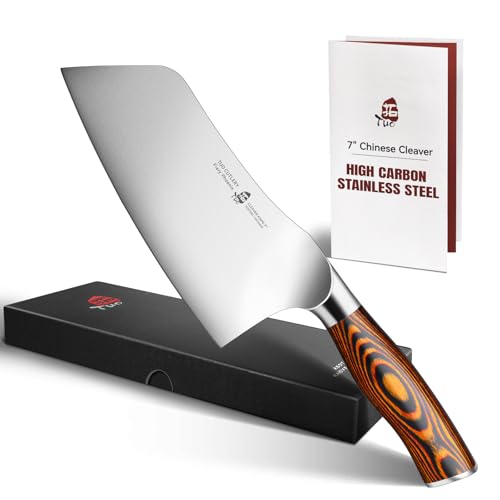
The TUO Fiery Phoenix 7-Inch Vegetable Cleaver takes a curved-profile approach. Its listing describes a sharp tip for cutting vegetables, a middle section for crushing garlic, and a lower section for mincing meat. It also identifies the knife as a 7-inch Chinese chef’s knife with a full-tang structure. These details make the model particularly relevant to cooks who want one broad blade for several prep motions.
The Dexter-Russell S5198 8-Inch Chinese Chef’s Knife uses a larger profile. Its listing specifies a 3.25-inch blade height and emphasizes knuckle clearance, chopping, gathering, transferring, and portioning. The larger blade height may suit batch preparation, while the 8-inch length should be considered alongside available board and storage space.
The Babish 7.5-Inch Clef Hybrid Knife is explicitly described as combining chef-knife and cleaver characteristics. It is a documented option for cooks seeking a hybrid profile rather than a strictly traditional cleaver shape.
Steel names and hardness figures provide useful specification evidence, but they do not independently prove real-world edge retention or cutting results. They show how much technical information is available in each listing. The PAUDIN uses forged German 1.4116 steel and states 58+ HRC. The HOSHANHO 7-Inch Japanese Steel Cleaver identifies 10Cr15CoMoV stainless steel and states 58+2 HRC. The imarku lists Japanese high-carbon stainless steel at 57+1 HRC, while the TUO lists 1.4116 German stainless steel at HRC56±2.
High-carbon terminology also affects maintenance expectations. The ENOKING 7.5-Inch Hand-Forged Cleaver specifically advises washing and drying after use and keeping the blade away from acidic, alkaline, or corrosive substances. That is an explicit care requirement. The Mueller 7-Inch German Steel Meat Cleaver, HOSHANHO, imarku, and other selected models have their own listing-specific instructions, so care should be checked for the exact product rather than assumed from the general cleaver category.
Examine the edge geometry
A stated edge angle helps explain how a product is presented, but the listing alone cannot establish how the edge will perform over time. The PAUDIN lists 13 degrees, the imarku and HOSHANHO list 15 degrees per side, and the ENOKING lists 16 degrees per side. The TUO and Mueller list 18 degrees per side.
The SYOKAMI 7.7-Inch Two-Zone Cleaver uses a different documented arrangement. Its front section is listed at 15 degrees per side for slicing, while its rear section is listed at 30 degrees per side for chopping. This divided geometry is relevant if you want one blade with separately described slicing and chopping zones. The listing also identifies shock-absorbing holes as part of the design.
Prioritize handle control and construction
A broad cleaver blade can handle differently from a narrow chef knife, so handle construction deserves attention. Full-tang construction is documented for the PAUDIN, Babish, ENOKING, TUO, and Mueller models. The PAUDIN adds triple rivets and a G10 fiberglass handle. ENOKING lists a triple-riveted wood handle. TUO lists a full-tang Pakkawood handle, while Mueller lists a full-tang seamless stainless handle.
Handle material also affects care considerations. The PAUDIN listing states that the knife is dishwasher safe. The Mueller listing describes its seamless stainless handle as dishwasher safe. The Victorinox Fibrox 7-Inch Chinese Cleaver is also listed as dishwasher safe and includes an ergonomic non-slip handle. By contrast, the ENOKING listing calls for hand washing and drying because of its high-carbon steel. These differences are practical specification trade-offs.
Consider storage and secondary features
Wide blades require suitable drawer, rack, or countertop storage. A sheath can protect the edge during storage or transport. The SYOKAMI includes a sheath and herb stripper. The PAUDIN listing describes an ingredient-scoop function, while the Mueller listing describes a broad blade that can transfer prepared ingredients. These features may matter to cooks who move food from the cutting board to a pan or need protected storage.
Secondary features should not replace the core evaluation. A box, warranty statement, or storage accessory may be useful, but the central questions remain blade profile, steel information, edge geometry, handle construction, and care requirements.
Choose by kitchen task
For mostly vegetables and herbs, start with the PAUDIN, TUO, imarku, HOSHANHO, or Victorinox. Their listings describe vegetable preparation, slicing, chopping, mincing, or related daily kitchen tasks. For a documented hybrid format, the Babish combines chef-knife and cleaver language in its product description.
For mixed boneless meat and vegetable preparation, ENOKING and Mueller provide broad task descriptions. Mueller is more explicitly associated with poultry joints, rib bones, brisket, scoring, and boning. SYOKAMI describes a rear chopping zone and a front slicing zone. These descriptions support mixed kitchen use, but they do not establish that any selected knife is appropriate for every type or size of bone.
Final Recommendation
PAUDIN 7-Inch German Steel Cleaver ranks first overall in this specification-based comparison under the published weighted criteria.
PAUDIN 7-Inch German Steel Cleaver is the first overall specification-based choice among the best cleaver chef knives.
It combines detailed steel and hardness information, a stated 13-degree edge, a 2.3 mm blade, full tang, triple rivets, a G10 handle, and a broad list of daily preparation uses. Its listing also states dishwasher-safe construction and describes the broad blade as suitable for ingredient transfer.
Among the top cleaver chef knives, the imarku 7-Inch Japanese Steel Cleaver and HOSHANHO 7-Inch Japanese Steel Cleaver provide especially clear steel, hardness, edge-angle, and blade-thickness specifications. The TUO Fiery Phoenix 7-Inch Vegetable Cleaver documents a curved profile and full tang. ENOKING documents a hand-forged high-carbon blade, a 16-degree-per-side edge, and full-tang construction.
The Mueller 7-Inch German Steel Meat Cleaver is the most explicitly oriented toward poultry joints, ribs, brisket, and related tasks in its listing. SYOKAMI offers two stated edge zones, while Babish provides the clearest hybrid chef-knife and cleaver description. Dexter-Russell emphasizes blade height and foodservice preparation, and Victorinox provides a Swiss-made utility profile with a straight edge, non-slip handle, and dishwasher-safe construction.
Treat the ranking as a structured starting point based on the supplied specifications. Before buying, confirm the current product listing, included accessories, care instructions, and whether the blade profile suits your ingredients, cutting board, and storage method.
Frequently Asked Questions
What are the best cleaver chef knives for vegetables?
The PAUDIN, TUO, imarku, HOSHANHO, and Victorinox models all document vegetable-related uses. The PAUDIN and imarku provide particularly specific blade-thickness and edge-angle information. TUO emphasizes a curved profile with areas for cutting, crushing garlic, and mincing. Victorinox is a straightforward option with a straight edge and a utility-focused description.
Can a Chinese-style cleaver replace a chef knife?
A selected cleaver can cover many preparation tasks, including slicing, dicing, mincing, and transferring ingredients. The Babish 7.5-Inch Clef Hybrid Knife is explicitly described as combining chef-knife and cleaver characteristics. Whether it can replace another knife depends on the user’s preferred blade height, weight, edge geometry, and cutting technique. The supplied listings do not establish that any one cleaver is appropriate for every kitchen task.
Which selected cleaver has the clearest edge specifications?
The SYOKAMI 7.7-Inch Two-Zone Cleaver provides the most differentiated edge description, with a 15-degree-per-side slicing section and a 30-degree-per-side chopping section. PAUDIN lists a 13-degree V edge, while imarku and HOSHANHO list 15-degree-per-side edges. ENOKING lists 16 degrees per side, and TUO and Mueller list 18 degrees per side.
Are these cleavers dishwasher safe?
The PAUDIN and Victorinox listings state dishwasher-safe construction, and Mueller describes its seamless stainless handle as dishwasher safe. Other selected models recommend hand washing, drying, or both. The ENOKING listing specifically calls for washing and drying after use. Follow the care instructions for the exact knife rather than applying one rule to every cleaver.
Which cleaver is listed for heavier meat preparation?
The Mueller listing specifically mentions poultry joints, rib bones, brisket, scoring, and boning. SYOKAMI describes a rear chopping zone for heavier work and a front slicing zone for everyday preparation. ENOKING also lists poultry and deboning-related tasks. These are product-listing descriptions, not hands-on findings, and they do not establish suitability for every bone-cutting application.