Buying Guide
Choosing the best stain-resistant chef knives starts with separating surface protection from general sharpness. A stainless or high-carbon stainless blade can resist staining, rust, and corrosion, but the listing may describe that protection through the steel itself, a coating, or care instructions. OOU provides the clearest coating-based approach, while imarku documents a seamless steel body and several knives make direct corrosion-resistance claims.
An 8-inch chef knife is the most adaptable size represented here. It provides a useful middle ground for chopping vegetables, slicing meat, mincing herbs, and routine meal preparation. OOU, Victorinox, MOSFiATA, KUMA, LEVINCHY, and TIVOLI all use an 8-inch format, though their handles, steel descriptions, and edge specifications differ.
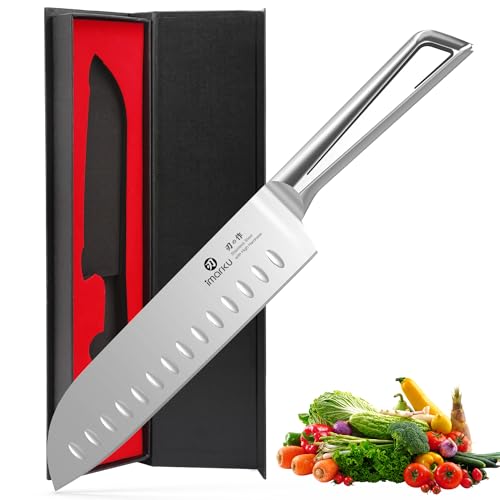
A shorter blade can feel more compact. imarku uses a 7-inch santoku profile with hollow scallops intended to help food release. That shape may suit cooks who often prepare vegetables, herbs, potatoes, cheese, or other foods described in its listing as prone to clinging.
Longer blades are more specialized. GRAND SHARP lists a 9-inch kiritsuke-style knife, while BOLEXINO lists a 10-inch chef knife intended for large foods such as watermelon, cabbage, and pumpkin. Extra length may help make longer cuts, but it can also require more counter space and control.
Examine the steel and edge evidence
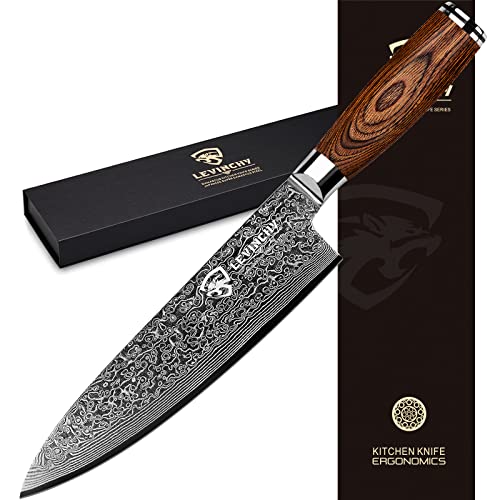
Steel information is useful when it is specific enough to compare. KUMA names a Japanese AUS10 core and 67 micro-layers of Damascus steel. LEVINCHY lists 73-layer Damascus stainless steel, an HRC range, and an 8-to-12-degree-per-side edge. GRAND SHARP also identifies AUS10 and an HRC range.
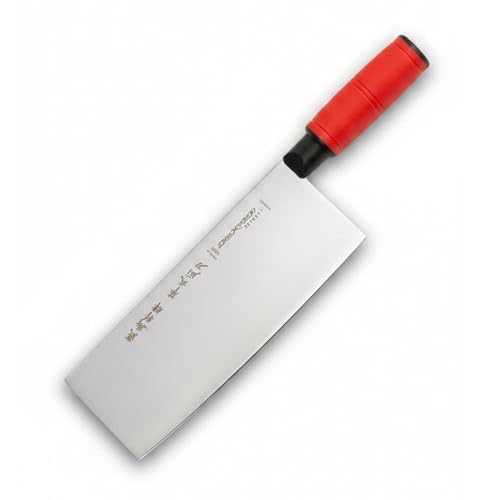
MOSFiATA identifies German EN1.4116 high-carbon stainless steel and a 16-degree-per-side edge. TIVOLI specifies 1.4116 steel heat-treated to 62 HRC. OOU gives a 15-degree edge and describes 27-step grinding. Victorinox provides a tapered stainless-steel edge and laser-tested blade language without naming a grade. Dexter identifies high-carbon DEXSTEEL but supplies less geometry information.
A narrow edge angle can indicate a fine cutting design, while a wider angle may suggest a more general-purpose approach, but the supplied listings do not provide enough evidence to predict real-world longevity or cutting feel. Treat these specifications as comparison points rather than guarantees.
Look beyond the blade for control
Grip and balance matter because a stain-resistant blade is still a kitchen tool that must be controlled. Victorinox uses a thermoplastic elastomer handle described as nonslip when wet. Dexter’s SOFGRIP rubber handle is also specifically described as slip resistant. MOSFiATA combines a full tang with a textured handle and finger points, while BOLEXINO lists a non-slip PP handle and finger guard.
KUMA’s G10 handle is described as balanced and substantial. LEVINCHY uses pakka wood, TIVOLI uses wood, and GRAND SHARP lists an octagonal rosewood handle. If you prefer a low-gap surface for cleaning, imarku’s seamless integrated stainless-steel handle is the most directly documented option here.
Consider construction and storage
OOU emphasizes coating and grinding, while TIVOLI emphasizes single-piece construction. These are different construction stories, so decide whether your priority is surface protection, handle integration, or traditional handle structure.
Storage is another practical detail. MOSFiATA includes a blade guard, KUMA includes a sheath, and BOLEXINO includes a finger guard. Packaging is not a substitute for a secure storage solution, but a sheath or blade guard can be useful when a knife will be stored in a drawer.
Read the care instructions carefully
Stain resistance does not mean a knife should be left wet or submerged. BOLEXINO recommends hand washing and complete drying, and MOSFiATA’s listing similarly emphasizes hand washing despite its anti-corrosion language. Wood-handled options such as LEVINCHY, GRAND SHARP, and TIVOLI may be better matched with careful hand cleaning and drying because their listings do not present dishwasher use as a feature.
OOU, Victorinox, and imarku document dishwasher-safe use, although OOU recommends hand-drying and BOLEXINO’s listing says hand washing is preferred. Following the maker’s full instructions remains the cautious approach.
Final Recommendation
MOSFiATA 8-Inch Professional Chef’s Knife ranks first overall in this specification-based comparison under the published weighted criteria.
OOU Black Blade 8-Inch Chef Knife is the first overall specification-based choice among the best stain-resistant chef knives in this comparison. Its combination of high-carbon stainless steel, Cerablack and AgShield coatings, a documented 15-degree edge, broad prep uses, and dishwasher-safe guidance gives it a strong specification profile.
Victorinox is the more practical grip-focused alternative, particularly for cooks who value a nonslip handle and straightforward everyday design. MOSFiATA is a strong choice when full-tang construction, German steel, edge information, and included guards are important. imarku is a clear pick for a seamless, low-gap stainless design and a santoku profile.
The top stain-resistant chef knives are not identical in shape or care requirements. Choose KUMA or LEVINCHY for layered Damascus construction, GRAND SHARP for a longer kiritsuke-style blade, TIVOLI for a stated 62 HRC specification, Dexter for its rubberized work grip, or BOLEXINO for large produce. These rankings reflect supplied specifications, not hands-on performance testing.
Frequently Asked Questions
What makes the best stain-resistant chef knives different from ordinary stainless knives?
The listings document stain or corrosion resistance through several routes. OOU adds Cerablack and AgShield coatings; imarku describes rust- and stain-resistant high-carbon stainless steel with an all-steel body; and other models identify anti-corrosion, rust-prevention, or stain-resistance properties. The evidence varies, so check both the material claim and the recommended care.
Is an 8-inch chef knife the best size for most kitchens?
An 8-inch blade is a versatile middle size and is represented by many selected products, including OOU, Victorinox, MOSFiATA, KUMA, LEVINCHY, and TIVOLI. A 7-inch santoku such as imarku may suit cooks who prefer a shorter, scalloped blade, while the 9-inch GRAND SHARP and 10-inch BOLEXINO are aimed at longer cuts and larger ingredients.
Can these knives go in the dishwasher?
Only some listings explicitly document dishwasher-safe use. OOU, Victorinox, and imarku provide that guidance, while BOLEXINO recommends hand washing to maximize service life. MOSFiATA also presents hand washing as the preferred approach. For wood-handled knives such as LEVINCHY, GRAND SHARP, and TIVOLI, the supplied evidence does not establish dishwasher use, so careful hand cleaning and drying is the cautious choice.
LEVINCHY lists an 8-to-12-degree-per-side edge, while OOU lists 15 degrees and MOSFiATA lists 16 degrees per side. KUMA describes a V-shaped edge, and Victorinox describes a tapered, laser-tested edge without giving an angle. These figures help compare the listings, but they do not establish how long an edge will last in actual use.
Are Damascus knives automatically more stain resistant?
No automatic conclusion is supported by the supplied data. KUMA and LEVINCHY document layered Damascus construction and stain or corrosion-related benefits, but their care details differ. The relevant comparison is the specific steel, any stated resistance claim, handle material, and cleaning guidance—not the Damascus label alone.