Buying Guide
The best carbide joinery router bits are not interchangeable. A dovetail cutter creates an interlocking drawer or box joint, while a finger-joint bit cuts repeated rectangular fingers. Lock-miter bits form an angled interlocking corner, and tongue-and-groove sets cut complementary profiles. Start with the joint you actually need, then check the dimensions and router setup before comparing carbide claims.
Match the bit to the joint
Choose a finger-joint bit when the project calls for repeated fingers on the ends of boards. The Yonico 15141 covers 3/8- to 1-1/2-inch stock, giving it the broadest stated stock range in this comparison. The Newdeli finger-joint bit instead documents a 7/16- to 1-1/4-inch joint height and a reversible design. Those ranges are not interchangeable, so measure the workpiece and compare the listed capacity before buying.
A lock-miter cutter is intended for a corner where two boards meet at 90 degrees. The Newdeli three-piece set covers three cutting heights, while the Rockler option is specified for 3/8- to 3/4-inch stock. Both listings emphasize table-mounted routing, and the Newdeli listing notes that the profile can take a large bite. That makes router-table compatibility and safe setup important selection factors, not minor details.
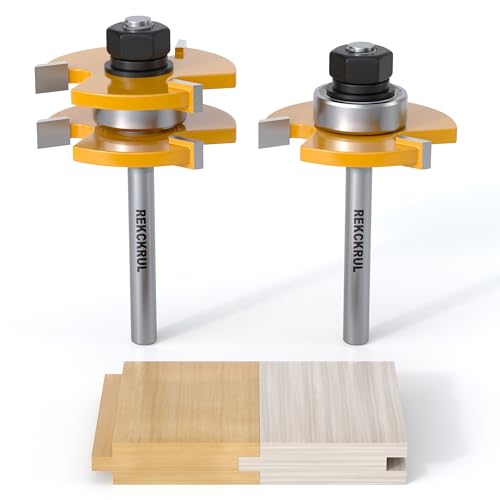
Tongue-and-groove sets are useful when two boards or door components need complementary edges. The Junreox set is specified for 3/4-inch stock, a 1/2-inch cutting depth, and adjustable cutter spacing. The REKCKRUL set is also specified for 3/4-inch stock and 1/2-inch depth, with a matched two-bit configuration. A set with the correct stock specification is preferable to assuming that any tongue-and-groove pair will fit.
Dovetail bits suit drawers, cabinets, boxes, and furniture where the angled sides of the joint are part of the design. HARFINGTON documents a 14-degree angle, 1-inch diameter, and 1-inch cutting depth. Yonico’s 14111q uses a 10-degree profile with a compact 1/2-inch width and length specification. The angle changes the resulting joint geometry, so select based on the desired profile and available stock rather than brand alone.
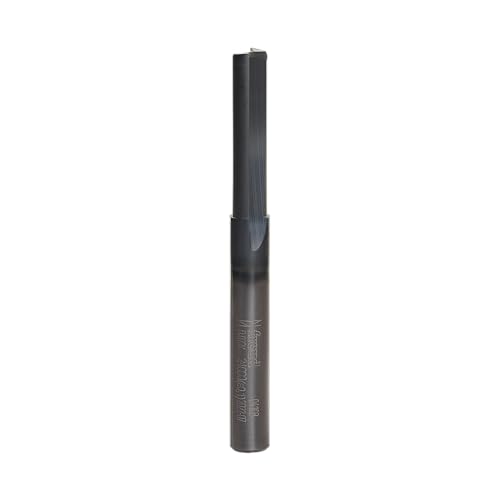
For biscuit joinery, the Yonico #10 biscuit slot cutter is the directly matched option here. It is a single-purpose cutter, which can be an advantage when the project consistently uses #10 biscuits. It also has a 1/4-inch shank and is listed for handheld and table-mounted routers. Bosch’s 85249MC serves a different need: hinge mortising and controlled mortising cuts, with a design intended to help chip clearance.
Check carbide and cutter construction
The listings use several descriptions for cutting construction, including carbide-tipped, micrograin carbide, C3 micro-grain tungsten carbide, and carbide alloy steel. These terms should be read as supplied specifications, not as proof of a particular result. Yonico documents C3 micro-grain tungsten carbide blades and silver induction brazing on several models. Bosch documents micrograin carbide and a heat-treating process on the mortising bit. Newdeli, Junreox, and REKCKRUL also identify carbide cutting elements in their listings.
A carbide specification matters most when it matches the intended material and profile. Several selected products list wood, MDF, plywood, particleboard, or composite materials, but none should be treated as a metal-cutting tool. The Newdeli and REKCKRUL listings specifically exclude ferrous metal or non-wood materials. Follow the supplied material limits and make a test cut on scrap where the listing recommends it.
Verify shank and machine compatibility
Shank diameter is a practical filter. The selected products use either 1/4-inch or 1/2-inch shanks. The Yonico 15141, Newdeli lock-miter set, and Rockler lock-miter bit use 1/2-inch shanks. The other selected options generally use 1/4-inch shanks. Confirm the router collet before ordering; a bit cannot be made compatible by changing the joint setup.
Compatibility language varies. HARFINGTON and Yonico’s dovetail bit list CNC, handheld, and table-mounted routers. Junreox lists CNC, handheld, and table-mounted use for its tongue-and-groove set. By contrast, the Yonico finger-joint bit is listed for table-mount use only, and the lock-miter listings place strong emphasis on a router table. Treat the narrowest stated setup as the controlling limitation.
Use dimensions to plan setup
Compare cutting diameter, height, depth, angle, and stock capacity together. A larger profile may require more careful passes and adequate work holding, but the supplied evidence does not establish performance results for any product. The Newdeli lock-miter set gives three cutting heights, while the Rockler bit provides a narrower stock range. The Junreox set gives a tongue size and cutting depth, and HARFINGTON gives both diameter and depth for dovetail work.
The listing instructions also provide useful operating boundaries. Junreox lists use at or below 24,000 RPM and advises routing no more than 1/4 inch at a time. These are product-specific instructions, so consult the selected bit’s listing and your router manual rather than applying one rule to every cutter.
Choose a single bit or set
A single-purpose bit is usually easier to match to one joint. The biscuit, mortising, and individual dovetail options are straightforward when their profiles fit the project. Sets add flexibility: Newdeli provides three lock-miter cutting heights, while Junreox and REKCKRUL provide complementary tongue-and-groove cutters. Bosch’s RBS010 was not selected in the top 10 because it is an assorted set, although its supplied evidence includes a cabinetry/joinery bit among several other profiles. For this comparison, the selected products offer more direct joinery identity.
Final Recommendation
HARFINGTON 14-Degree Dovetail Bit ranks first overall in this specification-based comparison under the published weighted criteria.
Yonico 15141 Easy-Setup Finger Joint Bit is the highest-scoring returned product and the first overall specification-based choice. Its stated 3/8- to 1-1/2-inch stock range, 1/2-inch shank, C3 micro-grain carbide blades, and direct finger-joint purpose make it the most specification-aligned fit when table-mounted routing is acceptable. The best carbide joinery router bits choice changes with the joint, however: choose Newdeli’s three-piece lock-miter set for stock-height flexibility, Junreox for adjustable tongue-and-groove work, HARFINGTON for a deeply specified dovetail, or Yonico’s biscuit cutter for #10 slots. These are also among the top carbide joinery router bits when their documented dimensions and machine compatibility match the project.
Frequently Asked Questions
What should I check first when choosing the best carbide joinery router bits?
Check the joint profile, stock thickness, cutting depth or height, and shank diameter first. Those specifications determine whether the bit can produce the intended joint and fit your router. Carbide construction is important, but it cannot compensate for an incorrect profile or incompatible collet.
Are lock-miter router bits suitable for handheld routing?
The supplied listings emphasize router-table use for both selected lock-miter options. Newdeli states that its set is suitable for handheld and table routers but recommends a router table because the bit can take a large bite. Rockler’s listing specifically directs users to a table-mounted router. Follow the individual product instructions and use appropriate work holding.
What is the difference between the selected finger-joint bits?
The Yonico 15141 uses a 1/2-inch shank and documents 3/8- to 1-1/2-inch stock. The Newdeli bit uses a 1/4-inch shank, a 1-3/8-inch cutting diameter, and a 7/16- to 1-1/4-inch joint-height range. Compare those capacities with your material and router before selecting one.
Can a 1/4-inch-shank bit fit a 1/2-inch router?
Only if the router has a compatible 1/4-inch collet or an approved manufacturer-specified collet arrangement. The shank must be securely held by the correct collet. Do not assume that a 1/4-inch-shank cutter is suitable simply because the router is physically larger.
Which bit is intended for biscuit joinery?
The Yonico #10 Biscuit Joint Slot Cutter is the selected product specifically identified for #10 biscuit glue joints. It uses a 1/4-inch shank and is listed for handheld and table-mounted routers. Confirm that the cutter size matches the biscuit size planned for the project.