Buying Guide
The best plywood joinery router bits are not chosen by diameter alone. Plywood sold as a nominal thickness can require a cutter sized to the panel’s actual dressed thickness, especially when the goal is a snug dado or mortise. The listings in this comparison include both dedicated undersized plywood cutters and broader joinery profiles. Start by identifying the joint, then confirm the panel thickness, shank diameter, router format, and cutter coverage.
Match the bit to the joint
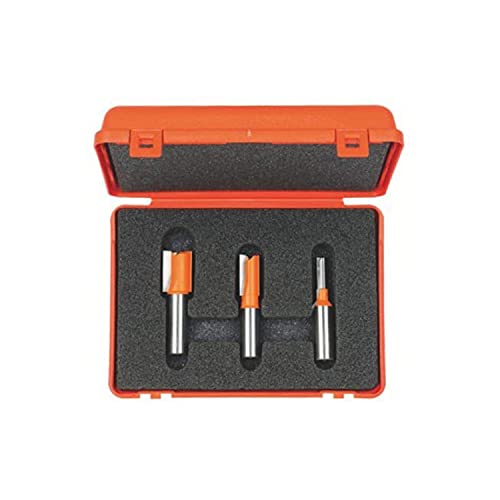
For dados and straight grooves, dedicated undersized sets are the most directly documented option. The Freud 90-106 set lists four plywood-matching sizes from 1/4 to 3/4 inch. The Whiteside 470 covers 1/4-, 1/2-, and 3/4-inch plywood with stated cutter dimensions, while the CMT 811.001.11 set lists 15/64-, 31/64-, and 23/32-inch diameters for matching plywood joints. These sets make sense when shelving, dividers, or cabinet panels must fit into routed grooves.
A single bit can be preferable when a project uses one panel size repeatedly. Bosch 84602MC is specifically sized at 23/32 inch for 3/4-inch plywood. It avoids buying multiple cutters, but it does not provide the flexibility of a set. The Yonico 14323 set is another dado-oriented choice; its listing names dados and straight cuts for dressed plywood and supports several router platforms, although the supplied evidence does not disclose each included diameter.
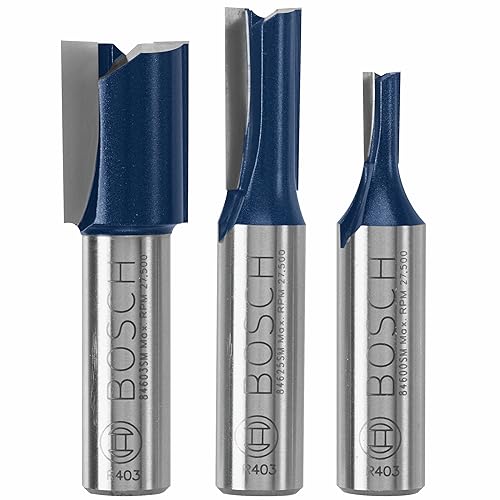
For mortises, consider the Bosch RBS024SXW set or Bosch 84602MC. Both listings emphasize undersized plywood mortising and micrograin carbide construction. The three-piece Bosch set offers broader size coverage, whereas the 84602MC is a focused choice for 3/4-inch panels.
Consider tongue-and-groove and interlocking joints
Straight dados are only one way to join plywood. The Yonico 15231 set is intended for 1/4-inch plywood center panels and creates a stated 5.2 mm tongue and groove. It is a logical match for frame-and-panel work, but the listing specifies table-mounted router use only. Junreox’s two-piece set also makes a tongue-and-groove profile for stock up to 3/4 inch and allows cutter spacing adjustment. Its listing names CNC, handheld, and table-mounted routers, giving it broader stated machine compatibility.
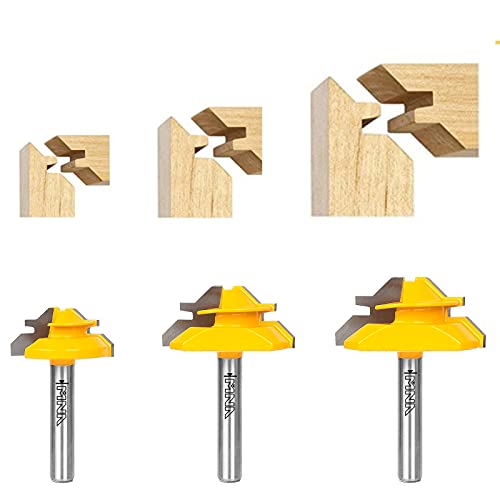
The MNA 45-degree lock-miter set serves a different purpose. Its three cutting heights are intended for 1/2-, 5/8-, and 3/4-inch stock, and the listing describes an interlocking joint with glue surface. A router table is strongly recommended. Because the supplied material list does not explicitly name plywood, treat it as a broader composite-board joinery option rather than a dedicated plywood-thickness cutter.
Check shank size and machine compatibility
Shank size is a practical filter. The Freud 90-106 and CMT 811.001.11 sets use 1/4-inch shanks, while the Whiteside 470 and Yonico 14323 use 1/2-inch shanks. Bosch’s RBS024SXW listing does not state a shank size in the supplied specifications, so verify it before ordering. The 1/4-inch format can suit routers with smaller collets, but a 1/2-inch shank may be the better match for a router configured for that collet. Never assume compatibility from brand or bit diameter alone.
Machine-use restrictions also differ. Freud’s undersized set is listed for handheld and table-mounted routers. Yonico 14323 is listed for CNC, table-mounted, and handheld use. Yonico 15231 is listed for table-mounted routers only, and MNA recommends a router table because the lock-miter profile takes a substantial cut. Use the stated limitation as a buying requirement, not a minor detail.
Review cutter and body construction
The supplied listings use several construction descriptions. Whiteside combines a steel body with solid-carbide and carbide-tipped cutting edges. Bosch identifies micrograin carbide tips, reinforced steel shanks, and a heat-treating process. Yonico lists C3 micro-grain tungsten carbide blades and silver induction brazing. CMT specifies industrial chrome carbide cutting edges and a non-stick coating. Freud lists carbide-compatible plywood work and Perma-SHIELD coating on its undersized set.
These details help distinguish tools on paper, but they do not prove a particular finish, service life, or cutting result in your material. Plywood varies by veneer, adhesive, and core construction. Use the construction information to compare intended durability and maintenance features without treating it as a hands-on test result.
Plan the setup around the panel
A set with several sizes is useful when plywood thicknesses vary across a project. The Freud 90-106 has the broadest stated coverage in this list, while the Whiteside 470 and CMT set cover three commonly encountered sizes. For a repeatable 3/4-inch application, Bosch 84602MC offers a focused 23/32-inch option.
Specialty profiles require more setup attention. Tongue-and-groove bits need matching cutter alignment, and Junreox includes adjustment guidance for spacing. The Yonico 15231 set is factory-matched for a specific 1/4-inch panel application. Lock-miter work requires correct bit height and stock positioning; MNA supplies three cutting heights but still calls for router-table use. Follow the supplied operating instructions, use adequate shank engagement, and confirm the joint on scrap before routing the finished panel.
Final Recommendation
Freud 90-106 Undersized Plywood Bit Set ranks first overall in this specification-based comparison under the published weighted criteria.
The final choice among the best plywood joinery router bits depends on the documented features that match your intended use.
Freud 90-106 is the highest-scoring returned product and the first overall specification-based choice. Its four stated plywood thickness matches, broad material coverage, and handheld/table-router compatibility make it the most versatile starting point for general panel joinery. The Whiteside 470 is a strong alternative for users with a 1/2-inch collet who primarily cut three common dado sizes, while Bosch RBS024SXW is better aligned with a mortising-focused workflow.
Among the top plywood joinery router bits for specialized joints, choose Yonico 15231 for 1/4-inch plywood frame-and-panel work, Junreox when adjustable tongue-and-groove spacing matters, and MNA when an interlocking lock-miter profile suits the project. For a single repeated 3/4-inch panel size, Bosch 84602MC keeps the choice focused. Always verify the router’s collet, the actual plywood thickness, and any table-only restriction before purchase.
Frequently Asked Questions
What makes the best plywood joinery router bits different from ordinary straight bits?
Dedicated plywood bits are sized around stated panel thicknesses or describe an undersized design for standard plywood. Freud 90-106, Whiteside 470, CMT 811.001.11, and Bosch 84602MC all provide explicit plywood-related sizing information. A general straight bit may not correspond to the panel’s actual thickness, so it may require more careful setup or test fitting.
Which selected product covers the most plywood thicknesses?
Freud 90-106 has the broadest explicitly stated range in this comparison: 1/4, 3/8, 1/2, and 3/4 inch. Whiteside 470 covers 1/4, 1/2, and 3/4 inch, while CMT 811.001.11 lists three plywood-oriented diameters. The right choice still depends on your router’s shank capacity.
Should I choose a 1/4-inch or 1/2-inch shank?
Choose the shank that matches the router collet and the bit’s listed compatibility. Freud 90-106 and CMT 811.001.11 use 1/4-inch shanks; Whiteside 470 and Yonico 14323 use 1/2-inch shanks. Do not use a bit unless the shank is fully compatible and properly clamped according to the router and bit instructions.
Are tongue-and-groove bits suitable for plywood panels?
Yes, when the panel thickness and profile match the listing. Yonico 15231 is specifically designed for a 1/4-inch plywood center panel. Junreox is listed for plywood and stock up to 3/4 inch, with adjustable cutter spacing. These are different from straight dado sets and require careful alignment of the mating cuts.
Which option is intended for rabbets rather than dados?
Freud 32-504 is the selected rabbeting set. Its interchangeable bearings are listed for rabbet depths from 1/8 to 1/2 inch, and the product is described for plywood, composites, furniture, and cabinet work. It is a better match for recesses and back-panel rabbets than a dedicated undersized dado bit.