Buying Guide
Choosing among the best dovetail router bits starts with the joint profile, not the brand name. A bit must match the jig, template, or hardware system, and its shank must fit the router collet. The listings here include single cutters, angle-specific options, and multi-bit sets, so the right choice depends on whether you need one repeatable profile or a broader woodworking assortment.
Match the angle to the joint system
Angle is one of the most important specifications. Freud 22-112, Freud 22-124, Freud 22-134, Whiteside D14-51, Bosch 84703M, and MICROJIG MATCHFIT MB-025-0514 all document 14-degree profiles. That makes them easy to compare, but it does not mean they are interchangeable with every jig or clamp system. Confirm the angle and dimensions required by your setup before ordering.
Amana Tool 45828 provides an 8-degree alternative. This is useful when a project or jig calls for a shallower profile, but the supplied data does not establish compatibility with a particular fixture. Treat the angle as a key selection point rather than assuming that a different profile will produce the same joint.
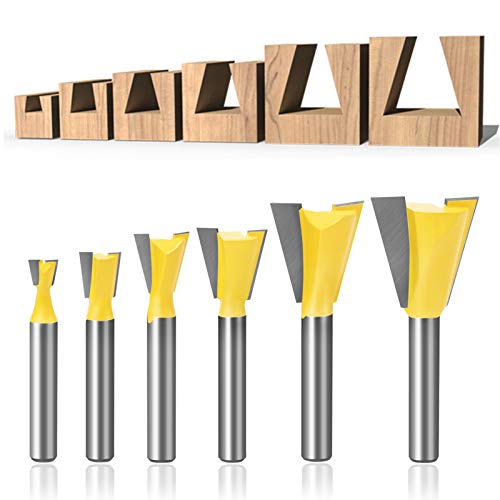
The YONICO 14520q, Meihejia six-size set, and YAKAMOZ six-piece set are more appropriate when you need variety. YONICO specifically describes five common sizes and angles. The Meihejia set lists six cutting diameters, while YAKAMOZ identifies half-blind and through dovetail applications. With any set, check the individual bit dimensions against your templates.
Check the shank before comparing diameter
A 1/4-inch cutting diameter and a 1/4-inch shank are different measurements. The shank is the part held by the router collet; the cutting diameter describes the working profile. Freud 22-112 and Freud 22-134 list 1/2-inch shanks, while the supplied Bosch 84703M specification does not state its shank diameter. Verify that detail before purchase.
Freud 22-124, Whiteside D14-51, Amana Tool 45828, MICROJIG MATCHFIT MB-025-0514, YONICO 14520q, Meihejia, and YAKAMOZ specify 1/4-inch shanks. These are candidates for routers with compatible 1/4-inch collets, not automatic choices for every router. Check the router manufacturer’s instructions rather than assuming an adapter is appropriate.
Consider cutting height and overall diameter
Cutting height helps indicate how much vertical profile the bit is designed to cut, while overall diameter affects the joint shape and the clearance required by a jig. Freud 22-112 and Freud 22-124 list 1/2-inch carbide height. Freud 22-134 lists a 3/4-inch carbide height, and Amana Tool 45828 lists a 0.825-inch cutting height.
A larger diameter is not automatically better. The 3/4-inch Freud 22-134 is a logical candidate for a larger profile, while the 1/2-inch Freud and Whiteside options may be easier to match with mid-size layouts. Compare the bit’s dimensions with the stock thickness, template opening, and intended joint depth.
Evaluate construction details carefully
The supplied listings mention carbide-tipped or carbide cutter construction across the selected products. Freud models add Perma-SHIELD coating, two cutters, and, for 22-112, ground carbide with titanium, anti-kickback, and computer-balanced design details. Whiteside D14-51 is carbide-tipped. Bosch 84703M lists micrograin carbide tips and a control-cut design.
The sets use different construction descriptions. YONICO specifies C3 micro-grain tungsten carbide blades and silver induction brazing. Meihejia lists C3 micro-grain tungsten carbide two-flute blades and a hardened steel body. YAKAMOZ lists carbide-tipped cutters and a corrosion- and heat-resistant Teflon coating. These are useful specification differences, but they are not a substitute for hands-on testing or a guarantee of a particular finish.
Choose for the machine and material
Several products are listed for CNC, handheld, and table-mounted routers, including Freud 22-112, Freud 22-124, Freud 22-134, Whiteside D14-51, MICROJIG MATCHFIT MB-025-0514, YONICO 14520q, Meihejia, and YAKAMOZ. Bosch 84703M specifically recommends a fixture or router table. That guidance matters when planning a controlled cut.
Material guidance is also useful. Whiteside D14-51 names natural and composite woods. Meihejia lists wood, MDF, particleboard, and plywood, while YAKAMOZ lists wood, MDF, particleboard, and plywood and warns against ferrous metal and other non-wood materials. Use only the materials and machines supported by the product listing, and follow the router and bit manufacturer’s operating instructions.
Choose a single bit or set
A single bit is practical when a jig already dictates the profile. Freud 22-112 is a balanced specification-based option, while MICROJIG MATCHFIT MB-025-0514 is more targeted to its documented clamp and hardware system. A set makes more sense when you build different boxes, drawers, or casework and want several diameters available.
The YONICO, Meihejia, and YAKAMOZ sets offer the broadest listed coverage among these picks, but their specifications do not provide identical detail. Confirm whether the set’s angles, cutting heights, and shank format match your project. More pieces can increase flexibility, yet they can also make storage and profile identification more important.
Final recommendation
Freud 22-134 3/4-Inch Dovetail Bit ranks first overall in this specification-based comparison under the published weighted criteria.
Freud 22-134 3/4-Inch Dovetail Bit is the highest-scoring returned product in this specification-based comparison.
Freud 22-112 is a leading choice among the best dovetail router bits. Its 14-degree, 1/2-inch profile, 1/2-inch shank, two-cutter construction, and listed compatibility with CNC, handheld, and table-mounted routers create a balanced fit for many documented woodworking uses.
For a 1/4-inch collet, Whiteside D14-51 is an alternative because it combines a 14-degree profile with stated natural- and composite-wood use. MICROJIG MATCHFIT MB-025-0514 is the focused option for MATCHFIT clamps and hardware. If you need a larger profile, consider Freud 22-134; if you need several sizes, YONICO 14520q or Meihejia provide broader listed coverage. Among the top dovetail router bits, the best match is the one whose angle, shank, and cutting dimensions agree with your jig and router.
Frequently Asked Questions
What should I check first when buying the best dovetail router bits?
Check the required angle and profile from your jig or project, then confirm the shank diameter against your router collet. After that, compare cutting height, overall diameter, and the supported machine and material types. A bit with suitable specifications can still be unsuitable if its shank or angle does not match the setup.
Are 1/4-inch and 1/2-inch shanks interchangeable?
No. They are different shank sizes and require a compatible router collet. Freud 22-112 and Freud 22-134 list 1/2-inch shanks, while Freud 22-124, Whiteside D14-51, Amana Tool 45828, and MICROJIG MATCHFIT MB-025-0514 list 1/4-inch shanks. Check the router manufacturer’s instructions before using any accessory.
Is a dovetail bit set better than a single bit?
A set is useful when you need multiple diameters, angles, or joint styles. YONICO 14520q documents five common sizes and angles, Meihejia lists six diameters, and YAKAMOZ describes half-blind and through dovetail use. A single bit may be simpler when one jig specifies one exact profile.
Can these bits be used in a handheld router?
Several selected products explicitly list handheld-router compatibility, including Freud 22-112, Whiteside D14-51, Freud 22-124, Freud 22-134, MICROJIG MATCHFIT MB-025-0514, YONICO 14520q, Meihejia, and YAKAMOZ. Bosch 84703M recommends a fixture or router table. Follow the specific bit and router instructions for setup and operation.
Which selected bit offers an angle other than 14 degrees?
Amana Tool 45828 documents an 8-degree angle. YONICO 14520q states that its set includes common sizes and angles, although the supplied listing does not enumerate each one. Confirm the exact profile needed before purchase.