Buying Guide
Choosing the best flexible roof flashings starts with the pipe, not the brand name. A roof boot must slide over the pipe, trim cleanly to the measured outside diameter, and leave enough base area to fasten against the roof. The listings in this comparison describe flexible pipe flashings primarily for metal-roof penetrations, although some products also document use on wood or other roof materials. This is a specification-based guide, not a hands-on test.
Measure the pipe outside diameter first
Measure the outside diameter of the installed pipe where the boot will sit. Do not choose from the nominal pipe name alone. Flashers #3 Silicone Square Roof Jack and Flashers #3 Grey EPDM Round Roof Jack both cover 1/4 to 5 inches, making them versatile for small and medium penetrations. Dektite #1 is more compact at 1/4 to 2 1/2 inches, while Flashers #1 Silicone Grey Square Base and Nuanchu #1 Silicone Roof Jack top out at 2 inches.
For larger penetrations, match the range carefully. Dektite #4 covers 3 to 6 1/4 inches, Flashers #5 covers 4 1/4 to 7 1/2 inches, and ACNOYEL #6 covers 4 3/4 to 10 inches. Flashers #7 covers 6 to 11 inches, while VEVOR’s two boots cover 6 1/4 to 11 3/4 inches. A boot that is too small cannot be trimmed to a useful fit, and a boot that is excessively large may require more base area than the roof location provides.
Compare silicone and EPDM materials
Silicone is the better-documented choice when the temperature range is a leading concern. The selected Flashers silicone models, ACNOYEL #6, and Nuanchu #1 list continuous service from -100°F to +450°F. VEVOR lists -101°F to 437°F. Those figures are technical listing specifications, not independent test results, and the product should remain within the stated service limits.
EPDM remains useful where its documented range suits the installation. Flashers #3 Grey EPDM Round Roof Jack lists -65°F to +250°F. Dektite #1 and Dektite #4 list -58°F to 239°F. The material choice should follow the pipe temperature, local exposure, and the manufacturer’s stated limits rather than color or appearance.
Look at the flexible roof base
A flexible metal base helps a flashing conform to roof contours. Flashers listings describe a heavy rubber fold and aluminum ring that can fit roof pitches and metal profiles. Dektite describes a flexible aluminum collar for uneven metal roofing. The flexible cone-and-aluminum-base construction is also documented for the selected Flashers EPDM models.
Square bases are documented on Flashers #1 Silicone Grey Square Base, Flashers #3 Silicone Square Roof Jack, ACNOYEL #6, and VEVOR. VEVOR specifically describes its 0.6 mm aluminum square base as adaptable to sloped and flat metal roofs. Nuanchu uses a cone shape with an aluminum component and states compatibility with slopes up to 45 degrees. These details help compare roof adaptation, but they do not replace checking the panel profile and available fastening area.
Check trimming and fastening details
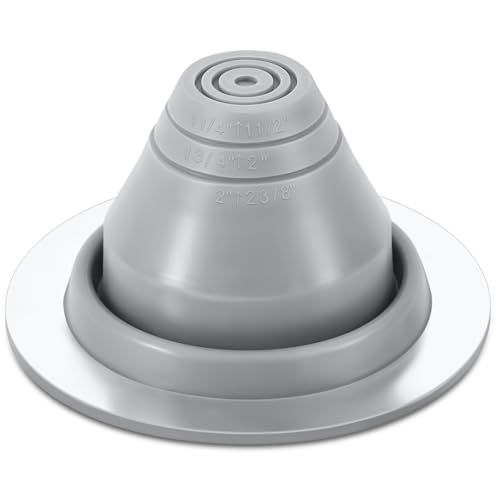
Many of the best flexible roof flashings use a marked cone that can be cut to the pipe diameter. Flashers specifies inch and millimeter markings and trimming with tin snips or scissors. Dektite specifies shears or heavy scissors and gives fastening guidance for metal-roof screws. ACNOYEL #6 and VEVOR also describe cutting the sleeve to the required size.
Review what the package contains before planning the installation. ACNOYEL #6 lists butyl tape, roofing screws, and a hex socket. VEVOR describes installation with sealant and screws. Dektite provides fastening guidance, while Nuanchu explicitly states that installation hardware is not included. Included hardware can simplify preparation, but the listing does not establish that every roof, pipe, or sealant combination will be suitable.
Match the base shape and size to the roof
Base dimensions matter when the penetration is close to a seam, ridge, rib, or other obstruction. Dektite #1 has a 4 3/4-inch base, and Flashers #1 Silicone Grey Square Base lists a 4.75-by-4.75-inch base. Flashers #3 Grey EPDM Round Roof Jack lists a 7.75-by-7.75-inch footprint, while Dektite #4 lists a 9 1/2-inch base diameter.
Larger models occupy more roof area. Flashers #7 lists a 14.25-by-14.25-inch size, VEVOR lists 17.5 by 17.5 inches, and ACNOYEL #6 lists 12 by 12 inches. Use those supplied dimensions to confirm clearance before ordering. A broad pipe range is helpful only when the base can sit flat enough for the planned fastening and sealing method.
Final recommendation
Among the top flexible roof flashings, the ranked products differ under documented pipe fit range and sizing clarity, material and temperature range, roof-base flexibility and adaptation, installation features, and specification completeness.
Flashers #7 Grey Silicone Pipe Flashing ranks first overall in this specification-based comparison under the published weighted criteria.
Flashers #3 Silicone Square Roof Jack is the highest-scoring returned product and the first overall specification-based choice.
The final choice among the best flexible roof flashings depends on the documented features that match your intended use. Flashers #3 Silicone Square Roof Jack combines a 1/4- to 5-inch fit range, -100°F to +450°F silicone rating, flexible aluminum-ring base, and marked trimming cone. These specifications give it a balanced profile for many small and medium metal-roof pipe penetrations.
Choose Flashers #7 Grey Silicone Pipe Flashing or VEVOR 2-Pack Large Silicone Roof Boots when the pipe is in the roughly 6- to 11 3/4-inch range. For a large pipe below 10 inches, ACNOYEL #6 adds listed butyl tape and fastening hardware. Flashers #5 fills the 4 1/4- to 7 1/2-inch silicone range, while Flashers #3 Grey EPDM Round Roof Jack provides an EPDM alternative with 1/4- to 5-inch coverage.
For smaller pipes, compare Dektite #1, Flashers #1 Silicone Grey Square Base, and Nuanchu #1 by material rating, base dimensions, and included hardware. Dektite offers the clearest fastening detail; Flashers supplies the broad silicone temperature specification; Nuanchu documents slope compatibility but excludes installation hardware. Always verify outside diameter, roof clearance, base shape, and the installation materials required for your roof assembly.
Frequently Asked Questions
What are the best flexible roof flashings for a small pipe?
The best flexible roof flashings for a small pipe depend on the temperature and exact outside diameter. Flashers #1 Silicone Grey Square Base and Nuanchu #1 Silicone Roof Jack cover 1/4 to 2 inches and list -100°F to +450°F continuous service. Dektite #1 covers a slightly larger maximum of 2 1/2 inches, uses EPDM, and provides specific metal-roof fastening guidance. Measure the pipe before choosing among them.
Is silicone better than EPDM for a roof pipe flashing?
Neither material is universally better from the supplied evidence. Silicone models in this selection generally document a wider continuous temperature range, including -100°F to +450°F for several products. EPDM models list ranges from -65°F to +250°F or -58°F to 239°F. Choose the material whose stated service range fits the application, then confirm the fit and base design.
How do I select the correct flashing size?
Measure the pipe’s outside diameter and compare it with the product’s stated range. For example, Dektite #4 covers 3 to 6 1/4 inches, Flashers #5 covers 4 1/4 to 7 1/2 inches, and Flashers #7 covers 6 to 11 inches. The cone can often be trimmed along marked lines, but a flashing should not be selected below its minimum diameter or without enough base clearance.
Several selected products document flexible aluminum collars, rings, or bases intended to adapt to metal-roof profiles. Flashers describes accommodation for roof pitch and metal profiles, and Dektite describes sealing against uneven metal roofing. VEVOR lists a flexible square base for sloped and flat metal roofs. Actual installation still depends on panel shape, clearance, fasteners, and the specified sealing method.
Which selected boot includes installation accessories?
ACNOYEL #6 lists butyl tape, roofing screws, and a hex socket. VEVOR describes installation with sealant and screws, while Dektite provides fastening guidance. Nuanchu states that installation hardware is not included. Check the package details before starting because included accessories vary by product and may not cover every requirement of the roof assembly.