Buying Guide
The best stainless steel meat cleavers are not all built for the same type of preparation. Some are compact kitchen tools intended for meat, vegetables, and mincing, while others emphasize thick blades and bone chopping. Start by matching the blade design to your actual work rather than choosing by size alone.
Choose the blade material carefully
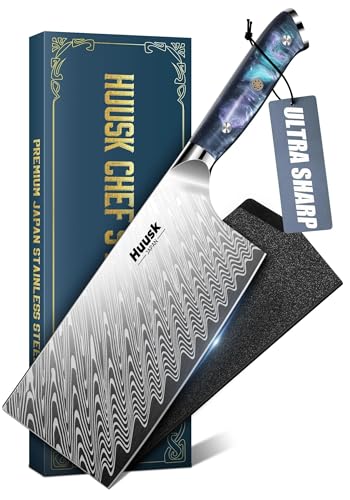
The selected listings use several stainless or high-carbon stainless descriptions, including German X50, Japanese high-carbon stainless steel, Nitrum stainless steel, 30Cr13, 50CR15MoV, and 80Cr13. A named steel or treatment gives more useful comparison evidence than a generic claim that a blade is durable. The Messermeister identifies German X50 stainless steel, while Arcos names its Nitrum process. The imarku, PAUDIN, Huusk, and Aroma House listings go further by providing hardness or edge details.
High-carbon stainless terminology can indicate an effort to balance hardness and corrosion resistance, but the listing evidence does not establish real-world longevity. Treat hardness figures as specification points, not as guarantees. Any stainless blade can still benefit from prompt cleaning and drying, especially when the manufacturer recommends hand washing.
Match blade size to the work surface
The selected products range from 6 to 8.1 inches. Seven-inch options such as the imarku, PAUDIN, Huusk, and Aroma House models are middle-sized choices for mixed kitchen work. The SHI BA ZI ZUO and TJ POP cleavers offer larger working areas, with the latter also specifying a 3.5 mm blade thickness.
A larger blade can cover more food during a single chopping motion, but size does not automatically mean better control. Consider the blade width, listed weight, handle shape, and the space available for storage. The imarku lists a 0.74-pound weight, while the SHI BA ZI ZUO lists a 0.725-pound weight despite its larger blade. These figures show why blade length alone is not enough to predict handling.
Compare edge geometry
Edge information is especially helpful when comparing top stainless steel meat cleavers. Messermeister, imarku, and PAUDIN list 15-degree edges, while Aroma House lists 17 degrees. TJ POP lists a 25-to-30-degree V-shaped edge for its bone-oriented design. These are meaningful differences in intended use, but they do not prove that one knife will perform better for every task.
A more acute listed angle may suit slicing and general prep, while a wider angle may be appropriate for a cleaver marketed toward hard ingredients. The product descriptions should guide the choice: TJ POP explicitly emphasizes bones, whereas imarku and Huusk describe chopping, mincing, and slicing across meats and vegetables.
Look for stable construction
Full-tang construction appears in the Cutluxe, Huusk, PAUDIN, and SHI BA ZI ZUO listings. It is a useful construction detail for buyers who prioritize stability. Messermeister instead documents one-piece stamped construction, and TJ POP describes a forged blade with a seamless blade-and-handle connection.
Handle material also affects the care routine. Pakkawood appears on several models and is described as comfortable or corrosion resistant, but PAUDIN specifically recommends hand washing and drying. Huusk uses resin, while Arcos uses POM, a synthetic material described as resistant to detergents and extreme temperatures. Do not assume all handles tolerate the dishwasher simply because a blade is stainless steel.
Consider versatility and storage
A meat cleaver can be a dedicated chopping tool or a broad kitchen knife. The imarku, PAUDIN, ZHANG XIAO QUAN, and Aroma House listings describe meat and vegetable preparation, with some also mentioning fish, poultry, fruit, mincing, or garlic. That range can make a cleaver more useful for cooks who want one wide blade for several prep tasks.
Storage features vary. Among the selected products, PAUDIN’s sheath is the documented storage accessory. For every other knife, plan for a suitable knife block, magnetic storage solution, or protective storage method compatible with the blade.
How this comparison was scored
This is a specification-based comparison using public listing data, not hands-on testing and not a summary of customer opinions. Editorial scores consider blade material evidence, edge detail, construction, handle control, documented versatility, and care or storage practicality. No score uses ratings, review activity, purchase activity, marketplace badges, or popularity signals. Products were also grouped by non-empty parent listing so variants were not counted as separate recommendations.
Final Recommendation
Messermeister Pro Series 6-Inch Meat Cleaver ranks first overall in this specification-based comparison under the published weighted criteria.
Messermeister Pro Series 6-Inch Meat Cleaver is the first overall specification-based choice under the published weighted criteria.
Messermeister Pro Series 6-Inch Meat Cleaver is the first overall specification-based choice among the best stainless steel meat cleavers. Its German X50 stainless steel, one-piece stamped construction, 15-degree edge, and NSF-approved non-slip handle provide a particularly complete evidence package for a compact professional-style tool.
Choose Arcos Universal if a synthetic POM handle and professional-use orientation are more important than a stated edge angle. Choose imarku for the clearest combination of Japanese stainless steel, hardness, edge angle, and blade thickness. PAUDIN is a versatile alternative with a sheath and detailed edge specifications. For a bone-focused design, TJ POP provides the clearest thick-blade and wider-edge documentation. These top stainless steel meat cleavers differ in purpose, so the best fit depends on whether your priority is control, broad kitchen use, or heavy chopping.
Frequently Asked Questions
What should I look for in the best stainless steel meat cleavers?
Look for a clearly identified stainless steel type, useful edge information, construction details, and a handle suited to your care routine. Blade size and listed weight also matter. The Messermeister, imarku, and PAUDIN listings are particularly detailed about steel or edge characteristics, while TJ POP is more explicitly focused on bone work.
Are all of these cleavers intended for cutting bones?
No. The TJ POP listing specifically emphasizes hard ingredients and bones, and Messermeister describes cutting meat and bone. Other selected products describe broader kitchen tasks such as slicing, mincing, vegetables, fish, or poultry. Read the intended use before choosing a lighter, general-purpose cleaver for demanding bone work.
Is a full-tang cleaver preferable?
Full-tang construction is a useful stability specification, but it is not the only construction approach. Cutluxe, Huusk, PAUDIN, and SHI BA ZI ZUO document full-tang designs. Messermeister documents one-piece stamped construction, and TJ POP describes a forged blade-and-handle connection. Compare the complete construction and handle details rather than relying on one label.
Should a stainless steel meat cleaver be put in the dishwasher?
Follow the individual listing. PAUDIN recommends hand washing and drying, while ZHANG XIAO QUAN advises prioritizing hand washing and wiping the blade after use. Arcos describes its POM handle as resistant to detergents and extreme temperatures, but that does not replace the manufacturer’s care directions. Drying the blade promptly is a cautious general practice.
Which size is easiest for everyday kitchen prep?
Seven-inch models offer a middle ground in this selection, including imarku, PAUDIN, Huusk, and Aroma House. A 6-inch cleaver may be easier to control in a compact workspace, while an 8-inch or larger blade can provide more working surface. Consider your cutting board, storage, and intended ingredients together with the nominal blade length.