Buying Guide
The best hdmi kvm switches are defined first by the number of computers and monitors they can connect. A KVM switch combines display switching with keyboard and mouse sharing, and many of the selected models add USB ports for printers, storage devices, webcams, or other peripherals. Start by drawing the signal path for every computer: count its HDMI or DisplayPort outputs, then confirm the USB connection needed for keyboard, mouse, and shared accessories.
Match the monitor layout to the KVM design
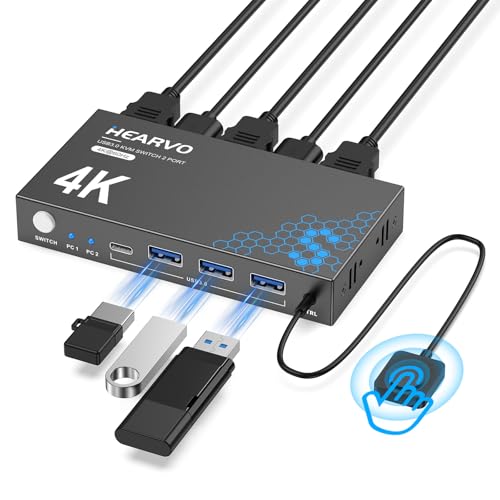
Single-monitor KVMs are the simplest arrangement. The UGREEN 8K HDMI KVM Switch for two computers, the UGREEN four-computer model, the TCNEWCL eight-port unit, the MLEEDA 16-port unit, the TESmart four-computer model, and the Hearvo switch all document one shared monitor. These products suit desks where each host uses the same display and the main goal is to avoid moving a keyboard, mouse, and other USB accessories between systems.
Dual-monitor KVMs require more planning because each computer must provide two video connections. The UGREEN dual-monitor HDMI model documents two HDMI cables plus one USB-A cable per computer. The ATLAHET four-computer dual-monitor switch also requires two HDMI ports on each computer. The TJCXELE three-computer model follows the same general dual-screen concept and documents extended and copy modes. These designs are appropriate when both screens should follow the selected computer.
A triple-monitor layout is available from the UGREEN model with two DisplayPort 1.4 outputs and one HDMI 2.1 output. It requires two DisplayPort connections and one HDMI connection from each computer. Check the computer’s physical outputs before choosing a mixed-output KVM; a system with only HDMI ports would not match this documented connection plan.
Compare resolution and refresh-rate claims
Resolution support should be checked at both ends of the connection. Several selected models list 8K at 60Hz, including the TESmart, the dual-monitor and four-computer UGREEN models, the UGREEN triple-monitor model, and the ATLAHET dual-monitor model. The same listings also identify lower-resolution modes such as 4K or 1080p. The TCNEWCL, TJCXELE, and Hearvo models document 4K at 60Hz, while the MLEEDA model documents 4K at 60Hz for its 16-host design.
Refresh rate matters when the monitor and computer are intended to use a faster mode. The TESmart listing specifies 4K at 144Hz, the UGREEN four-computer model lists 4K at 240Hz, and the UGREEN dual-monitor model also lists higher 4K refresh rates. These are specifications, not independent performance results. To achieve any listed mode, the computer, KVM, display, and cable must all support the required standard. The UGREEN triple-monitor model also documents VRR, FreeSync, and G-Sync support, which may matter for compatible display setups.
Count USB ports and device types
USB capacity determines how much of the desk can be shared. Most selected switches provide four USB 3.0 ports, commonly described as a mix of keyboard, mouse, printer, storage, or webcam connections. The UGREEN dual-monitor and four-computer models each specify three USB-A ports and one USB-C port. The Hearvo model documents the same port mix, while the TJCXELE and ATLAHET models document four USB 3.0 ports without the same port breakdown.
The TESmart model expands the peripheral design with four USB 3.0 ports, two USB 1.1 ports for keyboard and mouse, two charging-capable USB ports, audio, microphone, and Gigabit Ethernet. MLEEDA goes in another direction with six USB 3.0 ports plus SD and TF card slots. Those additional interfaces are useful only when they match the devices you intend to connect, so avoid choosing a more elaborate layout if your desk needs only a keyboard, mouse, and display.
Choose the switching method
Every selected product documents a physical switching method, but the control options differ. Front-panel buttons are common and keep the basic action close to the KVM. Desktop controllers place the selection button on the desk or within reach while the main unit can sit farther away. UGREEN, Hearvo, TJCXELE, and several ATLAHET models document this external-control approach.
The TESmart model offers the broadest control list: panel buttons, custom hotkeys, an infrared remote, mouse-wheel switching, and auto-scan. TCNEWCL adds both a wired controller and infrared remote for its eight inputs. MLEEDA documents panel buttons, a digital wired remote, and RS232. By contrast, the ATLAHET four-computer dual-monitor model explicitly states that hotkey switching is not supported. Read the switching details carefully if keyboard shortcuts or remote selection are important to your workspace.
Check EDID, power, and operating-system notes
EDID features can affect how a computer handles display information when the active input changes. The TESmart, MLEEDA, TJCXELE, ATLAHET four-computer dual-monitor, and Hearvo listings document EDID emulation or adaptive EDID. These claims describe the included design; they should not be treated as independent testing results. If preserving display parameters or window arrangement matters, prioritize a model that explicitly documents EDID behavior.
Power requirements vary. The UGREEN triple-monitor model says to connect its power adapter for normal use. The Hearvo listing instead states that no separate power supply is required. Follow the supplied connection instructions, particularly when sharing hard drives, webcams, or other devices that may draw more power.
Finally, verify operating-system and device compatibility. UGREEN’s selected models document Windows, macOS, and Linux support. TESmart documents broad computer and device use, while MLEEDA lists Windows, Mac OS, Linux, and Chrome OS. The UGREEN triple-monitor model adds a specific USB-C laptop note requiring an adapter when the laptop lacks USB-A. These details can matter more than headline video numbers when the source computers use different ports.
Final Recommendation
TESmart 8K HDMI KVM Switch, 4 Computers ranks first overall in this specification-based comparison under the published weighted criteria.
The final choice among the best hdmi kvm switches depends on the documented features that match your intended use.
TESmart 8K HDMI KVM Switch 4 Computers 1 Monitor is the first overall specification-based choice among these top hdmi kvm switches. Its four-host layout, 8K and high-refresh support, EDID emulators, Ethernet, audio, microphone, powered USB ports, and broad control options give it the most complete documented feature set.
For a two-monitor HDMI desk, the UGREEN 8K HDMI KVM Switch Dual Monitor is the more direct match. It documents extend and mirror modes, four USB 3.0 ports, and two ways to switch. The UGREEN triple-monitor model is the better fit when two DisplayPort outputs and one HDMI output are available from each computer. For many hosts on one screen, MLEEDA’s 16-port model and TCNEWCL’s eight-port model provide the clearest high-density layouts.
Before selecting, confirm the number of video outputs on every computer, the monitor resolution and refresh target, the USB-A or USB-C connection plan, the need for EDID, and whether the unit requires external power. Those checks narrow the field more reliably than choosing by a headline specification alone.
Frequently Asked Questions
What should I check first when choosing the best hdmi kvm switches?
Start with the number of computers and monitors. A one-monitor KVM cannot replace a dual- or triple-monitor model, and dual-monitor products generally require two video connections from every computer. Then check the USB connection used to share the keyboard, mouse, and other devices. The UGREEN dual-monitor model, for example, specifies two HDMI cables and one USB-A cable per computer.
Do HDMI KVM switches support extended displays?
Some do, but the feature depends on the specific design and the computer’s graphics capability. The UGREEN dual-monitor, UGREEN triple-monitor, ATLAHET dual-monitor, and TJCXELE models document extended and mirror or copy modes. The dual-monitor listings also state that the computers must support the required number of simultaneous displays. Confirm the computer’s graphics outputs before relying on an extended layout.
Why does EDID matter in a KVM switch?
EDID is used to communicate display information between the computer and monitor. Selected models from TESmart, MLEEDA, TJCXELE, ATLAHET, and Hearvo document EDID emulation or adaptive EDID. These features are intended to help the computer retain or recognize display parameters during input changes, but the exact behavior depends on the connected equipment and the product’s implementation.
Do I need an externally powered HDMI KVM switch?
Not always. The Hearvo listing states that its switch does not require a separate power supply, while several multi-monitor and high-density models document external adapters for stable operation. Power becomes especially relevant when the KVM shares devices such as hard drives or webcams. Follow the selected model’s instructions and confirm whether the adapter is included before planning the installation.
Can a KVM switch share audio or network access as well as video?
Some models document those extra functions. TESmart’s selected four-computer KVM includes Gigabit Ethernet, audio, microphone, and USB connectivity. Other selected products focus on HDMI or DisplayPort video and USB peripherals. If network or audio sharing is required, choose a model that explicitly lists those ports rather than assuming every HDMI KVM includes them.