Buying Guide
Choosing the best slot cutter router bits starts with the joint or groove you need to make, then moves to the router’s collet and the material being cut. The listings in this comparison cover single-size assemblies, bearing-guided cutters, and sets with several cutters or shims. Because this is a specification-based comparison, the guidance below stays within the supplied product descriptions and specifications rather than claiming hands-on results.
Match the slot height to the joint
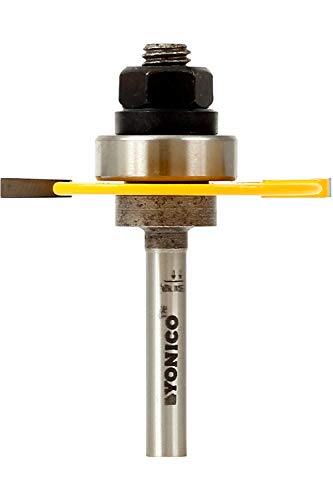
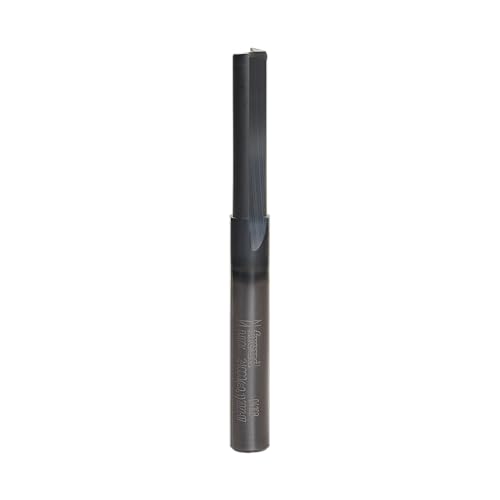
Slot height, kerf, or cutting height is the most important dimension when the cutter must fit a biscuit, spline, panel, or mating component. The Yonico 12103q lists a 1/8-inch slot, while the Yonico 12104q lists 5/32 inch and the Yonico 14180 lists 3/16 inch. These single-size choices are useful when the required dimension is already known.
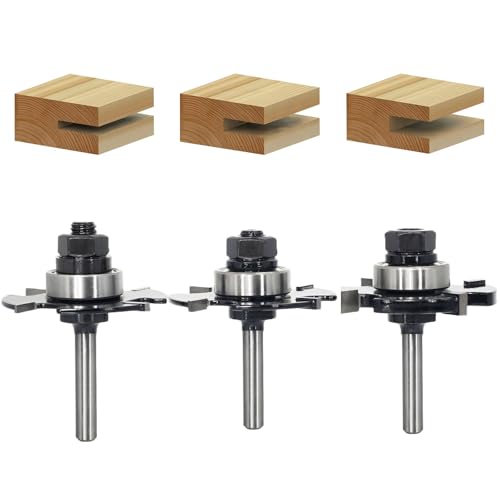
Sets are better suited to changing requirements. The Meihejia set lists six sizes from 5/64 to 1/4 inch. The WSOOX set lists five heights from 5/64 to 1/4 inch, and the SICWOOD three-piece set lists 1/4-, 1/8-, and 3/32-inch heights. CMT goes further with four cutters and 17 shims covering materials from 1/8 to 23/32 inch in height. That range is especially relevant when one router bit must support several joinery layouts.
Do not treat similar-looking size lists as interchangeable. A listed cutting height is not the same as cutting depth, and the two dimensions serve different purposes. Confirm both before ordering.
Check cutting depth and reach
Cutting depth describes how far the cutter can enter the workpiece or reach across an edge, depending on the design. Freud’s 63-162 and 63-112 list a 9/16-inch cut depth. The SICWOOD three-piece set also lists 9/16 inch, while the WSOOX set lists 1/2 inch and the Meihejia set lists a maximum of 1/2 inch. Yonico’s 14180 lists a deeper 3/4-inch cutting depth for its 3/16-inch biscuit-slot profile.
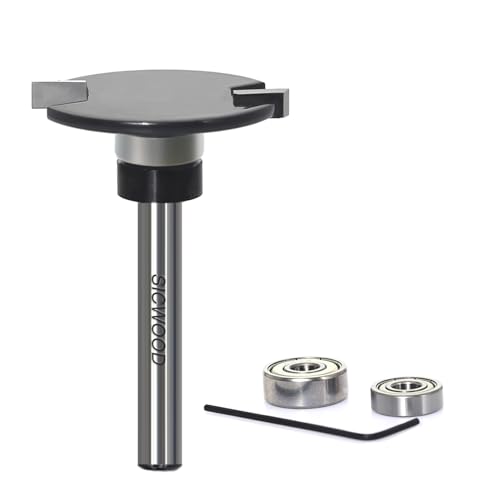
The SICWOOD top-bearing cutter lists a 31/64-inch depth and includes 3/4- and 5/8-inch bearings. The supplied description gives separate depth figures for those bearing choices, so it offers a way to change the guided setup without changing the cutter itself. Bearing selection does not replace checking the required slot dimensions; it changes the documented configuration around the cutter.
Verify the router shank
A 1/4-inch shank is documented for the Meihejia, WSOOX, SICWOOD, Freud 63-112, Yonico 12103q, and Yonico 12104q products. Those choices are aimed at routers accepting a 1/4-inch collet. The CMT set, Freud 63-162, and Yonico 14180 use 1/2-inch shanks. A 1/2-inch option should therefore be considered only when the router and collet support it.
Router-use claims also vary. Several products state compatibility with both handheld and table-mounted routers. WSOOX additionally lists CNC and automatic routers. By contrast, both SICWOOD listings explicitly say they cannot be used on CNC equipment. Meihejia is described for handheld and table-mounted routers and specifically excludes electric drills and drill machines. These machine restrictions are part of the selection decision, not minor details.
Compare cutter construction
Construction details help distinguish otherwise similar dimensions. Yonico’s selected models specify C3 micro-grain tungsten carbide blades and silver induction brazing. SICWOOD specifies C3 micro-grain carbide, and Meihejia specifies C3 carbide blades, alloy-steel bodies, and a heat-resistant Teflon coating. WSOOX lists YG8 carbide steel and a heat-resistant coating. Freud lists Silver ICE Coating on both selected Freud sets.
These are documented materials and coatings, not a guarantee of cutting life or finish. The Meihejia listing includes a specific limitation: its thin blade is not suitable for high-hardness wood. WSOOX cautions that short clamping might cause bending. Keep those warnings in view when comparing the best slot cutter router bits for a particular setup.
Decide between a single cutter and a set
A single cutter is efficient when the required slot size is fixed. The Yonico 12103q and 12104q provide distinct thin-slot profiles, and the 14180 focuses on a 3/16-inch biscuit slot. The SICWOOD top-bearing model is also a single cutter, but its two additional bearings expand its documented depth options.
A set makes more sense when the work includes several materials, joint sizes, or panel thicknesses. Meihejia and WSOOX provide multiple cutting sizes, while SICWOOD supplies three heights. Freud’s sets include three wing cutters plus an arbor and bearing, and CMT includes four cutters, a bearing, and shims. Count the actual included components rather than relying on the word set alone.
Consider the intended material and application
The supplied listings mention slots, grooves, rabbets, joinery, biscuit joining, and tongue-and-groove work. CMT specifically lists biscuit joints and tongue-and-groove joints. Yonico 14180 is presented for biscuit joining, while the other Yonico assemblies are described for joinery and general slotting. SICWOOD and Meihejia list wood-based materials such as MDF, plywood, particleboard, and solid or softwood. WSOOX also lists acrylic and wood composites.
Material compatibility is not universal. If the listing names a material, use that information as the starting point. If it does not, avoid assuming that a cutter is suitable for a harder or different material merely because the dimensions appear appropriate.
Final Recommendation
Meihejia 6-Size Slot Cutter Router Bit Set ranks first overall in this specification-based comparison under the published weighted criteria.
CMT 800.506.11 is the highest-scoring returned product and the first overall specification-based choice among these best slot cutter router bits. Its four cutters, 17 shims, bearing, 1/2-inch arbor, and listed 1/8- to 23/32-inch height range give it the most specification-aligned documented adjustment range. It is particularly well matched to users who expect to make biscuit, tongue-and-groove, and other slotting setups rather than one fixed-size joint.
Freud 63-112 is the more focused 1/4-inch-shank alternative when a 9/16-inch depth and 1/4-inch carbide height meet the job. The SICWOOD three-piece set is a strong 1/4-inch option when three listed cutting heights are more useful than shims. WSOOX stands out for five heights and stated CNC compatibility, but its short-clamping caution should be checked against the router setup.
For a single known profile, choose among the Yonico 12103q, Yonico 12104q, or Yonico 14180 according to the required slot thickness and shank. The top slot cutter router bits are not interchangeable solely because they share a 1/4-inch shank: cutting height, depth, bearing arrangement, and machine restrictions still determine the appropriate match.
Frequently Asked Questions
What should I check first when choosing the best slot cutter router bits?
Check the required slot height and depth first, then confirm the router shank. A 1/4-inch shank and a 1/2-inch shank require different compatible collets. After that, review whether the product is intended for handheld, table-mounted, CNC, or other router use.
Are multi-size slot cutter sets better than single cutters?
They are more adaptable when the work calls for several slot heights. Meihejia, WSOOX, SICWOOD, and CMT list multiple cutting sizes or adjustment components. A single cutter can be the simpler choice when one fixed dimension is required, as with the Yonico 12103q or 12104q.
Which selected product offers the widest adjustment range?
CMT 800.506.11 lists a height range from 1/8 to 23/32 inch and includes 17 shims. That is broader than the fixed profiles and smaller multi-size ranges listed for the other selected products. Its 1/2-inch shank must still match the router.
Can these slot cutters be used on CNC routers?
The WSOOX listing states compatibility with CNC and automatic routers as well as handheld and table-mounted routers. The SICWOOD listings state that they cannot be used on CNC equipment. For the other selected products, the supplied evidence does not establish CNC compatibility, so consult the product documentation before use.
What is the difference between a top-bearing slot cutter and a standard setup?
A top-bearing design uses the bearing as part of the guided configuration. The selected SICWOOD top-bearing cutter includes 3/4- and 5/8-inch bearings and lists different depth configurations for them. Standard assemblies in this comparison may include a bearing as part of the arbor setup, but the exact design and dimensions should be checked for the particular product.