Buying Guide
Choosing among the best portable graphics tablets starts with a basic workflow question: do you want to draw directly on a screen, use a standalone Android tablet, or connect a slim input pad to a computer or phone? Those designs are not interchangeable. A standalone model can run drawing applications independently, while a pen tablet without a display maps pen movement to a separate host screen. A pen display places the canvas under the stylus but still depends on a compatible computer or other host.
Standalone tablets versus connected tablets
The HUION KAMVAS Slate 11, PicassoTab X11, and RubensTab T12 document standalone operation. These models are the most self-contained choices in the comparison because their descriptions say they need no computer. They also include internal processors, memory, storage, and batteries. That makes them suitable for sketching in locations where carrying a laptop is inconvenient. Their trade-off is that they are thicker or heavier than the smallest connected pads, and their operating environments are based on the supplied Android-oriented descriptions.
Connected tablets divide into two types. The Wacom Intuos Small, XPPen Deco 01 V3, GAOMON WH851, and UGEE Q6 are screenless pen tablets. They are generally easier to carry because the drawing surface is separate from the display. The computer, phone, or Chromebook shows the artwork, while the tablet provides pen input. This design can be a good fit for people who already work in desktop creative software or want a compact annotation device.
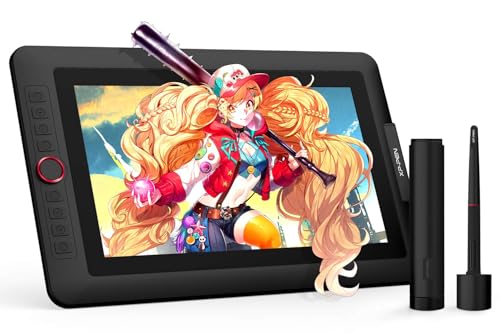
The UGEE UE12, VEIKK VK1200 V2, and XPPen Artist 13.3 Pro are pen displays. Their screens let you draw over the visible canvas, which may feel more direct for illustration and photo-editing workflows. Their descriptions also make clear that they need a compatible host connection. Before choosing one, check whether the computer supports the required USB-C, HDMI, USB, or adapter arrangement.
Screen and surface features
For screen models, look closely at size, resolution, lamination, glare treatment, and color information. The HUION KAMVAS Slate 11 has a 10.95-inch 1920×1200 display, 207 PPI, 99% sRGB coverage, and a 90Hz refresh rate. The PicassoTab X11 lists an 11-inch 2K laminated display, while the RubensTab T12 lists a 12-inch Full HD laminated display. These specifications describe different priorities: pixel density and refresh rate on the HUION, resolution and paper-like lamination on the PicassoTab, and a larger standalone canvas on the RubensTab.
Among connected displays, the XPPen Artist 13.3 Pro has the largest listed screen at 13.3 inches and documents 88% NTSC coverage. The UGEE UE12 lists an 11.6-inch FHD screen and 124% sRGB coverage. The VEIKK VK1200 V2 also uses an 11.6-inch laminated anti-glare display. Full lamination appears across these products and is described as reducing parallax or improving cursor accuracy. Treat that as a design feature rather than a guarantee about real-world results.
Screenless pads require a different evaluation. Their working-area size matters more than display resolution. The XPPen Deco 01 V3 offers a 10-by-6.25-inch area, while the GAOMON WH851 lists 8 by 5 inches. The UGEE Q6 and Wacom Intuos Small are more compact. A larger area can provide room for broad gestures, but a smaller one may fit more easily beside a laptop or in a travel bag.
Stylus and control layout
Battery-free pens are documented on the Wacom Intuos Small, XPPen Deco 01 V3, GAOMON WH851, UGEE Q6, UGEE UE12, VEIKK VK1200 V2, and XPPen Artist 13.3 Pro. This removes pen charging from the listed workflow. Pressure figures vary: the HUION KAMVAS Slate 11, PicassoTab X11, and RubensTab T12 list 4096 levels, while several connected models list 16,384 levels. The evidence also documents 60° tilt on the HUION, XPPen Deco, GAOMON, UGEE Q6, VEIKK VK1200 V2, and XPPen Artist.
Shortcut controls can be just as important as pen specifications. The GAOMON WH851 combines eight keys with a central dial. The VEIKK VK1200 V2 has six programmable keys, the XPPen Deco 01 V3 has eight, and the UGEE UE12 has eight. The Wacom Intuos Small has four ExpressKeys. The HUION KAMVAS Slate 11, PicassoTab X11, and RubensTab T12 emphasize standalone applications rather than a documented hardware shortcut array. Pick a control layout that matches the actions you repeat most often, such as zooming, changing brush size, undoing, or switching tools.
Compatibility and portability
Compatibility claims vary considerably. The HUION KAMVAS Slate 11, PicassoTab X11, and RubensTab T12 are described as independent tablets. The Wacom Intuos Small supports Chromebook, Mac, Android, and Windows. The XPPen Deco 01 V3 supports Windows, macOS, Android, Chrome OS, and Linux, and the UGEE Q6 lists the same broad desktop and mobile families. The GAOMON WH851 lists Windows, Android, and Mac. Check the exact operating-system version and application requirements before selecting a mobile workflow.
Physical dimensions also help separate the top portable graphics tablets. The UGEE Q6 lists a 249g weight, the Wacom Intuos Small lists 0.55 pounds, and the GAOMON WH851 lists about 0.88 pounds. The VEIKK VK1200 V2 lists about 1.78 pounds, while the XPPen Artist 13.3 Pro lists about 4.41 pounds. A larger screen can improve viewing space but may require more room and a more deliberate carrying setup. The XPPen Deco 01 V3 is listed at 8mm thick, and the HUION KAMVAS Slate 11 lists an 8000mAh battery, showing two different approaches to portable use.
Final recommendation
HUION KAMVAS Slate 11 ranks first overall in this specification-based comparison under the published weighted criteria.
HUION KAMVAS Slate 11 is the highest-scoring returned product and the first overall specification-based choice among the best portable graphics tablets. Its independent Android workflow, sharp FHD+ display, 90Hz refresh rate, laminated matte surface, 8GB RAM, and expandable storage give it the broadest documented combination of mobility and drawing features.
Choose the PicassoTab X11 or RubensTab T12 if standalone operation matters more than a computer-connected setup. Select the XPPen Artist 13.3 Pro, UGEE UE12, or VEIKK VK1200 V2 when a direct-drawing display is the priority. For a screenless pad, the GAOMON WH851 stands out for wireless connectivity and dial control, while the UGEE Q6 and Wacom Intuos Small emphasize compact carrying. The XPPen Deco 01 V3 is a practical middle ground with a large active area, 16K pen, and broad compatibility. Together, these are the top portable graphics tablets for distinctly different documented workflows.
Frequently Asked Questions
What are the best portable graphics tablets for drawing without a computer?
The HUION KAMVAS Slate 11, PicassoTab X11, and RubensTab T12 are the selected standalone models. Their supplied descriptions explicitly say they do not need a computer and identify internal software, storage, and battery features.
Should I choose a screenless tablet or a pen display?
Choose a screenless tablet such as the Wacom Intuos Small, XPPen Deco 01 V3, GAOMON WH851, or UGEE Q6 if you are comfortable viewing the work on a connected host display. Choose a pen display such as the UGEE UE12, VEIKK VK1200 V2, or XPPen Artist 13.3 Pro if drawing directly over the visible canvas is more important. The pen-display models still require a compatible host connection according to their descriptions.
Which selected tablet has the most portable design?
The UGEE Q6 lists a 249g weight and a detachable built-in Type-C cable. The Wacom Intuos Small lists a 0.55-pound weight, and the GAOMON WH851 lists about 0.88 pounds while adding Bluetooth. These figures make them especially suited to carrying between locations, although the Q6 and Wacom have smaller working surfaces than the larger pads.
Do any of these tablets support wireless connection?
The Wacom Intuos Small documents Bluetooth and USB-A connectivity. The GAOMON WH851 documents Bluetooth 5.0 and wired USB-C connectivity. The remaining selected connected tablets describe wired connections or adapters in the supplied evidence, so verify the required cable arrangement for your host device.
What should I check before using a tablet with a phone or Chromebook?
Confirm the operating-system version, application support, cable or adapter requirements, and any stated exceptions. The XPPen Deco 01 V3, UGEE Q6, Wacom Intuos Small, and GAOMON WH851 document mobile or Chromebook compatibility, while the HUION KAMVAS Slate 11, PicassoTab X11, and RubensTab T12 are standalone products. Compatibility should be matched to the specific device and software you plan to use.