Buying Guide
The best rescue climbing ropes are not interchangeable simply because they share a static label. A useful comparison starts with intended use, documented strength, diameter, length, construction, and compatibility with the hardware used in the system. The products above are ranked from listing specifications and stated applications. They were not hands-on tested, and this comparison does not establish that any product is approved for a particular professional rescue procedure.
Start with the rope type
Static rope is the dominant design in this comparison. Static or low-ductility construction is intended to limit stretch and provide more predictable positioning during rappelling, hauling, access, or rescue-oriented work. That does not mean every static rope is suitable for catching a lead fall. AOLEBA 10.5 mm Static Climbing Rope, AOLEBA 8.5 mm Static Climbing Rope, and DoMyfit 11 mm Static Safety Rope all explicitly describe static behavior. The AOLEBA 8.5 mm listing also states static elongation below 1%.
A dynamic rope serves a different purpose because it is designed to elongate under a fall. None of the selected products should be treated as a substitute for a documented dynamic system. Read the manufacturer’s instructions and confirm the intended use before connecting a rope to a person.
Compare diameter and device compatibility
Diameter affects more than strength. It can change how a rope fits a belay device, descender, ascender, pulley, rope grab, or other connector. The selected products range from 8 mm for NTR and X XBEN to 12 mm for LZ.MZXU. AOLEBA 8.5 mm is narrower than several alternatives, while DoMyfit is 11 mm and LZ.MZXU is 12 mm.
A thicker rope may be easier for some users to grip, but it can also be too large for a particular device. A thinner rope may be lighter and easier to carry, yet it may demand more careful compatibility checks. The evidence supplied here does not give a universal device chart for every product, so check the working range of every component rather than assuming that two items will fit together.
The listed strength figures are useful for comparison but should not be treated as working-load limits. AOLEBA 10.5 mm lists a 23 kN maximum tensile force. DoMyfit lists 26 kN, Lopevex lists the current price, and VEVOR lists the current price or 35.58 kN. Other selected ropes list values such as 20 kN for LZ.MZXU, 18 kN for NorthPada, and 15 kN for both NTR and X XBEN.
Breaking strength or maximum tensile force does not account for knots, edge contact, abrasion, shock loading, connectors, anchors, angles, wear, or rope condition. A rescue system should be designed around its weakest component and an appropriate safety factor. Use only working-load guidance and procedures supplied or approved by the manufacturer or a qualified authority.
Match length to the job
Length is one of the clearest practical differences. GINEE lists lengths from 35 to 250 feet, while AOLEBA 8.5 mm lists configurations from 32 to 230 feet. AOLEBA 10.5 mm offers 10 to 70 meters, and LZ.MZXU lists 32, 65, 100, and 164 feet. These choices are useful when the same rope family must cover different access heights or training arrangements.
Shorter ropes can be easier to store and carry. NorthPada’s 32-foot kit and DoMyfit’s 10-meter rope may suit compact tasks, but they may not reach the required anchor or descent point. Longer ropes such as Lopevex at 150 feet and VEVOR at 120 feet provide more reach but add bulk and require careful storage, inspection, and deployment planning.
Examine sheath and end treatment
Construction details indicate how a rope is intended to handle outdoor use. AOLEBA 10.5 mm describes high-tenacity nylon, while several other ropes use polyester. NTR lists a reinforced polyester sheath and nylon core. VEVOR and Lopevex use braided polyester constructions, and both describe sealed or protected ends. Heat-sealed ends can help reduce unraveling at the cut end, but they do not eliminate the need for inspection.
Look for evidence relevant to the environment. Lopevex lists resistance to moisture, UV exposure, and abrasion. AOLEBA 8.5 mm lists UV resistance and abrasion resistance. DoMyfit describes a tightly woven sheath, while X XBEN emphasizes a low outer-skin sliding rate. These are listing claims, not independent test results, so they should inform questions rather than replace inspection or certification review.
Consider visibility and included hardware
Bright colors can make a rope easier to locate in outdoor or low-light conditions, but color is not a safety certification. AOLEBA 10.5 mm is listed in bright green, NTR in orange, and NorthPada describes a reflective orange design. Visibility can help with organization and identification when several lines are deployed.
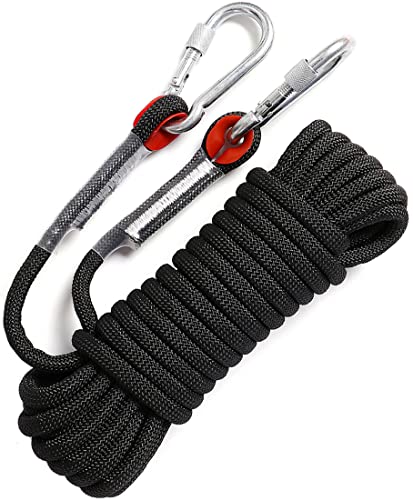
Some products include hardware. LZ.MZXU lists two carabiners and a carrying bag, NTR lists steel rings and carabiners, NorthPada includes an integrated hook, and X XBEN lists two sewn hook ends. Included hardware may make a kit convenient, but the supplied evidence does not establish that every included connector is appropriate for life-safety use. Verify each component’s rating and intended application independently.
Inspect, store, and retire correctly
A rope is a life-safety component only when it is compatible, maintained, and used within its instructions. Before use, check for sheath damage, unusual stiffness, contamination, chemical exposure, heat damage, pulled fibers, damaged stitching, and altered ends. Keep it away from sharp edges, excessive heat, chemicals, and uncontrolled abrasion. Store it clean and dry according to the manufacturer’s guidance.
Do not rely on a rope after a serious loading event or when its history is unknown. The DoMyfit listing specifically warns against over-speed drops and gives a storage or use temperature limit below 80 degrees Celsius. That reminder reinforces a broader point: a specification comparison cannot determine whether a used rope remains serviceable.
Scoring method
The published criteria assign 25% to documented load strength, 20% to static control and low stretch, 20% to construction and outdoor durability, 15% to length and configuration options, 10% to handling and visibility features, and 10% to documented rescue utility. Scores use only supplied technical and feature evidence. They do not use ratings, current listing information, purchase activity, or marketplace badges. This is a specification-based comparison, not a hands-on test.
Final recommendation
AOLEBA 10.5 mm Static Climbing Rope ranks first overall in this specification-based comparison under the published weighted criteria.
AOLEBA 10.5 mm Static Climbing Rope is the first overall specification-based choice among the best rescue climbing ropes in this comparison. Its 23 kN stated tensile force, 10.5 mm diameter, multiple length options, bright color, rope bag, and explicit fire-rescue and escape references give it a balanced documented profile.
For long working reach, Lopevex 1/2-Inch Static Arborist Rope and VEVOR 1/2-Inch Double-Braided Rope are useful alternatives based on length and stated strength. DoMyfit 11 mm is a strong option for users who prioritize a high stated kN figure in a shorter configuration. AOLEBA 8.5 mm suits users seeking a low-stretch, lighter design when compatible hardware is confirmed. LZ.MZXU is worth considering when a larger diameter and included hardware are useful.
The top rescue climbing ropes still need to be evaluated as part of a complete system. Confirm diameter ranges, connector ratings, anchor requirements, inspection intervals, and training procedures before use. No listing alone can establish that a rope is appropriate for every rescue scenario.
Frequently Asked Questions
Are the best rescue climbing ropes always static ropes?
No. The selected products are primarily static or low-ductility ropes because their listings describe rappelling, access, rescue, escape, tree work, or hauling. Dynamic ropes are designed for different fall-management purposes. Choose according to the specific system and manufacturer instructions rather than the word rescue in a product title.
Which selected rope has the broadest listed length range?
GINEE lists lengths from 35 to 250 feet, giving it the broadest stated range in this comparison. AOLEBA 8.5 mm also offers a wide range, from 32 to 230 feet. The correct length depends on anchor position, descent distance, backup requirements, storage, and the procedure being performed.
Is a higher kN number automatically safer?
No. A higher listed tensile or breaking-strength figure is only one specification. Knots, bends, abrasion, heat, connectors, anchors, loading direction, rope age, and inspection condition all affect a working system. Use the manufacturer’s working-load guidance and a qualified rescue procedure rather than comparing the headline number alone.
Can included carabiners or hooks be used for rescue?
Not automatically. LZ.MZXU, NTR, NorthPada, and X XBEN list included connection hardware, but the supplied evidence does not establish that every included item is approved for life-safety rescue use. Check individual markings, ratings, compatibility, and manufacturer instructions before relying on any connector.
What should I check before using a rescue-oriented rope?
Check the diameter against every device, inspect the sheath and ends, confirm the rope’s history, review environmental limits, and verify the anchor and connector system. Also confirm whether the listing’s stated certification applies to the exact rope configuration you are buying. Use appropriate training and follow a documented procedure.