Buying Guide
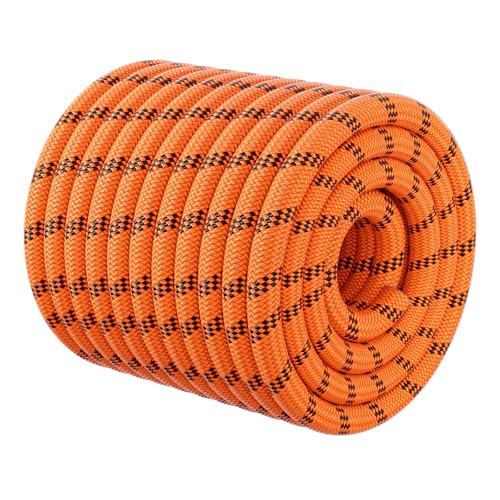
Selecting the best braided climbing rope requires more than comparing diameter or a headline strength number. The supplied listings cover several different designs: static climbing rope, double-braided arborist rope, compact accessory-style rope, and heavy-duty bull rope. Those categories overlap in their outdoor uses, but they are not interchangeable. Start by identifying whether the job calls for controlled low-stretch behavior, a long utility line, a thick rigging rope, or a shorter rope for practice and secondary systems.
Match the rope type to the task
Static rope appears repeatedly in the selected products. AOLEBA explicitly identifies its 10.5 mm rope as static and describes it for climbing, rescue, escape, and outdoor activities. NewDoar also describes a low-ductility static rope, while Lopevex and Ezjsdltech emphasize low stretch for rappelling, rigging, and pulling. Static construction can be useful when controlled positioning is the priority, but the AOLEBA listing specifically warns that it is not the dynamic type associated with ductility and shock absorption.
Arborist rigging rope is another major design group. Glfcai, Keepark, HOKINETY, and JANJOSN are framed around tree work, pulling, lowering, or rigging. These ropes may also be listed for climbing, camping, swings, or marine use, but the application language matters. A rope marketed primarily for arborist work should be evaluated against the equipment, working-load limits, and procedures used in that activity rather than treated as a universal climbing line.
Compare braid construction
Braiding affects the information available about the rope’s structure and intended handling. The selected products include 48-strand and 72-strand designs, as well as double-braided constructions with separate sheath and core descriptions. Glfcai lists a 48-strand high-density sheath and calls the rope a double-braid kernmantle. VEVOR also specifies 48 strands and a twisted inner core.
A more detailed construction description is useful because it lets you compare products on more than marketing language. Look for the stated sheath and core materials, strand count, and whether the listing identifies a double braid. Polyester appears frequently in the selected ropes because the listings associate it with outdoor resistance and stable handling. Keepark is different in that its evidence describes nylon inner cores with a polyester sheath. That mixed construction may be useful for its intended low-stretch utility profile, but it is another reason to read the material information closely.
Use breaking strength carefully
Breaking strength is not the same as a recommended working load. Several listings make this distinction explicit. Glfcai states a 9,000-pound minimum breaking strength and a 900-pound safe working load. Ezjsdltech gives approximately the current price of breaking strength and approximately the current price as its safe working load. VEVOR states an 8,000-pound breaking strength and separately suggests working within the current price.
These figures should not be combined casually or treated as a guarantee for a particular setup. Knots, hardware, wear, angle, shock loading, and the condition of the rope can affect a system. When a listing provides a safe working load, use that information as the more relevant starting point for the stated application. When it provides only a breaking-strength number, the capacity picture is less complete. HOKINETY is a good example of why careful reading matters: its feature text contains inconsistent strength figures, so its capacity should be verified before use.
Choose diameter and length deliberately
Diameter influences how the rope fits the intended hardware and how much material must be carried. NewDoar’s 8 mm rope is among the smaller selected options and is described as light enough to carry to a crag. AOLEBA uses a 10.5 mm diameter. The 3/8-inch HOKINETY model provides a lighter arborist format, while Lopevex, VEVOR, Ezjsdltech, Glfcai, and DerziNet use 1/2-inch formats. JANJOSN is the thickest selected option at 3/4 inch.
Longer lengths are useful for extended routes, lowering operations, and large outdoor setups, but they also add bulk. AOLEBA lists several length choices, while Lopevex and Glfcai provide 150-foot options. VEVOR lists 120 feet, and several other choices use 100 feet. NewDoar’s shorter pre-cut options may be more practical for compact systems or practice. Keepark requires special attention because its title and feature text state different lengths; confirm the actual variation before ordering.
Consider handling and end finishing
Handling claims are consistent across many of the selected listings. Lopevex describes a smooth grip and knot-tying capability. DerziNet says its twisting process is intended to keep the rope flexible rather than stiff. Ezjsdltech emphasizes flexible knot handling. By contrast, Glfcai says its tightly woven professional-grade design is deliberately stiff at first and may need a mechanical break-in period. That trade-off may be acceptable for abrasion resistance, but it is not ideal for every user.
End finishing is another practical detail. VEVOR, Keepark, HOKINETY, and Ezjsdltech mention heat-fused or heat-sealed ends intended to reduce fraying. Always inspect the actual end treatment and follow the manufacturer’s care and use instructions.
Check certification and documentation
Certification language can make a listing easier to evaluate, but it should be read exactly as presented. AOLEBA states CE certification to EN 892:2012+A2:2021 and supplies a certificate number. NewDoar references ASTM F2116, and Glfcai states ASTM F2116 certification. These details do not replace task-specific training or inspection, but they provide more documentation than a listing that supplies only a general strength claim.
A clear listing also distinguishes intended use from general versatility. Glfcai names arborist rigging and heavy-load lowering as primary purposes. AOLEBA lists climbing, rescue, and outdoor uses. NewDoar includes hauling, Prusik work, and rescue. Read the use description alongside diameter, construction, and load data rather than selecting solely by the longest list of applications.
Final Recommendation
Glfcai 1/2-Inch 150-Foot Arborist Rigging Rope ranks first overall in this specification-based comparison under the published weighted criteria.
The final choice among the best braided climbing rope depends on the documented features that match your intended use.
Glfcai 1/2-Inch 150-Foot Arborist Rigging Rope is the highest-scoring returned product and the first overall specification-based choice. Its combination of a 48-strand double-braid description, 9,000-pound minimum breaking strength, stated safe working load, ASTM F2116 certification, and low-elongation positioning gives it the most complete evidence profile in this comparison. It is especially appropriate for shoppers who want documented limits for arborist rigging and controlled lowering.
AOLEBA is the stronger alternative when certification detail, multiple length choices, and a 10.5 mm static format matter most. Lopevex is compelling for a 150-foot, 1/2-inch rope with a 48-strand design and broad outdoor utility. VEVOR suits buyers who want a 120-foot double-braided line with heat-sealed ends, while Ezjsdltech offers a useful balance of 100-foot length, stated safe working load, and flexible handling.
For compact use, NewDoar’s 8 mm options and pre-cut lengths are easier to carry, though their smaller format calls for careful system matching. JANJOSN is the thick-line choice for heavy arborist work, while HOKINETY and DerziNet cover lighter or balanced utility applications. Keepark stands out for low-stretch positioning but deserves a length check because the listing is inconsistent. Together, these choices cover the main specifications to compare when looking for a top braided climbing rope.
Frequently Asked Questions
Is the best braided climbing rope always dynamic?
No. Several selected products are explicitly static or low-stretch, including AOLEBA, NewDoar, Lopevex, and Ezjsdltech. Static rope is presented for controlled positioning, rigging, hauling, or rappelling. AOLEBA’s listing specifically distinguishes its static design from dynamic rope behavior, so buyers should identify whether their application requires low elongation or shock absorption before choosing.
What diameter should I choose?
Choose the diameter that matches the equipment and application instructions for the system. The selected range runs from NewDoar’s 8 mm rope to JANJOSN’s 3/4-inch rope, with 10.5 mm, 3/8-inch, and 1/2-inch options between them. Smaller rope may be easier to carry, while larger rope can provide a thicker handling surface, but diameter alone does not establish suitability or capacity.
Is breaking strength the same as safe working load?
No. Breaking strength describes the stated force at which a rope may fail under test conditions, while safe working load is a lower use figure when the listing provides one. Glfcai and Ezjsdltech provide both types of information. VEVOR also separates its stated breaking strength from a suggested working figure. Use the manufacturer’s working-load guidance rather than treating the breaking-strength number as a usable operating limit.
Are polyester braided ropes suitable for outdoor use?
The selected listings commonly describe polyester ropes as resistant to outdoor factors such as moisture, UV exposure, abrasion, chemicals, or weather. VEVOR, Glfcai, HOKINETY, and DerziNet provide examples of this documentation. These claims do not remove the need for inspection, correct storage, and application-specific procedures. Follow the product’s stated limits and replace rope that shows damage or unacceptable wear.
What should I verify before ordering?
Confirm the rope type, diameter, length, braid construction, material, strength figures, safe working load, end treatment, and any certification reference. Also check whether the listing contains conflicting information. Keepark has inconsistent length details, and HOKINETY presents conflicting strength figures in its features. Verifying those points before purchase is particularly important when the rope will support people, loads, or elevated work.