Buying Guide
The best strong ropes are selected by matching the rope’s documented specifications to the task, not by treating every large-looking cord as interchangeable. A rope for tree work has different priorities from one for camping repairs, a clothesline, or a decorative swing project. Start with the load information, then check construction, environment, handling, and length.
Define the job before comparing strength
First separate utility work from applications involving people or elevated loads. Keepark and HOKINETY are positioned for arborist work, pulling, and rigging, while X XBEN is presented for climbing-related, escape, rescue, and caving uses. Those descriptions identify intended applications, but they do not by themselves establish that a product is certified for a particular life-safety system. Follow the manufacturer’s instructions and any applicable professional requirements before using rope where failure could cause injury.
For ordinary securing, camping, gardening, bundling, and DIY tasks, a general-purpose rope may be more suitable. GIAHAND explicitly distinguishes a 1,300-pound breaking force from a 310-pound working force and warns against overhead lifting, human-weight support, and athletic equipment. That distinction is important: a breaking figure is not automatically a recommended working load.
Read breaking strength and working load correctly
The supplied listings use different terms. Keepark states a 9,000-pound capacity, HOKINETY lists a 3,500-pound breaking strength for the specified 3/8-inch format, and X XBEN lists a 15 kN maximum tensile force. Other products provide working figures: Glfcai states the current price, MaxxHaul states a 500-pound working load limit, and Koch states the current price. These numbers should not be compared as if they describe exactly the same test or operating condition.
Knots, bends, abrasion, hardware, edge contact, weather, and the way a load is applied can affect actual rope performance. GIAHAND specifically notes that knots can reduce strength by up to 50 percent. Use the most conservative applicable working information, inspect the rope regularly, and do not infer a safe load from diameter alone.
Choose the construction for control and durability
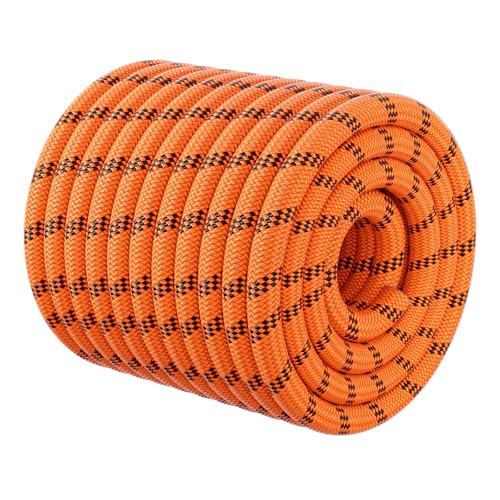
Double-braided designs put a sheath over a core. Keepark lists 28 inner high-tenacity nylon cores and a reinforced 96-strand polyester sheath. HOKINETY describes a 48-strand double-braided outer layer with an 8-strand inner core. These layered structures are relevant when you want a rope that combines a defined load figure with a substantial construction.
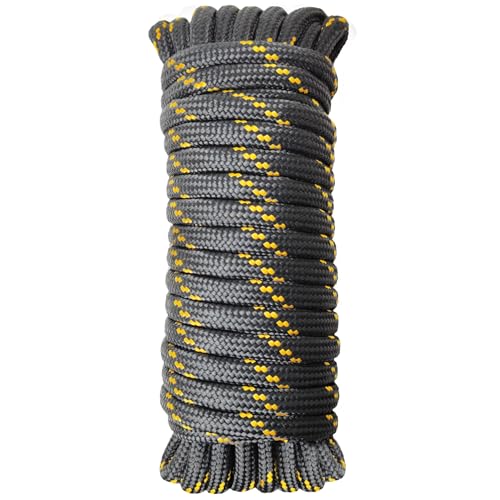
Diamond-braided ropes are common for general utility. MaxxHaul uses a non-woven core and textured diamond braid, while GIAHAND uses a nylon and polypropylene mix. These profiles emphasize handling, flexibility, and routine securing. Koch uses twisted polypropylene and is positioned for bundling, gardening, fencing, and cargo tying. Twisted rope can be a sensible choice when the job is simple and the rope will be cut or tied repeatedly.
Paracord is thinner and easier to carry. TRIBERION, Thadavo, and TECEUM all use a braided sheath over an inner core, but their stated strengths and core details differ. TECEUM gives the most specific construction description, including seven core yarns, twisted nylon fibers, a 32-strand sheath, and manufacture according to MIL-SPEC C-5040H. Thadavo adds reflective strips, and TRIBERION offers a 100-foot format with a stated 750-pound tested tensile strength.
Consider material and exposure
Synthetic fibers are generally the more practical starting point for wet or outdoor conditions when the listing documents that use. Koch says its polypropylene does not absorb moisture and resists mold, mildew, and rot. MaxxHaul lists resistance to moisture, sunlight, rot, oil, acid, and chemicals. HOKINETY lists resistance to moisture, UV rays, chemicals, abrasion, and extreme weather. These are product claims from the supplied listings, not independent test results.
Natural fibers serve different priorities. Glfcai’s hemp rope has a thick, tactile one-inch profile and is aimed at swings, tug of war, landscaping, and decor. The listing says it is mineral-oil treated and may have an industrial scent on arrival. That trade-off matters when selecting a rope for a visible indoor project or a grip-focused installation.
Match diameter and length to the task
Diameter affects handling, grip, storage, and the amount of rope available for knots. Glfcai’s one-inch hemp design offers a substantially larger grip than the 4mm paracords. Keepark’s half-inch arborist rope provides a middle ground for larger outdoor tasks, while HOKINETY’s 3/8-inch format is shorter and more manageable. X XBEN’s 8mm rope is only 32 feet long, which can be useful for a defined setup but limiting for long utility runs.
Length is equally practical. Keepark supplies 150 feet, HOKINETY and the selected paracords supply 100 feet, and MaxxHaul, Koch, GIAHAND, and Glfcai supply 50 feet. A longer coil can reduce the need for joining sections, but it also takes more space to store. For a clothesline, tent system, or garden project, measure the route first and allow extra length for knots and attachment points.
Check end finishing and visibility
Finished ends reduce handling problems. Keepark and HOKINETY list heat-sealed or heat-fused ends, while X XBEN lists sewn ends with hooks. These details can help prevent immediate unraveling or simplify attachment, but they do not replace inspection of the entire rope and connection hardware.
Visibility can be a deciding factor outdoors. Thadavo’s reflective strips are intended to make the cord more visible at night, while Keepark is offered in high-contrast colors according to the listing. If the line must be located in dim conditions, a visibility feature may be more useful than a small difference in capacity.
How this comparison was scored
The editorial scores use five category-specific criteria: documented load capacity at 30 percent, construction and material at 25 percent, environmental resistance at 15 percent, handling and control at 15 percent, and application coverage at 15 percent. The assessment uses supplied feature and specification fields only. It does not use customer opinions, ratings, current listing information, purchase activity, marketplace badges, or hands-on testing. The ranking favors products with clear, relevant evidence while retaining variety for different rope tasks.
Final Recommendation
Keepark 1/2-Inch Arborist Rope, 150 Feet ranks first overall in this specification-based comparison under the published weighted criteria.
The final choice among the best strong ropes depends on the documented features that match your intended use.
Keepark 1/2-Inch Arborist Rope, 150 Feet is the highest-scoring returned product and the first overall specification-based choice. Its stated 9,000-pound capacity, less than 1% static elongation, double-braided construction, and 150-foot length make it the most specification-aligned fit for demanding outdoor utility and arborist-oriented work in this comparison. X XBEN is the more specialized short static-rope option, while HOKINETY offers a useful balance of layered construction and outdoor resistance.
Among the top strong ropes for compact emergency kits and camping, Thadavo and TRIBERION stand out for their stated paracord capacities and 100-foot formats. TECEUM is the choice when detailed MIL-SPEC construction information matters. For routine household work, MaxxHaul and Koch provide more modest working limits with weather-oriented polypropylene designs. Glfcai is the distinctive natural-fiber pick when a thick one-inch profile is central to the project.
Before ordering, confirm the exact diameter, length, load terminology, and intended use. Do not treat a tensile or breaking figure as a working recommendation, and do not use a product for human support unless the relevant instructions and safety requirements specifically permit it.
Frequently Asked Questions
What are the best strong ropes for tree work?
Keepark and HOKINETY are the most directly aligned with tree work in the supplied listings. Keepark documents a 9,000-pound capacity, less than 1% static elongation, a nylon core, and a polyester sheath. HOKINETY lists arborist use, a 3/8-inch by 100-foot format, double-braided polyester construction, and a 3,500-pound breaking strength for the specified option. Verify the exact application requirements before use.
Is paracord strong enough for general outdoor tasks?
It can be appropriate for many lightweight or compact utility tasks when its documented capacity and intended use match the job. TRIBERION lists 750-pound tested tensile strength, Thadavo lists an 850-pound minimum breaking force, and TECEUM lists a 550-pound minimum strength. These are different measures and should not be treated as interchangeable working loads. Paracord is not automatically a replacement for arborist or climbing rope.
Which selected rope is easiest to spot outdoors?
Thadavo is the clearest visibility-oriented choice because its listing specifically describes reflective strips. Keepark is also offered in high-contrast colors according to its listing. Visibility can help with locating a line, but it does not change the rope’s load limit or make an application safe by itself.
Should I choose natural hemp or synthetic rope?
Choose based on the environment and the design priority. Glfcai’s hemp rope has a one-inch diameter and is positioned for grip-focused, decorative, landscaping, and swing projects. Synthetic options such as Koch, MaxxHaul, HOKINETY, and the paracords document various moisture, weather, UV, or chemical-resistance features. Glfcai is mineral-oil treated and may have an industrial scent initially, so that detail may matter for indoor use.
Why should working load and breaking strength be kept separate?
Breaking strength describes a failure threshold supplied by the listing, while working load language is intended to describe an operating limit. GIAHAND provides both figures and warns against overhead lifting and human-weight support. Knots and the surrounding setup can also reduce performance. For that reason, select by the applicable working information and the complete system, not by the largest number in a product title.