Buying Guide
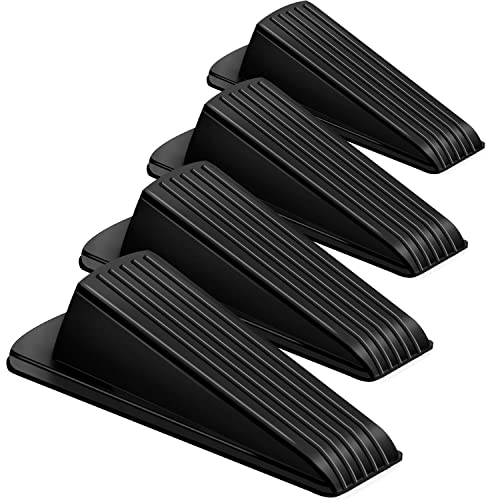
Rubber door stops are simple products, but fit and surface contact determine whether a wedge is useful. The best rubber door stops in this comparison are all wedge-style products designed to sit beneath a door, yet their heights, lengths, base patterns, materials, and pack sizes differ substantially. Start by measuring the space beneath the door rather than choosing by appearance alone.
Measure the door gap first
The most important specification is the clearance between the bottom of the door and the floor. A wedge that is too short may slide through without holding the door, while a wedge that is too tall may not enter the gap. Optish lists a 0.4- to 1.9-inch range, making it one of the clearest choices for a measured larger gap.
Standard wedges are better for ordinary interior clearances. FIGO HOME and JZWBLILY list 1.2-inch heights, and BHYTAKI lists 1.3 inches. Crosize lists a 0.2- to 1.1-inch individual range, so it is best checked against the actual gap. Scotch is the most compact option, with a listed 1-1/8-inch size.
Compare solid, hollow, and textured bases
Base design affects how the wedge contacts the floor. UXVEM documents a patented studded anti-slip base, while FIGO HOME lists a ridged base. Crosize and Scotch describe textured tread or surfaces, and XGXN and Lesunsul use hollow-base designs. These features are intended to increase friction, but the supplied listings do not establish performance on every floor or door. Treat the base pattern as a design consideration rather than a guarantee.
A solid wedge can be appealing when you want a dense, straightforward piece. UXVEM specifically describes a full solid construction. Other models use flexible or hollow structures to balance grip, stacking, or material use. For smooth tile, hardwood, or laminate, look for a listing that explicitly mentions non-scratch or non-marking behavior. BHYTAKI, JZWBLILY, FIGO HOME, and XGXN include floor-care claims in their supplied evidence.
Match the material to your floor and door
The category includes natural rubber, rubber-like material, silicone, and TPR rubber. UXVEM, BHYTAKI, JZWBLILY, and FIGO HOME identify natural rubber. These materials may feel and flex differently, but the evidence here does not support a durability ranking from testing. Instead, use the stated material to compare construction and check whether the listing addresses scratches, scuffs, odor, or deformation.
Floor compatibility is also listing-specific. Optish names carpet, hardwood, tile, and concrete. BHYTAKI names wood, carpet, concrete, tile, linoleum, stone, asphalt, and ceramic surfaces. XGXN lists wood, tile, carpet, concrete, glass-door use, and additional applications. If your floor is unusual, prioritize a product whose evidence names that surface rather than assuming every rubber wedge will behave identically.
Decide whether stacking matters
Stackability helps when the door gap exceeds the height of a single wedge. UXVEM, JZWBLILY, Crosize, and Lesunsul explicitly describe stacking or back-to-back use. Crosize gives a stacked height of up to 2.16 inches, while UXVEM recommends stacking two wedges for gaps above 1.18 inches. Stacking can also let one pack serve doors with different clearances, but it adds another piece to position and should be evaluated against the specific door geometry.
If you need several wedges for multiple rooms, Lesunsul, Crosize, BHYTAKI, FIGO HOME, and UXVEM provide larger packs. Scotch is more focused on compact, discreet placement than high-gap coverage.
Consider installation and portability
Every selected product is a portable under-door wedge rather than a permanently mounted stop. UXVEM and Lesunsul explicitly describe no-installation placement, and the Scotch listing likewise describes simply wedging the stop beneath the door. This approach avoids drilling and makes it easy to move the stop between rooms, but it does not protect a wall from a swinging door in the way a wall-mounted bumper can.
A portable wedge is useful for holding a door open temporarily, managing airflow, or preventing a door from closing on its own. The supplied evidence does not establish suitability for fire-door compliance, emergency egress, or security applications, so those requirements should be checked separately before purchase.
Choose pack size for the job
Pack size changes practical coverage. Scotch has two pieces, JZWBLILY and Optish have two-piece listings, and FIGO HOME, BHYTAKI, and UXVEM provide four-piece options. Crosize supplies five, while Lesunsul supplies six according to its title and description. A larger pack can cover multiple doors or leave spares available, but it is only useful if the included height and base design match the doors involved.
For one large door, a single large wedge such as Suspension Dudes may be sufficient. For several office, school, or household doors, a four-, five-, or six-piece pack is more adaptable. Confirm the exact package contents and dimensions before ordering, especially where a listing’s specifications and title use different unit wording.
Final recommendation
XGXN Big Stackable Door Stoppers ranks first overall in this specification-based comparison under the published weighted criteria.
The final choice among the best rubber door stops depends on the documented features that match your intended use.
UXVEM is the highest-scoring returned product and the first overall specification-based choice. Its solid natural-rubber construction, studded base, 1.18-inch stated fit, stackability, and four-piece format create the most balanced specification profile in this comparison. The top rubber door stops for larger gaps are Optish, XGXN, and Suspension Dudes because their listed heights reach 1.9 inches. For broad multi-room coverage, consider BHYTAKI, FIGO HOME, Crosize, or Lesunsul. For a discreet compact design, Scotch is the clearest alternative.
Frequently Asked Questions
How do I choose the best rubber door stops for my door gap?
Measure the vertical clearance beneath the door at the point where the wedge will sit. Then compare that measurement with the product’s stated fit or height. Optish lists a 0.4- to 1.9-inch range, while Crosize lists 0.2 to 1.1 inches for one wedge. A product that documents stacking, such as UXVEM or JZWBLILY, may offer more flexibility for a larger gap.
Are these rubber door stops suitable for hardwood or tile?
Several selected listings specifically name hardwood, wood, tile, or concrete and describe their wedges as non-scratch, non-scuff, or non-marking. Optish, BHYTAKI, JZWBLILY, and XGXN provide especially broad surface descriptions. Those claims are product-listing specifications, not independent floor tests, so inspect the base and keep the floor clean before use.
What is the benefit of a stackable door wedge?
A stackable wedge can extend the usable height for a door with more clearance than one piece can fill. UXVEM describes stacking two wedges above its 1.18-inch fit, and Crosize lists a stacked height of up to 2.16 inches. Stacking may require more careful positioning, so verify that the pieces sit securely and do not interfere with the door’s movement.
Should I buy a two-pack or a larger pack?
Choose a two-pack when you have one or two doors and already know the required size. Larger packs from UXVEM, BHYTAKI, FIGO HOME, Crosize, and Lesunsul make more sense for several rooms, classrooms, offices, or spare coverage. Pack size does not replace fit: every wedge still needs to match the door gap and floor surface.
Are rubber wedges permanently installed?
No. The selected wedge-style products are placed under the door and can be removed or repositioned. UXVEM and Lesunsul explicitly describe no-installation use, while Scotch describes simple under-door placement. This portability is convenient, but these products should not be treated as substitutes for a permanently mounted wall or floor stop when fixed impact protection is required.