Buying Guide
The best serrated kitchen utility knives are defined less by a single blade length than by how their serrations, handle, steel, and care instructions fit the food you prepare. A utility knife in this category commonly sits between a paring knife and a chef’s knife. The selected listings describe models from 4.5 to 6 inches, with uses ranging from tomatoes and sandwiches to cakes, cured meats, and crusty bread.
Match the edge to the food
Serrated edges are documented across the selection as suitable for foods with firm or slippery exteriors and softer interiors. The Shun Sora specifically uses a wavy serrated edge for crusty bread and leathery-skinned vegetables. The Cangshan ELBERT listing names bagels, crusty breads, cured meats, and tough-skinned produce. The OXO Good Grips focuses on cake slices, bagels, and tough crusts.
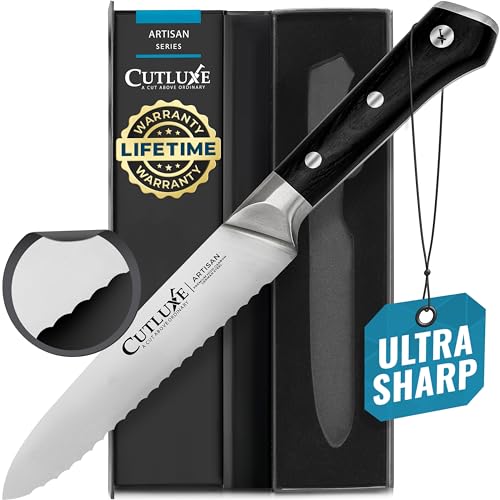
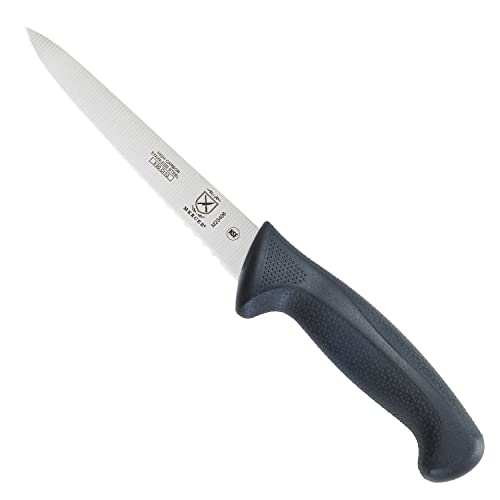
For tomato, fruit, and sandwich preparation, a compact serrated edge can be easier to position than a larger bread knife. Cutluxe identifies tomatoes, vegetables, juicy fruits, tender cakes, and small breads, while Mercer Culinary lists pickles, fruit, cheese, apples, and sandwiches. These descriptions support a broad utility role, but they do not establish that every knife will perform identically on every food.
Consider blade steel and construction
Blade descriptions vary substantially. The Shun Sora uses a San Mai arrangement with a VG10 edge supported by 420J stainless steel. Cangshan, Hammer Stahl, and Cutluxe specify German X50CrMoV15 or related high-carbon stainless steel constructions. All-Clad identifies fully forged German stainless steel and cryo-hardening, while Mercer Culinary specifies one-piece high-carbon Japanese steel.
Forged and full-tang construction appear repeatedly in the selected products. Cangshan documents a forged full-tang blade, Cutluxe specifies a full-tang triple-riveted handle, and All-Clad describes a fully forged blade with a full-tang handle. These are construction details, not independent proof of cutting performance, but they can help shoppers distinguish a more extensively specified knife from one whose listing provides fewer technical details.
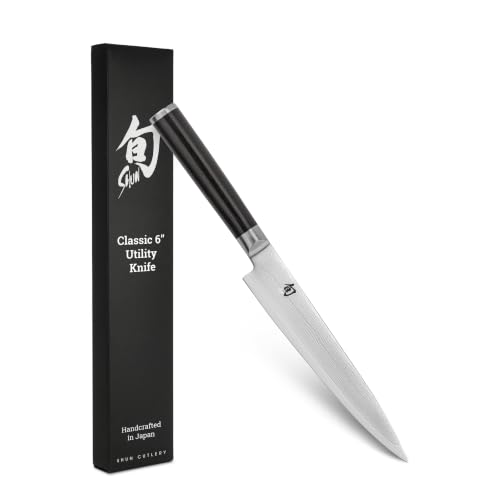
Edge angles are also useful when supplied. Shun gives a 16-degree edge, Cangshan gives 16 degrees per side, and All-Clad gives an 18-degree total cutting edge. The listings do not provide a common testing method, so these figures are best used for comparing the published design rather than predicting identical results in the kitchen.
Choose the right length
Blade length in this group ranges from Victorinox’s 4.5-inch model to 6-inch options from Hammer Stahl and Mercer Culinary. A 4.5- or 5-inch knife may be convenient for tomatoes, fruit, sandwiches, and cakes. The 5.5-inch Shun Sora and 6-inch knives provide more reach for larger sandwiches, bread portions, or a wider cutting path.
Shorter is not automatically better. Victorinox offers the most compact blade here, while Hammer Stahl and Mercer Culinary provide longer formats with broader task descriptions. Think about the ingredients you most often slice and the amount of board space available. The knife should feel proportionate to the food rather than simply maximizing blade length.
Examine grip and balance details
Handle information is especially important for a serrated knife because the edge is designed to engage food without the same smooth slicing motion as a plain edge. The Shun Sora lists a full-tang textured polymer handle for left- and right-handed users. Mercer Culinary adds textured finger points, and OXO identifies a nonslip grip and lightweight construction.
Wood and riveted handles appear on several more substantial models. Cutluxe uses a triple-riveted pakkawood handle, Cangshan lists a single mosaic rivet with a balanced handle, and Hammer Stahl specifies an ergonomic quad-tang pakkawood handle. These features describe construction and intended handling; they do not replace checking the actual dimensions or grip preferences before selecting a knife.
Check cleaning and storage requirements
Care instructions differ. Henckels states that its Statement model can be cleaned by hand or in a dishwasher. Mercer Culinary, Cangshan, and Hammer Stahl provide hand-wash guidance or maintenance language, so shoppers who prefer machine cleaning should read those instructions closely. OXO includes a locking sheath, and Shun includes a sheath and case, adding documented storage features to those models.
A sheath can be useful when a knife is stored in a drawer, but the supplied evidence does not establish that either sheath fits other products. Warranties also vary in wording, from lifetime coverage against manufacturer defects to limited lifetime warranties. Treat those statements as support terms rather than evidence of cutting results.
Use the scoring method carefully
This comparison scores only supplied product evidence across five category-specific areas: serration and cutting scope, blade material and edge design, handle control and construction, size and task fit, and care guidance and support. Each criterion is weighted according to its relevance to a serrated kitchen utility knife. The result is an editorial comparison of documented specifications, not a hands-on test, laboratory assessment, or customer-opinion summary.
Final Recommendation
Shun Sora 5.5-Inch Serrated Utility Knife ranks first overall in this specification-based comparison under the published weighted criteria.
Shun Sora 5.5-inch Serrated Utility Knife is the highest-scoring first overall specification-based choice among these best serrated kitchen utility knives. Its wavy edge, VG10-and-420J construction, 16-degree edge, full tang, textured ambidextrous handle, and included support details give it the most complete evidence profile in this comparison.
Cangshan ELBERT is a close alternative for shoppers who prioritize forged German steel, a defined 16-degree-per-side edge, and NSF certification. All-Clad adds cryo-hardened forged steel and a triple-riveted handle. For a longer blade, Hammer Stahl and Mercer Culinary document 6-inch designs with distinct grip features. OXO and Victorinox are the more compactly positioned selections, while Henckels offers the clearest dishwasher-cleaning statement.
Taken together, these top serrated kitchen utility knives cover compact tomato and sandwich work, broader produce preparation, and bread or cake slicing. Select the model whose documented edge, length, handle, and care requirements best match your kitchen routine rather than relying on a single specification.
Frequently Asked Questions
What foods suit the best serrated kitchen utility knives?
The selected listings commonly identify tomatoes, fruit, vegetables, sandwiches, cakes, bagels, cured meats, and bread. Serrations are particularly relevant when food has a firmer exterior and a tender or delicate interior. The Shun Sora, Cangshan ELBERT, Cutluxe, and OXO Good Grips each document examples of these food types.
Is a 5-inch or 6-inch serrated utility knife better?
The answer depends on the task. Five-inch models such as the Cangshan ELBERT, All-Clad, Cutluxe, WÜSTHOF Classic, and Henckels Statement are compact choices for smaller produce, sandwiches, and cakes. Six-inch models such as Hammer Stahl and Mercer Culinary may provide more reach. The evidence supports different use cases, not a universal length preference.
Which selected knife includes a protective sheath?
OXO Good Grips lists a locking sheath that secures and protects its serrated blade. Shun Sora lists both a protective sheath and a case. The other selected listings do not document an included sheath, so storage features should be compared directly rather than assumed.
How should these knives be cleaned?
Follow the individual listing. Henckels states that the Statement model can be washed by hand or in a dishwasher. Mercer Culinary and Cangshan provide hand-wash guidance, and Hammer Stahl emphasizes maintenance. When a listing specifies hand washing, use that instruction rather than generalizing from another knife.
Do serrated utility knives need sharpening?
The supplied evidence does not establish a universal sharpening schedule or method. Shun documents free honing support, while Hammer Stahl states that its knife is designed to be re-sharpened. Other listings discuss edge retention or sharpness but do not provide a complete sharpening procedure. Consult the manufacturer’s instructions for the specific model.