Buying Guide
Choosing the best ulu knives starts with understanding how the curved blade changes the cutting motion. Instead of lifting and drawing a long chef’s knife, the user rocks the crescent edge across the board. That makes an ulu relevant for mincing herbs, chopping vegetables, slicing cheese, cutting pizza, and preparing meat when the listing specifically supports those tasks.
Kitchen models in this comparison generally use blades around 6 to 7.2 inches. Lamson, The ULU Factory Alaskan Ulu, SHARDBLADE, Dessi, and Coowolf document blades in that range. A larger blade can cover more board area during rocking, while a compact model can be easier to control in a small prep space.
Gerber Gear Downwind Ulu is different: its listed blade length is 3.42 inches, making it a compact field design rather than a broad kitchen chopper. The shorter format may make belt carry easier, but it provides less coverage than a 6-inch kitchen ulu. FAIQENTERPRICE and River Cross list 7.2-inch blades for shoppers who prefer a larger rocking surface.
Compare blade materials carefully
Blade material is an important specification difference. Lamson lists hardened and tempered high-carbon stainless steel. The ULU Factory, SHARDBLADE, Dessi, and Coowolf identify stainless steel or Damascus steel. These descriptions do not establish a common performance level across brands.
FAIQENTERPRICE provides the most specific technical description, listing 1095 and 15N20 alloy steels, stated hardness, 352 layers, and blade thickness. TIVOLI describes a hand-forged high-carbon steel blade and a multi-step forging process. These are specifications rather than independent test results. High-carbon constructions may also call for more attentive drying or oiling when the listing says so.
Prioritize handle control
An ulu depends on controlled rocking, so handle information matters. Lamson lists riveted walnut handles, while The ULU Factory describes a large wooden handle. TIVOLI lists a solid rosewood handle and full tang construction. River Cross lists a full tang with camel bone and pakkawood, and FAIQENTERPRICE lists pakkawood, a mosaic pin, and brass rivet.
For field use, Gerber documents multi-layer G-10 scales, spine jimping, and control choils. Those features are more directly associated with grip and handling than the simple presence of a decorative wood handle. Dessi lists a camel-bone and Micarta handle with a leather lanyard, while Coowolf identifies an enlarged ergonomic handle and one-handed operation.
Decide between a stand and a sheath
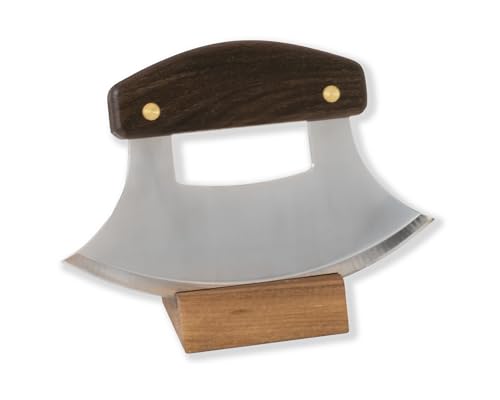
Storage accessories divide the selection into practical groups. The ULU Factory and Coowolf include wooden stands, and The ULU Factory model includes a walnut stand. A stand is useful for upright countertop storage and display, but it is not a carry solution.
SHARDBLADE, River Cross, Dessi, FAIQENTERPRICE, and Gerber document sheaths. Gerber’s waxed canvas sheath includes a security snap and belt loop, while Dessi lists a leather sheath and lanyard. A sheath is more relevant for outdoor transport, although it still requires careful storage when not being carried. Some products, including Lamson and TIVOLI, do not list either accessory.
Consider maintenance requirements
Wood handles and high-carbon blades deserve attention to care instructions. Lamson says to hand wash and treat the walnut with mineral oil when it appears dry. Coowolf recommends hand washing and quick drying. FAIQENTERPRICE says to wipe the Damascus blade, apply vegetable oil after use, avoid leaving it wet, and store it oiled.
When a listing does not provide detailed care information, avoid assuming dishwasher compatibility, corrosion resistance, or a particular sharpening method. Follow the seller’s supplied instructions and keep the edge protected.
Select for kitchen or outdoor use
The best ulu knives for kitchen work are represented by Lamson, The ULU Factory Alaskan Ulu, and Coowolf because their listings explicitly mention food preparation. TIVOLI and several Damascus models also document indoor and outdoor use. Gerber is the clearest hunting-oriented choice, with a compact blade, field-focused handle, and belt sheath.
Do not treat every ulu as interchangeable. A kitchen model with a wooden stand may suit a cutting board but be less convenient at a campsite. A compact sheath-equipped model may travel better but provide less blade coverage. The right choice depends on blade size, grip, intended tasks, and storage.
Final recommendation
FAIQENTERPRICE Handmade Damascus Ulu Knife ranks first overall in this specification-based comparison under the published weighted criteria.
The final choice among the best ulu knives depends on the documented features that match your intended use.
Lamson 6-inch Alaskan Ulu Knife is the first overall specification-based choice among these top ulu knives. Its high-carbon stainless-steel blade, riveted walnut handles, broad kitchen-use description, and USA manufacturing claim create a balanced documented package for everyday food preparation.
Choose The ULU Factory Alaskan Ulu if one-handed use, a large wooden handle, and a walnut stand matter most. Choose Gerber Gear Downwind Ulu for compact outdoor carry, or FAIQENTERPRICE for the most detailed blade specifications and explicit oiling guidance. River Cross, SHARDBLADE, and Dessi suit buyers prioritizing Damascus construction and a sheath. TIVOLI is the hand-forged rosewood option, while Coowolf offers a stand-equipped 6.5-inch kitchen format.
Frequently Asked Questions
What are the best ulu knives for everyday kitchen preparation?
Lamson, The ULU Factory Alaskan Ulu, and Coowolf are the clearest kitchen-focused choices in this comparison. Their listings identify food-preparation uses such as vegetables, meat, herbs, cheese, or pizza. The best fit still depends on whether you prefer a stand, a larger handle, or particular maintenance guidance.
Is a Damascus ulu automatically better than a stainless-steel ulu?
No. The listings document different materials and construction details, but they do not provide independent testing that establishes an automatic performance winner. Damascus models such as SHARDBLADE, River Cross, Dessi, and FAIQENTERPRICE offer distinct material descriptions, while Lamson and Coowolf provide stainless-steel options with clear kitchen applications.
Should an ulu have a stand or a sheath?
Choose a stand for upright countertop storage and a sheath for protected transport. The ULU Factory and Coowolf document stands, while Gerber, Dessi, SHARDBLADE, and River Cross document sheaths. Some products list neither, so confirm the included accessories if storage or outdoor carry is important.
Are larger ulu blades better for chopping?
A larger blade may provide more rocking coverage, but size is not the only consideration. The listed 7.2-inch FAIQENTERPRICE and River Cross models offer a larger format, while Gerber’s 3.42-inch design favors compact carry. Handle shape, intended use, workspace, and comfort should be considered alongside blade length.
How should a high-carbon ulu be maintained?
Follow product-specific instructions. Lamson recommends hand washing and mineral oil for its walnut handle, while FAIQENTERPRICE specifies wiping, oiling, avoiding prolonged wetness, and storing the Damascus blade oiled. Do not assume that care guidance for one model applies to another.