Buying Guide
The best vehicle cell phone signal boosters differ by the bands, antenna arrangement, vehicle size, and installation controls documented for each kit. A booster is not a replacement for cellular service or a source of coverage in a true dead zone. Before comparing features, confirm that the product supports the bands used by your carrier and that some outdoor signal is present where you plan to use it.
Match the booster to the vehicle
Passenger cars, vans, and SUVs usually benefit from compact antenna hardware and mounting that does not require drilling. The weBoost Drive X is documented for cars, trucks, vans, and SUVs and uses a magnetic roof antenna. SignalBrick’s car booster also uses a magnetic outdoor antenna and is positioned for cars, vans, and SUVs. The Metarepeater MB1 is more specific: its listing identifies cars, vans, SUVs, and small to midsized vehicles, while advising against truck and RV use.
Larger vehicles and rougher travel call for a different hardware profile. The weBoost Drive 4G-X OTR includes a 17-inch weather-resistant omnidirectional antenna, a three-way CB antenna mount, a mast extension, and a side-exit adapter. The Drive Reach Overland pairs its booster with a tough outdoor antenna and mounting bracket for adventure vehicles. Metarepeater’s MT1 uses a spring-mounted antenna and describes resistance to dust, oil, and water. These features may make a kit more appropriate for trucks, RVs, and off-road travel, but they can also mean more external hardware to position.
Check carrier bands instead of relying only on a 5G label
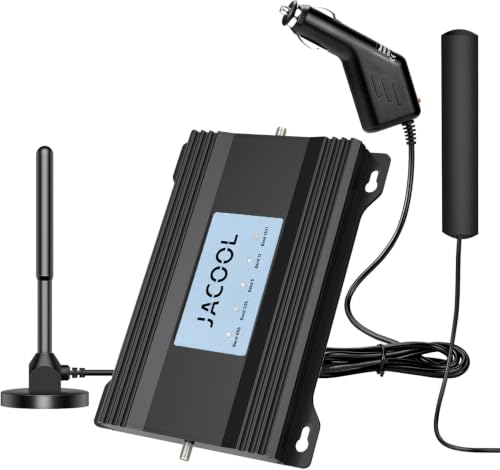
A listing that says 5G compatible does not necessarily mean every 5G band is supported. Compare the actual band information when it is provided. JACOOL lists bands 2, 4, 5, 12, 13, 17, 25, and 66. PRACOA lists the same broad eight-band set in a different order. ANNTLENT V50 documents bands 2, 4, 5, 12, 13, 17, and 25. SignalBrick, Metarepeater MB1, and Metarepeater MT1 list bands 12/17, 13, 5, 2/25, and 4.
The weBoost Drive X and Drive Reach Overland listings emphasize all-U.S.-carrier compatibility and 5G support but do not provide a complete band-by-band list in the supplied evidence. The Drive 4G-X OTR similarly emphasizes all-network compatibility while presenting a 4G-focused product description. If your carrier depends on a particular band, a product with a published band list may make the compatibility check easier. The PRACOA listing is especially broad, while JACOOL explicitly notes that a booster needs existing outdoor signal and does not create coverage in zero-signal areas.
Compare antenna mounting and cabin hardware
Omnidirectional antennas receive signals from multiple directions without requiring precise tower alignment. SignalBrick, Metarepeater MB1, Metarepeater MT1, JACOOL, and PRACOA all document omnidirectional antenna designs. Magnetic mounting appears on the weBoost Drive X, SignalBrick, and Metarepeater MB1. JACOOL uses a suction-cup antenna, which may be useful when a temporary or flexible mounting approach is preferred. The Drive 4G-X OTR uses a more involved truck-oriented mounting package.
Cabin-side hardware also affects installation. Confixpand documents an integrated indoor antenna intended to reduce cable clutter. ANNTLENT V50 describes an all-in-one design and an app that helps identify antenna placement using signal information. Traditional kits such as SignalBrick and Metarepeater MB1 document separate outdoor and indoor antennas. That arrangement can provide more placement choices, but it also means routing and positioning more components.
Look for automatic control or status feedback
Automatic gain control can adjust system power in response to signal conditions. SignalBrick, JACOOL, Confixpand, and PRACOA document automatic gain control or related control functions. These features are useful specification points because they describe how the system manages changing input conditions, but they do not establish a confirmed improvement in every location.
If visible monitoring matters, the Metarepeater MT1 and MB1 include color LCD displays. The MT1 display shows operating status and gain information for five bands, while the MB1 listing describes status and gain information for five bands as well. Confixpand uses LED monitoring, and ANNTLENT V50 provides app-based monitoring and setup assistance. The weBoost models in this selection emphasize vehicle hardware and carrier compatibility rather than a listed LCD or app feature.
Consider who needs the connection
Several selected products document simultaneous use by multiple phones or devices. The weBoost Drive X, Drive Reach Overland, Drive 4G-X OTR, SignalBrick, both Metarepeater models, JACOOL, ANNTLENT V50, and PRACOA all describe multi-user or multiple-device operation in the supplied evidence. This matters in a family vehicle, work truck, RV, or fleet setting. Confixpand’s listing does not explicitly state simultaneous multi-user support, so it ranks more on its integrated antenna, outdoor hardware, and monitoring features.
Installation and compliance checks
Follow each manufacturer’s antenna-placement and setup directions. Several listings describe no-drill, magnetic, suction-cup, or tool-free installation, but the exact process depends on the vehicle and the included components. FCC approval is documented for all products selected here, though certification does not remove the need to follow the product instructions and carrier-related requirements. Review the supported bands, antenna location, power connection, and vehicle-size guidance before installation.
Final Recommendation
weBoost Drive X ranks first overall in this specification-based comparison under the published weighted criteria.
The final choice among the best vehicle cell phone signal boosters depends on the documented features that match your intended use.
weBoost Drive X is the highest-scoring returned product and the first overall specification-based choice. It documents broad U.S. carrier compatibility, 5G and 4G LTE support, multi-user operation, a magnetic roof antenna, and tool-free installation across several vehicle types. For off-road hardware, the weBoost Drive Reach Overland offers a more adventure-focused antenna and bracket package. Truck users may prefer the weBoost Drive 4G-X OTR or Metarepeater MT1 for their truck-oriented antenna designs, while the Metarepeater MB1 is better aligned with smaller vehicles.
Among the top vehicle cell phone signal boosters with published band lists, JACOOL and PRACOA provide especially broad coverage on paper. ANNTLENT V50 adds app-guided placement, Confixpand reduces cabin antenna clutter with an integrated design, and SignalBrick balances multiple bands with magnetic installation. No listed model should be treated as a source of service in a zero-coverage location; compatibility and available outdoor signal remain essential.
Frequently Asked Questions
Among the best vehicle cell phone signal boosters, do vehicle cell phone signal boosters work without any outdoor signal?
No selected listing supports that conclusion. JACOOL specifically states that the booster requires at least one to two bars of existing outdoor cellular signal and does not create signal in zero-coverage areas. A booster is intended to amplify compatible cellular signal received by its outside antenna, not generate a connection where the carrier provides none.
Is every 5G vehicle booster compatible with every 5G band?
No. The supplied listings use different levels of detail. ANNTLENT V50, JACOOL, PRACOA, SignalBrick, and both Metarepeater models publish specific supported bands. The weBoost Drive X and Drive Reach Overland state 5G support and all-carrier compatibility but do not provide a complete band list in the supplied evidence. Check your carrier’s bands before selecting one of the best vehicle cell phone signal boosters.
Which selected models are aimed at trucks or RVs?
The Drive Reach Overland, Drive 4G-X OTR, Metarepeater MT1, ANNTLENT V50, Confixpand, JACOOL, and PRACOA all document truck, RV, overland, or other large-vehicle use. The Metarepeater MB1 is the exception among the selected Metarepeater products: its listing recommends it for cars, vans, SUVs, and small to midsized vehicles and not for trucks or RVs.
What is the difference between a magnetic and suction-cup antenna?
A magnetic antenna attaches to a suitable metal vehicle surface, as documented for the weBoost Drive X, SignalBrick, and Metarepeater MB1. JACOOL documents a suction-cup antenna instead. The supplied evidence does not establish that one mounting type performs better in every vehicle. Choose based on the available mounting surface, desired permanence, cable routing, and the manufacturer’s installation directions.
Do these boosters support several phones at once?
Most selected products document multi-user or multiple-device operation, including the weBoost Drive X, Drive Reach Overland, Drive 4G-X OTR, SignalBrick, Metarepeater MT1, Metarepeater MB1, ANNTLENT V50, JACOOL, and PRACOA. Confixpand’s supplied listing does not explicitly state simultaneous multi-user support, so that feature should not be assumed for it.