Buying Guide
The best high-gain phone signal boosters are not selected by gain alone. A useful comparison starts with the signal available outside the building or vehicle, then checks whether the booster can receive the bands used by your carrier and distribute that signal through the intended space. The listings in this guide describe home, office, RV, truck, and off-road designs, so their coverage figures are not directly interchangeable.
Start with the outside signal
A booster amplifies an existing cellular signal; it does not create service where the outdoor antenna receives nothing. The HiBoost Hero listing likewise asks users to confirm an outside signal of approximately one to two bars and a compatible tower within three to five miles.
That makes antenna placement a central buying decision. A roof, mast, exterior wall, or other unobstructed location may provide a better input signal than an indoor position. Before choosing a system, identify where your carrier signal is most usable and whether you can route coaxial cable from that point to the booster.
Match supported bands to your carrier
“All US carriers” is helpful but not a complete compatibility check. The most useful listings also provide band information. The F FREEQUEEN LOVE LIFE model lists bands 2, 4, 5, 12, 13, 17, 25, and 66. HiBoost F08G-5S-IOT lists bands 12, 17, 13, 5, 25, 2, and 4, while the HiBoost Hero lists the same group without band 66.
Check the bands used in your location before installation. A product can support the same carrier name as another model while covering a different subset of frequencies. The supplied listings also describe some 5G compatibility as operation through permitted 4G bands or DSS, rather than support for every type of 5G deployment. Treat the exact band list as more useful than a broad generation label.
Compare gain with coverage
Maximum gain is expressed in decibels, but it does not guarantee a particular indoor result. ZORIDA lists 72dB power, while the F FREEQUEEN LOVE LIFE and HiBoost 10K PRO listings each state 70dB. Several other home models list 65dB, including the subroad unit, HiBoost 4K Mate, and HiBoost Hero. HiBoost Travel 2.0 RV lists up to 50dB, and weBoost Drive Reach Overland lists 50dB maximum gain.
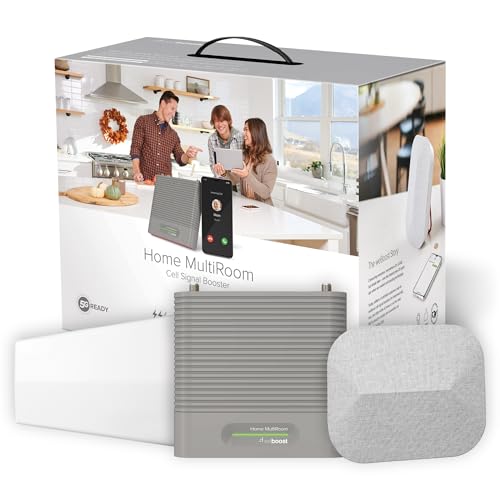
Coverage claims also vary considerably. HiBoost 10K PRO lists up to 8,000 square feet, the F FREEQUEEN LOVE LIFE model lists 6,000, and the subroad and weBoost Home MultiRoom listings describe up to 5,000. ZORIDA states up to 4,000, while the HiBoost 4K Mate lists 4,500 and the Hero lists 3,000. These figures are manufacturer-stated specifications, not results from a hands-on test. The available outside signal, building materials, cable length, antenna separation, and layout can all affect the usable area.
Choose the antenna arrangement
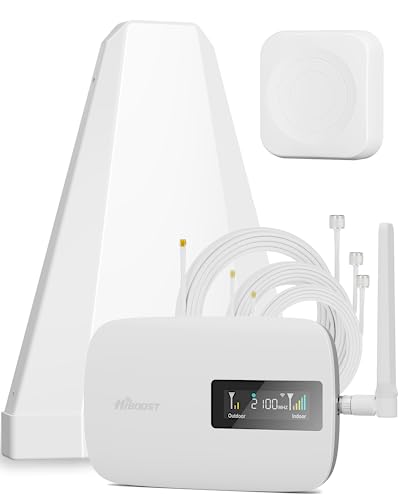
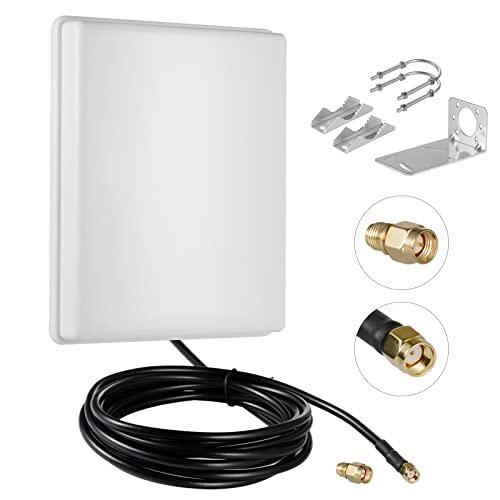
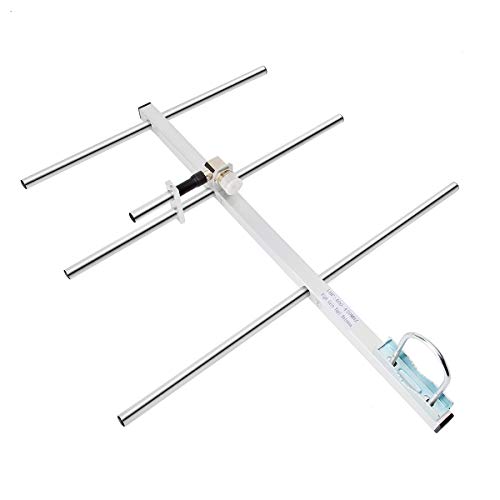
A directional outdoor antenna can be useful when the tower direction is known or when a distant signal needs targeting. The subroad system documents a weatherproof Yagi antenna designed to pinpoint towers, and HiBoost F08G-5S-IOT and HiBoost Hero list directional outdoor antenna configurations. These designs may require more careful aiming.
An omnidirectional antenna receives from multiple directions and can be more convenient when tower direction is uncertain. Indoor distribution matters too: HiBoost 10K PRO uses two indoor antennas, the Hero offers panel and whip choices, and the weBoost Drive Reach RV II uses a repositionable mini panel antenna.
For an RV, cable routing and mounting deserve special attention. The weBoost Drive Reach RV II includes a 25-foot cable, a bracket with multiple mounting approaches, and AC/DC or hardwire power options.
Look for installation feedback and control
App and display features can make setup more measurable. ZORIDA documents real-time signal measurements in its app. HiBoost 4K Mate combines an app with an LCD, while HiBoost F08G-5S-IOT lists both LCD and app monitoring. The F FREEQUEEN LOVE LIFE system uses an LCD to show working status and AGC to adjust operation. HiBoost 10K PRO also lists app-based installation guidance.
Automatic Gain Control, or AGC, appears in several listings. It is described as adjusting output in response to signal conditions. That can be useful during setup, but it does not remove the need to separate the outside and inside antennas and follow the manufacturer’s installation instructions.
Check the intended environment
Home systems are the natural fit for rooms, basements, offices, cabins, and metal buildings. ZORIDA, subroad, HiBoost 10K PRO, and weBoost Home MultiRoom all document indoor or multi-room use. Vehicle systems use different antenna hardware, power connections, and mounting methods. HiBoost Travel 2.0 RV is built for an RV, truck camper, van, or trailer, while weBoost Drive Reach Overland is positioned for 4x4 and overland vehicles.
Do not choose a vehicle model solely because its gain number looks similar to a home model. The antenna, power supply, mounting hardware, and intended coverage environment are equally important. Likewise, a large home system may be unnecessary for a compact office if its antenna arrangement is difficult to place.
Final Recommendation
HiBoost 10K PRO Multi-Room Booster ranks first overall in this specification-based comparison under the published weighted criteria.
HiBoost 10K PRO Multi-Room Booster is the highest-scoring returned product and the first overall specification-based choice among the best high-gain phone signal boosters. Its documented 70dB gain, up to 8,000-square-foot coverage, two indoor antennas, broad band list, AGC, LCD, and app make it the most complete home comparison entry.
The F FREEQUEEN LOVE LIFE 6000 Sq. Ft. Booster is a close alternative when 70dB gain and an LCD status display matter. ZORIDA Ver 5S Pro stands out for its stated 72dB gain and app measurements, while the subroad 5,000 Sq. Ft. Yagi Booster is the more antenna-focused rural option. HiBoost 4K Mate and HiBoost Hero provide flexible indoor configurations for smaller spaces.
For a vehicle, the weBoost Drive Reach RV II is the most adaptable RV-oriented design because of its repositionable indoor panel, long cable, mounting choices, and dual power options. Drive Reach Overland is the more targeted fit for off-road vehicles. These are the top high-gain phone signal boosters in their respective documented environments, but each still requires a usable outside signal and compatible carrier bands.
Frequently Asked Questions
What should I verify before choosing among the best high-gain phone signal boosters?
Verify the carrier bands used in your area, the signal available at the proposed outdoor antenna location, the intended coverage area, and the space available for antenna separation and cable routing. A broad all-carrier statement should be checked against the detailed band list when one is provided.
No. Building materials, antenna placement, cable routing, and separation between antennas can affect the result. Use the stated figures as comparison data rather than a performance guarantee.
Is a directional or omnidirectional outdoor antenna better?
It depends on the installation. A directional Yagi or panel-oriented setup may suit a known tower direction, as documented by subroad and several HiBoost systems.
Are home and RV boosters interchangeable?
They are different design types. Home models emphasize room coverage and indoor antenna distribution, while RV models add vehicle mounting, cable routing, and AC/DC or hardwire power considerations. The weBoost Drive Reach RV II and HiBoost Travel 2.0 RV are documented for RV use, whereas HiBoost 10K PRO and weBoost Home MultiRoom are documented for indoor spaces.
What do app and LCD features add?
They can provide setup information such as signal strength, tower location, gain settings, or working status. ZORIDA, HiBoost 4K Mate, HiBoost F08G-5S-IOT, and the F FREEQUEEN LOVE LIFE model document these tools. They assist with placement and monitoring but do not replace carrier-band checks or proper antenna installation.