Buying Guide
The best wi-fi home automation modules are small relay controllers that add app, voice, scheduling, or scene control to an existing circuit. They are not all interchangeable. A module may be intended for a wall switch, a low-voltage gate, a garage-door opener, a multi-output control panel, or a higher-load appliance. Start by identifying the circuit type, available power, enclosure space, and smart-home platform before comparing features.
Match the module to the circuit
For low-voltage work, Shelly Plus Uni is the clearest fit in this selection because its listing specifies 8-24 VAC, 9-28 VDC, and 5 VDC applications. MHCOZY also accepts DC 5-32V and uses a passive dry-contact output, which is useful for garage-door and access-control triggers. These designs should not be treated as direct substitutes for a line-voltage wall switch without checking the wiring requirements.
For higher-load projects, the RODOT 30A High-Power WiFi Switch provides the most specific supplied load information: a 30A relay, 3000W resistive load, and 800W inductive load at a stated 110-240V range. Those figures describe the listing’s claimed operating scope, not an independent safety assessment. Electrical work should be matched to the circuit, enclosure, local requirements, and the product instructions.
Matter can reduce dependence on a single smart-home ecosystem. SONOFF Basic-1GS Gen5, Shelly 1 Gen4, Shelly 1 Mini Gen4, and SwitchBot document Matter support. The SONOFF model also names Apple Home, Alexa, Google Home, and Home Assistant, while Shelly’s two selected Gen4 relays list Wi-Fi, Zigbee, and Matter.
SwitchBot adds another approach: its module lists Matter compatibility, Wi-Fi, Bluetooth, and an integrated Bluetooth repeater. The listing says the repeater can network up to 10 SwitchBot Bluetooth subdevices. It also notes that a compatible hub or speaker is required for some Matter control paths, so read the ecosystem requirements rather than assuming every function is hub-free.
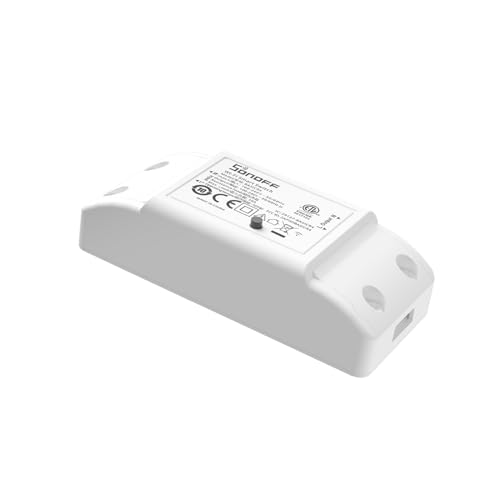
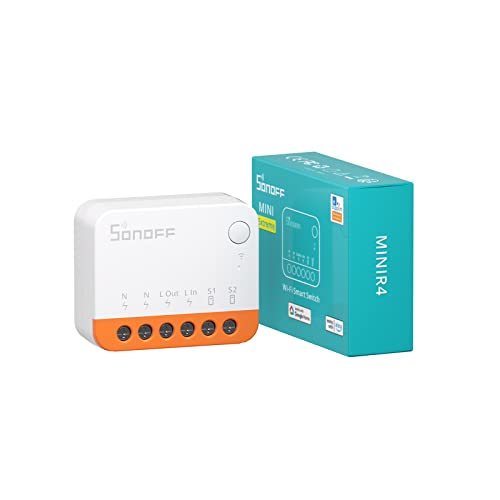
Modules without Matter can still be useful. SONOFF BASICR4 and MINIR4 use the eWeLink environment and document Alexa or Google Home compatibility. DieseRC and MHCOZY also use eWeLink-based control. The practical question is whether the module fits the apps and voice assistants already used in the home.
Compare control features
Remote app control is common across this category, but the automation details differ. Schedules and countdown timers appear across several listings. SONOFF Basic-1GS Gen5 adds smart scenes, local control, and group control. BASICR4 adds group control and an eWeLink-Remote gateway function. Shelly devices document scenes, schedules, notifications, and remote management through the Shelly Smart Control App.
For a garage door, gate, or access-control project, dry contacts and operating modes matter more than a simple on/off claim. MHCOZY lists momentary and self-locking modes. DieseRC lists inching and self-locking modes across four independent relays. Shelly Plus Uni describes reed-switch status feedback for gates and garages, while Shelly 1 Gen4 lists garage-door compatibility with additional components. These features can help match the module to a pulse-triggered opener or a maintained switch, but the device wiring must be verified.
Measure enclosure space and wiring needs
Compact dimensions can matter when a module must fit behind a switch or inside a junction box. SONOFF MINIR4 is specifically presented as a mini module for small mounting boxes. Shelly 1 Mini Gen4 is also positioned as a compact relay for small appliances and garage-door installations. SwitchBot provides compact dimensions and describes installation in most switch boxes and sockets without rewiring, although installation suitability remains dependent on the actual box and circuit.
The SONOFF Basic-1GS Gen5 listing explicitly says a neutral wire is needed. That requirement can eliminate it from some retrofit locations. Other modules may have different power and wiring requirements, so do not infer compatibility from the word “mini” or from a similar-looking enclosure. Confirm line, neutral, low-voltage, dry-contact, and load-terminal requirements before purchase.
Decide between one channel and several
A single-channel relay is appropriate when one light, appliance, door, or circuit is the target. Shelly 1 Gen4, Shelly 1 Mini Gen4, SONOFF BASICR4, and SONOFF MINIR4 fit that general pattern. A four-channel board such as DieseRC is more appropriate when several outputs need independent control from one controller. Its normally open, common, and normally closed terminals provide more wiring choices than a basic single-output module.
Final Recommendation
Shelly 1 Gen4 Smart Relay ranks first overall in this specification-based comparison under the published weighted criteria.
Shelly 1 Gen4 is the highest-scoring returned product and the first overall specification-based choice among these best wi-fi home automation modules. Its combination of Wi-Fi, Zigbee, Matter, Bluetooth gateway functionality, dry contacts, a stated 16A channel, voice-platform compatibility, scenes, schedules, and garage-door support gives it a broad documented use range.
The right alternative depends on the project. Choose SONOFF Basic-1GS Gen5 when Matter and local control are priorities and a neutral wire is available. Choose Shelly Plus Uni or MHCOZY for low-voltage and dry-contact work. Choose DieseRC when four independently controlled relays are more valuable than a compact wall-box form factor. For a documented higher-load option, the RODOT 30A High-Power WiFi Switch has the clearest supplied load figures.
The top wi-fi home automation modules are not defined by one universal feature. Protocol support, relay type, voltage range, channel count, enclosure size, and automation functions should be weighed against the exact installation. A specification-first selection avoids treating a low-voltage trigger module, a Matter wall retrofit, and a high-load controller as equivalent products.
Frequently Asked Questions
What are the best wi-fi home automation modules for Matter?
The selected Matter options include SONOFF Basic-1GS Gen5, Shelly 1 Gen4, Shelly 1 Mini Gen4, and SwitchBot. SONOFF documents compatibility with Apple Home, Alexa, Google Home, and Home Assistant. Shelly’s Gen4 products add Zigbee alongside Wi-Fi and Matter. Check each device’s wiring and load requirements before choosing based only on protocol support.
Do these modules require a hub?
Requirements vary. SONOFF Basic-1GS Gen5, Shelly 1 Gen4, and Shelly 1 Mini Gen4 are listed as requiring no hub for their Matter-enabled operation. SwitchBot states that some Matter control paths require a compatible hub or speaker, while its listing also describes Wi-Fi and local Bluetooth control. Always distinguish “no hub required” from optional ecosystem equipment used for expanded functions.
Can a Wi-Fi relay module control a garage door?
Several selected products document garage-door use. Shelly 1 Gen4 supports 12V and 24-48V DC garage-door systems with additional setup components. Shelly Plus Uni, Shelly 1 Mini Gen4, and MHCOZY describe garage or gate applications, while MHCOZY and DieseRC provide momentary or inching-style modes suited to pulse triggers. Confirm the opener’s input type and required voltage before wiring.
What should I check before installing a smart relay?
Check whether the project uses line voltage or low voltage, whether a neutral wire is available, the relay’s stated channel and load limits, the available enclosure space, and whether the output is powered or dry contact. Also confirm Wi-Fi-band requirements and platform compatibility. Turn off power before electrical work and follow the product instructions; the supplied listings are not a substitute for installation guidance.
Is a multi-channel module better than a single-channel module?
It depends on the project. A single-channel device is simpler when one circuit or door is being automated. DieseRC’s selected four-channel module is more suitable when four outputs need independent control and adjustable relay modes. Multiple single-channel modules may be easier to place around a home, while a multi-channel board can consolidate control in one location. Compare wiring layout, enclosure space, and the number of outputs required.