Buying Guide
Choosing the best bluetooth network antennas starts with the connector on the host device. The listings in this comparison use either SMA male or RP-SMA male interfaces, and those are not interchangeable. A standard SMA male connector has a center pin, while the RP-SMA male descriptions identify a center hole. Check the socket on the router, PCIe card, motherboard, amplifier, or adapter before comparing gain or frequency coverage.
Match the connector first
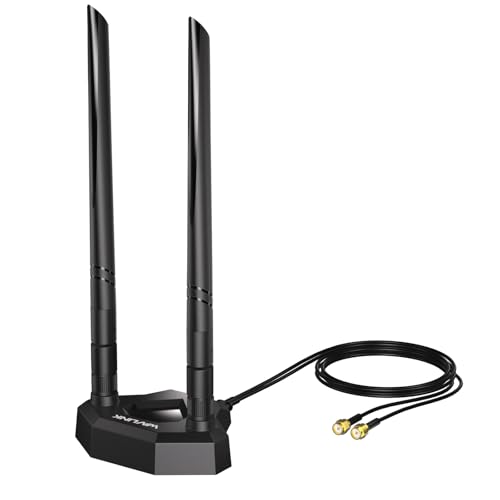
The WAVLINK Tri-Band Magnetic-Base Antenna and Fosi Audio BlueAnt use SMA male connections. The other selected products are primarily RP-SMA designs, including the Superbat, Eifagur, Dixingtek, Eightwood, Boobrie, DORHEA, Bingfu, and onelinkmore models. This distinction is the most important compatibility filter because a physically similar antenna can still be the wrong fit.
The product listings also describe the intended host equipment. The WAVLINK model names Intel Wi-Fi cards and desktop systems, while Fosi Audio identifies Bluetooth amplifiers and preamplifiers. RP-SMA models list routers, desktop PCs, PCIe cards, USB adapters, cameras, and Bluetooth motherboards. Use those application notes as a cross-check, not as a substitute for verifying the actual jack.
Compare frequency coverage
Most of the best bluetooth network antennas here cover the 2.4GHz band, which is central to Bluetooth use. Dual-band models add 5GHz or 5.8GHz support for compatible Wi-Fi equipment. The Fosi Audio BlueAnt and onelinkmore mini antennas are 2.4GHz-focused, so they are more specialized than the dual-band options.
Tri-band models add 6GHz support for Wi-Fi 6E equipment. WAVLINK, Superbat, Eifagur, and Dixingtek document 6GHz operation. This does not mean every Bluetooth device uses 6GHz; rather, it makes the antenna suitable for a broader host-device setup when the network card or router supports that band. Confirm the host radio’s supported frequencies before selecting a tri-band design.
Interpret gain carefully
Gain is a published specification, not a guarantee of a particular range in every room or installation. The selected models range from 2dBi on the onelinkmore mini antenna to 9dBi on Eifagur and Eightwood. Bingfu lists 3dBi, DORHEA and Fosi Audio list 6dBi, Dixingtek lists 6dBi, Boobrie lists 8dBi, and Superbat’s magnetic-base model does not provide a numeric gain in the supplied listing.
A higher stated gain can be useful when comparing otherwise similar antennas, but the antenna pattern and placement also matter. The selected products describe omnidirectional operation, making them suitable when the signal direction is not fixed. Avoid treating a gain number as a standalone performance measurement because the supplied evidence does not include controlled testing.
Decide between direct and remote placement
Direct screw-on antennas are compact and simple. Bingfu, DORHEA, Boobrie, Dixingtek, Eifagur, Fosi Audio, and onelinkmore fit this general approach, with swivel or tilt adjustment documented on some models. They work well when the host device is already positioned in a useful location.
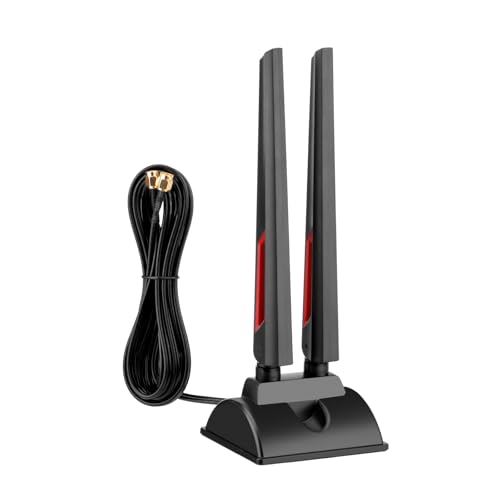
Remote designs use a cable and, in some cases, a magnetic base. WAVLINK includes a 6.6-foot extension cable, Superbat includes a 6-foot cable, and Eightwood includes a 6.5-foot cable. Their bases can place the antenna on or near a metal surface away from the desktop card or router. This can be more practical when the computer sits under a desk or inside a cabinet, although cable routing becomes part of the installation.
Consider one antenna or a pair
Two-antenna packs are common in this category. They may suit host hardware with two antenna ports or a MIMO arrangement. Bingfu explicitly describes MIMO, while WAVLINK, Eifagur, DORHEA, Fosi Audio, Boobrie, Dixingtek, and onelinkmore also supply two antennas. Match the number of antennas to the host device’s available ports and its radio design.
A single remote base can be preferable when the equipment has one antenna connection or when one centrally placed antenna is easier to install. The supplied listings do not establish that one package format is universally better, so the host configuration should guide this choice.
Check physical space and adjustment
Compact antennas such as onelinkmore’s 3cm model can fit small enclosures and crowded rear panels. Larger direct-mount models provide more physical reach, while remote-base products require room for a cable and base. Fosi Audio documents 90-degree tilt and 360-degree swivel; DORHEA describes swivel positioning; WAVLINK documents horizontal and vertical rotation.
For the best bluetooth network antennas match, prioritize the documented interface, band support, and installation geometry before focusing on the gain figure. The top bluetooth network antennas are not identical: some are specialized 2.4GHz choices, some support 6GHz, and others solve placement problems with a cable and base.
Final Recommendation
Among the top bluetooth network antennas, the ranked products differ under documented frequency coverage, connector fit clarity, documented signal gain, placement flexibility, and device compatibility.
WAVLINK Tri-Band Magnetic-Base Antenna ranks first overall in this specification-based comparison under the published weighted criteria.
WAVLINK Tri-Band Magnetic-Base Antenna is the first overall specification-based choice. Its documented combination of SMA male compatibility, tri-band 2.4GHz/5GHz/6GHz coverage, dual 5dBi antennas, 6.6-foot cable, magnetic base, and Bluetooth 5.3 support gives it the broadest feature mix in this comparison. Choose Superbat Wi-Fi 6E Magnetic-Base Antenna when the device uses RP-SMA and remote placement matters. Choose Eifagur 9dBi Tri-Band Antenna 2-Pack when high stated gain and direct RP-SMA installation are more important than a cable.
For dual-band systems, Eightwood supplies remote placement and 9dBi gain, while Boobrie offers an 8dBi direct two-pack. DORHEA and Bingfu provide simpler dual-band pairs with clearly documented compatibility. Fosi Audio is the targeted SMA choice for 2.4GHz Bluetooth audio equipment, and onelinkmore is the compact option for tight spaces. These are the best bluetooth network antennas in this selection based on listed specifications, not hands-on testing.
Frequently Asked Questions
What should I check before choosing the best bluetooth network antennas?
Check whether the host device uses SMA or RP-SMA, whether it has one or two antenna ports, and which frequency bands its radio supports. The connector distinction is especially important: SMA male and RP-SMA male are different interfaces. Then consider whether a direct screw-on antenna or a cable-mounted base better suits the equipment’s location.
Do Bluetooth devices need a tri-band antenna?
Not necessarily. Bluetooth operation is associated with the 2.4GHz range in the supplied listings, so a 2.4GHz model may suit a Bluetooth-focused installation. Tri-band options such as WAVLINK, Superbat, Eifagur, and Dixingtek add 5GHz and 6GHz coverage for compatible Wi-Fi equipment. Select those bands only when the host device supports them.
Is a higher gain specification always better?
No conclusion of universal superiority can be made from the supplied listing data alone. Gain is one specification, while connector fit, frequency coverage, antenna pattern, and placement also affect suitability. For example, Eightwood and Eifagur list 9dBi gain, but WAVLINK adds a long cable, magnetic base, and tri-band coverage. Compare the complete design against the installation requirements.
When is a magnetic-base antenna useful?
A magnetic-base antenna is useful when the host device is in a poor location and the antenna can be positioned elsewhere. WAVLINK, Superbat, and Eightwood document magnetic bases, with cables ranging from 6 to 6.6 feet. The base can mount on a metal surface, while the cable provides separation from the computer or router. Confirm that the connector matches before installation.
Are two antennas better than one?
A two-antenna pack may be appropriate when the host has two antenna ports or uses a MIMO arrangement. Bingfu explicitly identifies MIMO, and several other selected products provide two antennas. A single remote-base unit may be simpler for a one-port device. The correct choice depends on the host hardware rather than package count alone.