Buying Guide
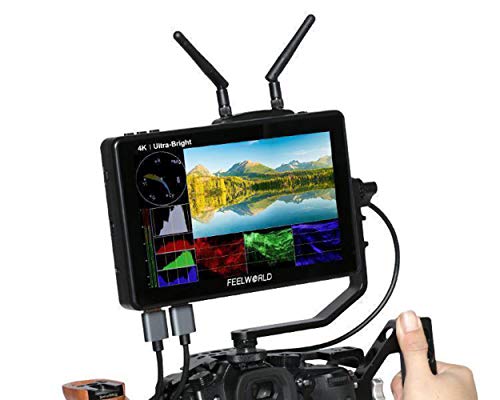
The best vectorscope video monitors are field monitors that add objective video-analysis tools to a camera display. A vectorscope is useful for inspecting color information, but buyers should also consider waveform, RGB parade, histogram, focus assistance, false color, and zebra functions. Those tools address different parts of exposure, color, focus, and framing, so a monitor with several of them is generally more useful than one that only lists a vectorscope.
Start with the signal connections
HDMI is common on DSLR, mirrorless, and many compact cinema cameras. Several selected models support 4K HDMI input and output, allowing the live signal to continue to another display or recorder. The FEELWORLD LUT11S, VILTROX DC-X3, FEELWORLD LUT7S PRO, FEELWORLD LUT6S, and Shimbol Memory I Pro also document 3G-SDI support. That matters when a production uses professional cameras, longer cable runs, or a mixed HDMI-and-SDI setup.
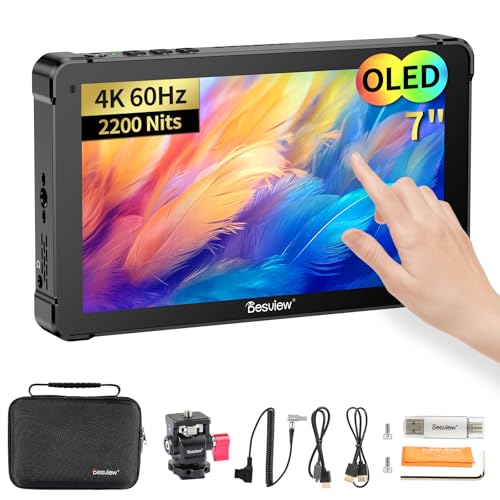
Check the stated signal limit as well as the connector type. The Desview OL7 documents 4K 60Hz HDMI, while several other models specify 4K 30Hz. A 60Hz input/output path may be more appropriate when the camera and downstream equipment use higher-frame-rate 4K signals. Conversely, a 4K 30Hz monitor can still be suitable for many standard monitoring workflows, provided it matches the camera output.
Match brightness to the location
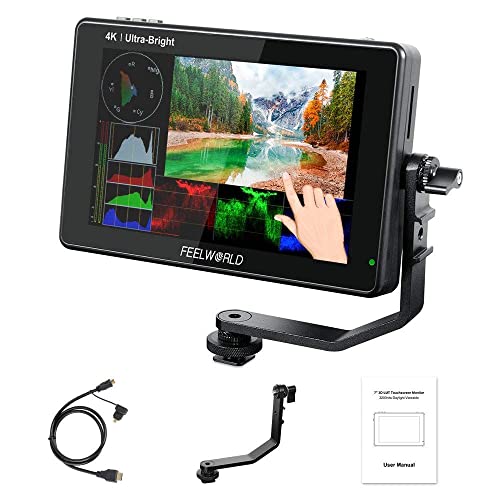
Brightness is one of the clearest differences in this category. The FEELWORLD LUT6S and Desview R6 list 2600 and 2800 nits respectively, while the FEELWORLD LUT7, LUT7S PRO, and LUT7S list 2200 nits. Other selected monitors list 2000 nits or less, and the T7 Plus lists 450cd/m². These figures are supplied listing specifications, not independent measurements, but they indicate the intended use of each design.
A bright panel can help in outdoor shooting, while an ambient-light sensor can automatically adjust brightness as conditions change. The LUT11S, LUT11, LUT7, LUT7S PRO, LUT7S, and Desview OL7 document a light-sensing or automatic-brightness feature. A sunshade, such as the one listed with the VILTROX DC-X3, can also help manage reflections. Do not assume that brightness alone makes a monitor equally suitable in every position; screen size, viewing angle, reflections, and rig placement still matter.
Choose the right screen size
A 5.5- or 6-inch monitor is easier to place on a compact camera rig. The Desview R6, Desview P5II, Shimbol Memory I Pro, and VILTROX DC-X3 fall into that smaller range. They can provide enough room for scopes while keeping the camera package relatively compact. The 7-inch models offer more viewing area for focus and composition, but they may require a stronger mounting solution.
The 10.1-inch FEELWORLD LUT11S and LUT11 provide the largest displays in this selection. They are useful when several crew members need to inspect the image or when a larger scope view is preferable. Their physical size may be less convenient for handheld or gimbal work. The right choice is therefore a rig decision rather than simply a preference for the largest panel.
Most selected monitors document custom 3D LUT loading. LUT support can show a preview of a transformed or graded look while the camera records its chosen source profile. It should not be confused with a claim that the monitor is a calibrated reference display. Look for the details that matter to your workflow: the LUT11S states support for up to 50 custom LUTs, the LUT6E states up to 32, and the LUT7 PRO states up to 50.
The FEELWORLD LUT6S goes further by documenting custom LUT image output, while the Shimbol Memory I Pro supports LUT adjustment during recording. The Desview OL7 also lists HDR and 99.8% DCI-P3 calibration. These features may be useful for specialized workflows, but compatibility with the camera signal and your intended viewing pipeline should be checked before purchase.
Review power and mounting before ordering
Field monitors commonly use removable camera batteries or an external DC supply. The VILTROX DC-X3 documents NP-F, 12–18V DC, and USB-C power options. The Desview R6 lists NP-F and E6 battery compatibility, and the Desview OL7 supports dual NP-F970 batteries, USB-C, and D-Tap charging. The LUT11 and LUT11S also document dual-battery or external-power features.
Accessory power can reduce cable clutter. The FEELWORLD LUT7 PRO and LUT7S PRO include an F970 external install and power concept, while the LUT11 provides a similar external mount and power design. The VILTROX DC-X3 includes a rig cage. These additions are useful when a monitor must carry a wireless transmitter, light, converter, or other small accessory, but they can add weight and bulk. Also note that several listings explicitly say batteries are not included.
Final Recommendation
FEELWORLD LUT7S PRO ranks first overall in this specification-based comparison under the published weighted criteria.
Shimbol Memory I Pro is the highest-scoring returned product and the first overall specification-based choice among these best vectorscope video monitors. Its combination of vectorscope and waveform tools, HDMI and SDI connectivity, custom LUT workflow, 2000-nit screen, and integrated recording and playback gives it the broadest documented feature set.
For a large display, the FEELWORLD LUT11S is a strong alternative because it pairs a 10.1-inch panel with 3G-SDI, dual HDMI inputs, 4K 60Hz support, and extensive scopes. The Desview OL7 is the better fit for buyers specifically seeking OLED presentation and 4K 60Hz HDMI, while the FEELWORLD LUT7S PRO is compelling for rigs that need an external accessory mount and power output.
Outdoor users should compare the stated brightness figures closely. The Desview R6 and FEELWORLD LUT6S list the highest brightness in this group, while the FEELWORLD LUT7, LUT7S, and LUT7S PRO offer 7-inch screens with automatic brightness adjustment. For a lightweight HDMI setup, the FEELWORLD T7 Plus keeps the design thin and adds a useful scope set, but its listed brightness is substantially lower than the daylight-oriented choices.
The top vectorscope video monitors are not interchangeable in every production. Verify camera output, required frame rate, battery type, mounting space, and whether SDI or recording is actually needed. A specification-based ranking can narrow the field, but these compatibility checks should determine the final purchase.
Frequently Asked Questions
What makes the best vectorscope video monitors different from ordinary field monitors?
They include a vectorscope alongside other technical tools such as waveform, RGB parade, histogram, false color, zebra, and focus peaking. The selected models also function as camera field monitors, with features such as touchscreen control, LUT loading, signal pass-through, or multiple power options.
Do all of these monitors support SDI?
No. The FEELWORLD LUT11S, VILTROX DC-X3, FEELWORLD LUT7S PRO, FEELWORLD LUT6S, FEELWORLD LUT7S, and Shimbol Memory I Pro document 3G-SDI connectivity. The supplied evidence for the Desview OL7, Desview R6, FEELWORLD LUT7, FEELWORLD T7 Plus, and FEELWORLD LUT11 focuses on HDMI connectivity instead.
Is a higher brightness specification always better?
Not necessarily. A higher stated brightness can be useful outdoors, but mounting position, reflections, viewing angle, and power consumption also matter. An ambient-light sensor may make brightness easier to manage. The listing data identifies the Desview R6 and FEELWORLD LUT6S as especially bright, while the FEELWORLD T7 Plus is a lower-brightness option intended more toward portability.
Do these monitors include batteries?
Battery inclusion varies, and several listings explicitly state that batteries are not included. The products document different compatibility and power approaches, including NP-F, E6, USB-C, DC input, dual battery plates, and D-Tap. Confirm the battery requirement and package contents before ordering.
Which model is most suitable for recording as well as monitoring?
The Shimbol Memory I Pro is the clearest fit because its listing explicitly documents HDMI and SDI real-time recording, playback, and LUT-enabled recording. The other selected products are described primarily as field monitors, even when they provide extensive scopes and signal pass-through.